France 法国 French 法国人,法语 查看更多


题目列表(包括答案和解析)

Mary is __41__  English girl, but she is in France (法国) now. She is six __42__ old. Her mother says to her. “You are six,   43  you will be school here. You will like the school because (因为) it’s a __44__ school.” “Is it an English school?” Mary asks. “Yes, it  45  .” Mother answers.
Mary goes to school. The teachers __46__ very friendly and speak good __47__. And there   48  two other English girls in the class, __49__. She begins to like the school.
Her mother takes her  50  school __51__ the morning and brings her home in the afternoon.
One day ,when her mother is at school, Mary runs out  52   the classroom and says, “We have a __53__ girl in our class today. She is six, too. She is very nice, __54__ she isn’t English. She is a German (德国人).” “Doesn’t she speak English?” Mary’s mother asks. “No, but she always laughs __55__ English.” She says happily.

【小题1】
A.anB.aC.theD./
【小题2】
A.yearB.yearsC.years’D.year’s
【小题3】
A.and B.but C.or D.at
【小题4】
A.oldB.badC.smallD.nice
【小题5】
A.isB.amC.areD.has
【小题6】
A.areB.isC.aren’tD.isn’t
【小题7】
A.JapaneseB.EnglishC.ChineseD.French(法语)
【小题8】
A.isB.amC.areD.have
【小题9】
A.eitherB.alsoC.allD.too
【小题10】
A.toB.fromC.atD.in
【小题11】
A.onB.atC.inD.of
【小题12】
A.inB.onC.atD.of
【小题13】
A.niceB.newC.goodD.old
【小题14】
A.andB.orC.butD.because
【小题15】
A.inB.atC.withD.on

查看答案和解析>>

Mary is __41__  English girl, but she is in France (法国) now. She is six __42__ old. Her mother says to her. “You are six,   43  you will be school here. You will like the school because (因为) it’s a __44__ school.” “Is it an English school?” Mary asks. “Yes, it  45  .” Mother answers.

Mary goes to school. The teachers __46__ very friendly and speak good __47__. And there   48  two other English girls in the class, __49__. She begins to like the school.

Her mother takes her  50  school __51__ the morning and brings her home in the afternoon.

One day ,when her mother is at school, Mary runs out  52   the classroom and says, “We have a __53__ girl in our class today. She is six, too. She is very nice, __54__ she isn’t English. She is a German (德国人).” “Doesn’t she speak English?” Mary’s mother asks. “No, but she always laughs __55__ English.” She says happily.

1.

A.an

B.a

C.the

D./


2.

A.year

B.years

C.years’

D.year’s


3.

A.and

B.but

C.or

D.at


4.

A.old

B.bad

C.small

D.nice


5.

A.is

B.am

C.are

D.has


6.

A.are

B.is

C.aren’t

D.isn’t


7.

A.Japanese

B.English

C.Chinese

D.French(法语)


8.

A.is

B.am

C.are

D.have


9.

A.either

B.also

C.all

D.too


10.

A.to

B.from

C.at

D.in


11.

A.on

B.at

C.in

D.of


12.

A.in

B.on

C.at

D.of


13.

A.nice

B.new

C.good

D.old


14.

A.and

B.or

C.but

D.because


15.

A.in

B.at

C.with

D.on


查看答案和解析>>

Mary is 1 English girl, but she is in France (法国) now. She is six2 old. Her mother says to her. “You are six, 3you will be school here. You will like the school because (因为) it’s a4 school.” “Is it an English school?” Mary asks. “Yes, it 5.” Mother answers.
Mary goes to school. The teachers6 very friendly and speak good7. And there 8two other English girls in the class,9. She begins to like the school.
Her mother takes her 10school11 the morning and brings her home in the afternoon.
One day ,when her mother is at school, Mary runs out 12the classroom and says, “We have a13 girl in our class today. She is six, too. She is very nice,14 she isn’t English. She is a German (德国人).” “Doesn’t she speak English?” Mary’s mother asks. “No, but she always laughs15 English.” She says happily.

  1. 1.
    1. A.
      an
    2. B.
      a
    3. C.
      the
    4. D.
      /
  2. 2.
    1. A.
      year
    2. B.
      years
    3. C.
      years’
    4. D.
      year’s
  3. 3.
    1. A.
      and
    2. B.
      but
    3. C.
      or
    4. D.
      at
  4. 4.
    1. A.
      old
    2. B.
      bad
    3. C.
      small
    4. D.
      nice
  5. 5.
    1. A.
      is
    2. B.
      am
    3. C.
      are
    4. D.
      has
  6. 6.
    1. A.
      are
    2. B.
      is
    3. C.
      aren’t
    4. D.
      isn’t
  7. 7.
    1. A.
      Japanese
    2. B.
      English
    3. C.
      Chinese
    4. D.
      French(法语)
  8. 8.
    1. A.
      is
    2. B.
      am
    3. C.
      are
    4. D.
      have
  9. 9.
    1. A.
      either
    2. B.
      also
    3. C.
      all
    4. D.
      too
  10. 10.
    1. A.
      to
    2. B.
      from
    3. C.
      at
    4. D.
      in
  11. 11.
    1. A.
      on
    2. B.
      at
    3. C.
      in
    4. D.
      of
  12. 12.
    1. A.
      in
    2. B.
      on
    3. C.
      at
    4. D.
      of
  13. 13.
    1. A.
      nice
    2. B.
      new
    3. C.
      good
    4. D.
      old
  14. 14.
    1. A.
      and
    2. B.
      or
    3. C.
      but
    4. D.
      because
  15. 15.
    1. A.
      in
    2. B.
      at
    3. C.
      with
    4. D.
      on

查看答案和解析>>

阅读理解。
     Be careful on April 1st! When your classmates say "Your shoe's untied (未系好的)!" it may not be
true. And if you find your alarm clock is set back an hour, this may be a joke (玩笑), too.
     April Fool's Day is a traditional occasion. On that day people play harmless jokes on others and then
shout, "April Fool!" It's a "for-fun-only" day, so people don't buy gifts(礼物)or get the day off work or
school.
     April Fool's Day started in France (法国) in the 16th century. At that time, New Year's Day was
between March 25th and April 1st.
     When New Year's Day changes(改变)to January 1st in the mid-1560s, some people still celebrate
(庆祝) it on April 1st. Others played jokes on them and called them "April Fools".
     Each country celebrates April Fool's Day differently. In France, it is called "April Fish". The French
fool their friends by sticking (粘) paper fish to their friends' backs. When someone finds out this joke, they
shout, "April Fish!" In England, it is bad luck to play an April Fool's joke on someone after midday.
Americans play small tricks on friends and strangers alike.
根据短文内容判断下列句子正(T)误(F)。
(     )1. People think Americans started the April Fool's Day.
(     )2. New Year's Day was on January 1st five hundred years ago.
(     )3. People are late for work on April 1st.
(     )4. People don't get the day off work or school.
(     )5. A stranger may play jokes on you in America on April Fool's Day.

查看答案和解析>>

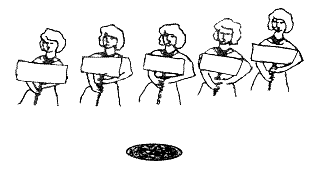
附加题。
       2008年奥运会将在中国举行。你会按照国际惯例安排下列国家代表队的入场顺序吗?请将代表该国的字母按字母先后顺序写在出场牌上。

C ― China                  A ―Australia ( 澳大利亚 )
J ―Japan                    G ―Germany ( 德国 )
F ― France ( 法国 )
                                                                                    

查看答案和解析>>


同步练习册答案