
题目列表(包括答案和解析)
Food or friends? Lip salve (润唇膏) or iPod? What is the most important thing in the US teenagers’ lives today? Let’s take a look.
Some find that they can’t do without people.
“My biggest need is my friends. Without them, I wouldn’t do much,” said Adrian Fernandez, a 14-year-old boy.
With others, food always comes first.
“I do not think that I could live without chili con carne (辣子肉丁). I eat it every day. And if I didn’t have it, it’s all I would think about,” said Max Wu, an 8th-grade boy.
Sometimes, the things teenagers can’t do without are strange.
Take 14-year-old girl Hannah Sacchini for example. “I cannot live without lip salve, especially in winter,” said Hannah Sacchini. “I go mad if my lips get dry.”
Of course, today everybody uses mobile phones and computers. Some teens can’t live without these high-tech (高科技的) things.
Justin Beck, a 15-year-old boy, feels like this: “I would not be able to live without my iPod. I use it for so many different things. I always have it with me,” he said.
So, now we know the things US kids really must have. What about you and your classmates? What can’t you live without?
根据短文内容,选择最佳选项。 (10分)
1.To Adrian Fernandez, is the most important.
A.a friend B.lip salve C.a computer D.chili con carne
2.How often does Max Wu eat chili con carne?
A.Once a week. B.Every day.
C.Twice a day. D.Three times a week.
3.Hannah Sacchini will become if her lips get dry.
A.fat B.excited C.shy D.annoyed
4.We can learn that Justin Beck takes his iPod to school.
A.never B.sometimes C.always D.hardly ever
5.The passage mainly tells us .
A.what things the US kids really must have
B.what the US teenagers do every day at school
C.what the most important food in the US teenagers’ lives is
D.how the US teenagers’ lives are every day at school
What do you do if you're stranded(处于困境的)on a lonely island? Surely you need to find a way to get in touch with the outside world. Your best chance of doing this is to draw the attention of a passing plane.
Body signals(信号)
Pilots from different countries understand body signals if they have the correct training. When you wave your arms up and down in a straight line, it means "yes". When you point downwards and swing your arm from side to side, it means "no". If you want the pilot to know that it's safe to land, push your hands out in front of you and bend(弯曲)your knees. If you want to say that it's not safe to land, put your arms in the air and move them to one side.
Smoke signals
The smoke from a fire can be seen from far away, so it's a good way to draw attention. If the weather is dry, it isn't hard to start a fire. Remember, however, that fires can be very dangerous if they get out of control. Never light a fire unless you're sure that it can't spread. If the ground is dark, light smoke can be seen more easily. Green grass and leaves produce light smoke.
Ground-to-air signals
It's a good idea to build some signals, too. Use large pieces of wood to make the symbols(标记). If you can't find any wood, use earth. Some useful symbols are:
F "I need food and water."
II "I need medicine."
I "I am badly hurt."
X" I am unable to move from here."
Pilots' replies
If the pilot lowers the plane's wings from side to side, this means "message received and understood". (At night, the pilot flashes the plane's green lights.) If the pilots flies the plane in a clockwise circle, this means "message received but not understood".(At night, the pilot flashes the plane's red lights.)
However, there is no signal which means "message not received". Why not?
【小题1】 Which picture means "it's not safe land"?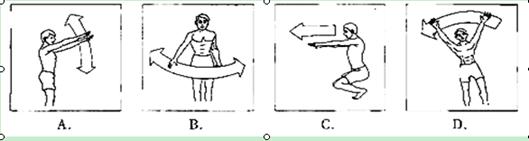
【小题2】 What can we learn from the passage?
| A.Swinging your arm from side to side means "yes". |
| B.If the ground is dark, light smoke can't be seen. |
| C.If you need some medicine, make a symbol "II". |
| D.The pilots make replies with a blue light at night. |
| A.The explanation of building signals on an island. |
| B.The importance of making signals on an island. |
| C.Ways of sending out signals on a lonely island. |
| D.Ways of receiving signals from a lonely island |
Once upon a time, a young man was standing in the middle of the town announcing that he had the most beautiful heart in the world. A large crowd gathered, and they al praised his heart for it was perfect.
Suddenly, an old man appeared and said, “Why ,your heart is not as beautiful as mine.”
The old man’s heart was ful of scars(伤疤). Some pieces of his heart were removed and some pieces from other people were put in, but they didn’t fit quite right. So there were several jagged(锯齿状的)edges. In fact, there were stil some holes in his heart where the pieces were missing.
The young man laughed,“Comparing yours with mine, mine is perfect and yours is a mess.”
“Yes,”said the old man. “But, every scar shows that I took out a piece of my heart and gave it to a person, and often he gave me a piece of his heart in return.”
“Why do you have some jagged edges in your heart?”asked the young man.“Because the shapes of the pieces weren’t the same.”“Then the holes?”“Sometimes I gave pieces of my heart away, and the other person hasn’t given back a piece of his, so … but I don’t care.”“How come?”“They remind me of the love we shared.”
The young man was deeply moved. He walked up to the old man, took a piece of his heart out and gave it to the old man.
The old man placed it in his heart, then took a piece from his old scarred heart and placed it in the wound(伤口)in the young man’s heart. It fitte d, but not perfectly, as there were some jagged edges.
The young man looked at his heart, not perfect any more but more beautiful than ever.
How sad it must be to go through life with a whole untouched heart!
【小题1】 The young man stood in the town to _____.
| A.meet the old man | B.compare his heart with others’ |
| C.show his beautiful heart | D.give pieces of his heart to others |
| A.a sily man | B.a humorous man |
| C.a wel-known man | D.a kind-hearted man |
| A.lost | B.moved | C.hurt | D.untouched |
| A.he didn’t expect others’return |
| B.he didn’t feel pain |
| C.he didn’t think it serious |
| D.he cared nothing |
| A.ideas | B.scars | C.love | D.beauty |
阅读短文,根据短文内容,从短文后的六个选项中选出能填入空白处的最佳选项。选项中有两项为多余选项。(共8分,每小题2分)
As you grow rapidly through your teenage years, you will experience a lot of changes. The changes may seem difficult. 1 Don’t panic! You will deal successfully with them! You are a young adult now!
With more responsibility, you will find more freedom to make your own choices. This is a time to be well informed about making choices. In this way you can make healthy balanced decisions. 2 You may already know your career path or you may have no idea at all what you want to do. Both situations are fine! Work hard and the right opportunity will present itself to you.
Young adulthood means greater freedom and more choices. 3 But try not to shut your family out of your life. You should learn to think of others even though you are old enough to look after yourself.
It is also perfectly natural at this time for you to spend more time with your friends than your family. Choose your friends wisely. A true friend will stand by you no matter what happens.
This period is a part of the life cycle. There are some people who will be with you throughout life’s journey. There will be some people with whom you part and go separate ways. Leaving school can be hard. The reality is that you may not even see all of your classmates again.
You are a young adult. It is your life. No one can live it for you. 4 So making the right choices will be important to you. Life is for living. Enjoy your life wisely.
A. They will help shape the future.
B. They may seem to happen quickly.
C. You will probably want to be independent.
D. You may appreciate what you have in your own life.
E. The choices that you make from now on will be your choices.
F. Your family has been with you since you came into this world.
In England recently three foreign gentlemen came to a bus stop and waited . About five minutes later, the bus they wanted came along. They were just going to get on when suddenly there was a loud noise behind them. People rushed onto the bus and tried to push them out of the way . Someone shouted at them. The bus conductor came rushing down the stairs to see what all the trouble was about. The three foreigners seem all at sea and looked embarrassed (窘迫的 . No one had told them about the British custom (习惯)of lining up for a bus that the first person who arrives at the bus stop is the first person to get on the bus .
Learning the language of a country isn't enough. If you want to have a pleasant visit, find out as much as possible about the manners and customs of your host country. You will probably be surprised just how different they can be from your own. A visitor to India would do well to remember that people there consider it impolite to use the left hand for passing food at table. The left hand is supposed to be used for washing yourself. Also in India, you might see a man shaking his head at another to show that he doesn't agree. But in many parts of India a shake of the head means agreement. Nodding (点头) your head when you are given a drink in Bulgaria will most probably leave you thirsty .
In that country, you shake your head to mean 'yes'— a nod means 'no' . At a meal in countries on the Arabic Peninsula, you will find that your glass is repeated refilled as soon as you drink up . If you think that you have had enough , you should take the cup or glasses in your hand and give it a little shake from side to side or place your hand over the top.
In Europe it quite usual to cross your legs when you are sitting talking to someone even at an important meeting. Doing this in Thailand, however, could bring about trouble . Also, you should try to avoid (避免)touching the head of an adult (成人) ——it's just not done in Thailand .
【小题1】The British people tried to push the three gentlemen out of the way, because the gentlemen______
| A.were foreigners | B.didn't have tickets |
| C.made a loud noise | D.didn't line up for the bus |
| A.learn the language of the country |
| B.understand the manners and customs of the country |
| C.have enough time and money |
| D.make friends with the people there |
| A.to use the right hand for passing food at table. |
| B.to pass food with the left hand. |
| C.to eat food with your hands. |
| D.to help yourself at table. |
| A.a common (平常的) habit | B.an important manner |
| C.a serious (严重的) trouble | D.a bad manner |
湖北省互联网违法和不良信息举报平台 | 网上有害信息举报专区 | 电信诈骗举报专区 | 涉历史虚无主义有害信息举报专区 | 涉企侵权举报专区
违法和不良信息举报电话:027-86699610 举报邮箱:58377363@163.com