
题目列表(包括答案和解析)
Mrs. Ball had a son. His name was Mick. She 26 him very much and as(因为)he was not a 27 child, she was always afraid that he might 28 ill. 29 she usually took him to see the best 30 in the town four times a year and asked the doctor to look 31 the son.
During one of these 32 , the doctor gave Mick all kinds of tests(检查) and then said to him, “Do you have any trouble with your nose or ears ?” Mick 33 for a second and then answered, “Yes, I 34 _.”
Mrs. Ball was very 35 . “But I’m sure you have 36 told me that, Mick!” she said worriedly. “Oh, really?” said the doctor 37 . “And what trouble do you have 38 your nose and ears, my boy?” “Well,” answered Mick. “I always have trouble with them when I’m 39 my sweater off, 40 the collar (领子) is very tight (紧的).”
| 【小题1】 |
|
| 【小题2】 |
|
| 【小题3】 |
|
| 【小题4】 |
|
| 【小题5】 |
|
| 【小题6】 |
|
| 【小题7】 |
|
| 【小题8】 |
|
| 【小题9】 |
|
| 【小题10】 |
|
| 【小题11】 |
|
| 【小题12】 |
|
| 【小题13】 |
|
| 【小题14】 |
|
| 【小题15】 |
|
There was a little boy who got angry easily. His father gave him a bag of nails(钉子) and told him that every 16 he got angry, to drive a nail into the back wall. The first day the boy had 17 37 nails into the wall. Then he put fewer and fewer nails. He found it was 18 to be not angry than to drive those 19 into the wall. Finally the day came when the boy didn't get 20 at all. He told his father about it and the father suggested that the boy now pull out one nail for each day that he was able to be not angry. The days 21 and the young boy was finally able to tell his father that 22 nails were gone. The father took his son by the hand and led him to the 23 . He said, "You have done 24 , my son, but look at the holes in the wall. The wall will 25 be the same. When you say things 26 , they leave a scar(伤疤) just like this one. You 27 put a knife in a man and draw it out. It won't matter 28 you say I'm sorry, the wound(伤口) is still there. A mental hurt is as bad as a physical one. Friends are a very rare jewel, indeed. They make you 29 and encourage you to succeed. They lend an ear, they share a word of praise, and they always 30 to open their hearts to us.
1.A. time B. day C. week D. year
2.A. turned B. driven C. pulled D. threw
3.A. harder B. tougher C. easier D. worse
4.A. sticks B. knives C. nails D. forks
5.A. happy B. sad C. excited D. angry
6.A passed B. came C. returned D. happened
7.A. some B. many C. all D. most
8.A. house B. nails C. room D. wall
9.A. badly B. well C. sadly D. kindly
10.A. never B. sometimes C. often D. always
11.A. politely B. carefully C. happily D. angrily
12.A. must B. need C. can D. should
13.A. how much B. how long C. how many times D. how far
14.A. cry B. jump C. lose D. smile
15.A. refuse B. want C. fail D. learn
A young father was visiting an old neighbor. They were standing in the old man’s garden, and talking about children. The young man said,“How strict should parents be with their children?”
The old man pointed to(指着)a string (细绳) between a big strong tree and a thin young one.
“Please untie (解开) that string.” said the old man. “But first pull the string tight so that(以便于)the young tree is straight again.” The young man did so. He untied the string and only found that the young tree bent(弯)over to one side.
Then the old man said,“There, it is the same with children. You must be strict with them. But sometimes you must untie the string to see how they are getting on. If they are not yet able to stand alone,you must tie the string tight again. But when you find that they are ready to stand alone,you can take the string away.”
1.The story is about ____________.
A. how to take care of young trees
B. how strict parents should be with their children
C. how the young father should get on with his old neighbor
2. The young man untied the string ________________.
A. in order to throw it away
B. so that both of the trees wouldn’t grow straight
C. and found that the young tree bent over to one side
3.When could the string be taken away?
A. When the old man left.
B. When the young man untied it next time.
C. When the young tree grew strong enough.
4. At last the old man told the young man ________________.
A. that he should be strict with his children if they could not
stand alone
B. that he should always be strict with his children
C. that he should be hard on his children
5.We learn that the big strong tree and the thin young one are like _________.
A. the young father and the old neighbor
B. parents and their children
C. the old neighbor and the children of young father
Salesman: $73.07,please.
Peter: What? Show me the receipt.
Salesman: Here it is. 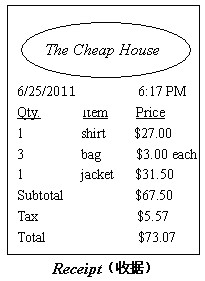
Peter: Look. The price on this shirt is $17. But the receipt says $27.
Salesman: You are right. The receipt is wrong.
Peter: And what is the $5.57 for?
Salesman: That’s for tax(税).
【小题1】 The $5.57 is for the ___________.
| A.tax | B.bags | C.jacket | D.shirt |
| A.On June 17. | B.At noon. | C.On June 25. | D.In the morning |
湖北省互联网违法和不良信息举报平台 | 网上有害信息举报专区 | 电信诈骗举报专区 | 涉历史虚无主义有害信息举报专区 | 涉企侵权举报专区
违法和不良信息举报电话:027-86699610 举报邮箱:58377363@163.com