
题目列表(包括答案和解析)
| A.before | B.since | C.during | D.after |
| A.taste the chemicals first |
| B.clean al the apparatus |
| C.read al instructions carefuly |
| D.report al the accidents to the teacher |
| A.bring food into the lab | |
| B.enter the lab anytime | |
| C.smel chemicals as you like | D.learn science directly in the lab |
| A.Before the Experiment |
| B.First Aid |
| C.During the Experiment |
| D.After the Experiment |
Laboratory work is your chance to learn science firsthand. It can be fun but you must be careful to prevent injury. Listen closely when your teacher reads and explains the rules before your first lab lesson.
LABORATORYRULES
Throughout the lesson
·Do not enter the science lab without the teacher’s permission.·No food or drinks are to be alowed in the science lab.
Before the Experiment
·Read al instructions carefuly before every experiment.
·Prepare al apparatus(仪器)and arrange them so that you wil not knock them over while doing the experiment.
During the Experiment
·If you are unsure of how to use any apparatus or how to operate, ask your teacher for help.·Never smel or taste chemicals unless your teacher gives permission.
After the Experiment
·Wash al apparatus after use and return them to the places where they were.
·Throw waste materials in proper waste baskets. First Aid
·Report al accidents to your teacher immediately.
·If you spil( 溅 出 )any chemicals onto your body or clothing, wash with plenty of water and report to your teacher.
1. Your teacher wil probably tel you the rules above _____ the first lab lesson.
A. before B. since C. during D. after
2. Before every experiment, you should _____.
A. taste the chemicals first
B. clean al the apparatus
C. read al instructions carefuly
D. report al the accidents to the teacher
3. When you are not sure how to use al apparatus, _____.
A. try them on your own
B. read the rules carefuly
C. ask your teacher for help
d. put them back
4. It is clear that you can _____.
A. bring food into the lab
B. enter the lab anytime
C. smel chemicals as you like
D. learn science directly in the lab
5. If you get chemicals on the clothing, you can find ways to solve it in the part _____.
A. Before the Experiment
B. First Aid
C. During the Experiment
D. After the Experiment
Laboratory work is your chance to learn science firsthand. It can be fun but you must be careful to prevent injury. Listen closely when your teacher reads and explains the rules before your first lab lesson.
LABORATORYRULES
Throughout the lesson
·Do not enter the science lab without the teacher’s permission.·No food or drinks are to be alowed in the science lab.
Before the Experiment
·Read al instructions carefuly before every experiment.
·Prepare al apparatus(仪器)and arrange them so that you wil not knock them over while doing the experiment.
During the Experiment
·If you are unsure of how to use any apparatus or how to operate, ask your teacher for help.·Never smel o r taste chemicals unless your teacher gives permission.
After the Experiment
·Wash al apparatus after use and return them to the places where they were.
·Throw waste materials in proper waste baskets. First Aid
·Report al accidents to your teacher immediately.
·If you spil( 溅 出 )any chemicals onto your body or clothing, wash with plenty of water and report to your teacher.
【小题1】 Yo ur teacher wil probably tel you the rules above _____ the first lab lesson.
| A.before | B.since | C.during | D.after |
| A.taste the chemicals first |
| B.clean al the apparatus |
| C.read al instructions carefuly |
D.report al the accident s to the teacher s to the teacher |
 s clear that you can _____.
A. bring food into the lab bring food into the lab | |
| B.enter the lab anytime | |
C.smel chemicals as you like | D.learn science directly in the lab |
| A.Before the Experiment |
| B.First Aid |
| C.During the Experiment |
| D.After the Experiment |
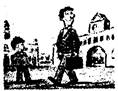
The clock in the old building in front of Max showed six o'clock. As the clock began 1 , he noticed a tall man with a bag walking to him. 2 turned around, looked at the clock, and then moved his steps 3 . Max walked faster as well. Miss Fritz invited him for dinner. He didn't want to be 4 .
"I’m glad you can come," Miss Fritz said. "I've 5 a lovely cake for us. " She pointed Max to a chair. "Good thing I prepared just now. A surprise visitor just left. " "Who 6 you?" Max asked.
"A teacher 7 a school for the deaf. He was totally deaf (耳聋的)himself. What a poor man! But he could 8 the shape of my mouth perfectly. He wrote down 9 he wanted to tell me." "Why was he here?"
"Well, the 10 needs more money. I was glad to help out. I got 11 money from the bank so I was able to give him five hundred 12 ." "Did he just leave? Was he a 13 man with a bag?"
"Yes."
"We'd better 14 the police. I don't think that man is honest. I know for sure 15 was not totally deaf," How did Max find it out?
1. A.to go B.to work C.to run D.to ring
2. A.Max B.A teacher C.The man D.Miss Fritz
3. A.farther B.closer C.slower D.faster
4. A.late B.early C.polite D.tired
5. A.passed B.given C.made D.sold
6. A.helped B.decided C.visited D.traveled
7. A.by B.behind C.around D.from
8. A.fit B.take C.read D.find
9. A.what B.who C.whom D.which
10. A.factory B.school C.police D.bank
11. A.little B.some C.no D.less
12. A.chairs B.bags C.clocks D.dollars
13. A.fat B.thin C.tall D.short
14. A.beat B.call C.catch D.save
15. A.I B.it C.he D.she
Paragraph 1
Scientists have learned a lot about the kinds of people need. They say that there are several kinds of food that people should eat every day, they are: (1) green and yellow vegetables of all kinds; (2) citrus (柑桔) fruits and tomatoes; (3) potatoes and other fruits and vegetables; 94) meat of all kinds, fish and eggs; (5) milk and foods made from milk; (6) bread or cereal (谷类), rice is also in this kind of food; (7) butter, or something like butter.
Paragraph 2
People in different countries and different places of the world eat different kinds of things. Foods are cooked and eaten in many different kinds of ways. People in different countries eat at different times of the day. In some places people eat once or twice a day; in other countries people eat three or four times a day. Scientists say that none of the differences is really important. It doesn’t matter whether foods are eaten raw or cooked, canned (罐装的) or frozen (冷冻的). It doesn’t matter if a person eats dinner at 4 o’clock in the afternoon or at eleven o’clock at night. The important thing is what you eat every day.
Paragraph 3
There are two problems, then, in feeding the large number of people on the earth. The first is to find some way to feed the world’s population so that no one is hungry. The second is to make sure that people everywhere have the right kinds of food to make them grow to be strong and healthy.
1.According to(依据)the scientists,which of the following groups of food is the healthiest for your lunch?
A. Chicken, apples, cereal and cabbages.
B. Potatoes, carrots, rice and bread.
C. Oranges, bananas, fish and tomatoes.
D. Beef, pork, fish and milk,
2.It is important for people to eat ______.
A. three times a day
B. dinner at twelve o'clock
C. cooked food all the time
D. something from each of the seven kinds of food every day
3.People in different countries and different places of the world ____ .
A. have the right kinds of food to eat
B. cook their food in the same way
C. have their meals at the same time
D. eat food in different ways
4.Which of the following is not true?
A. People in some places don't have enough to eat.
B. There are too many people in the world.
C. One of the problems is that no one is hungry.
D. The scientists are trying to make people grow to be strong and healthy.
5.If there is Paragraph (段落) 4, what do you think is going to be talked about?
A. When people eat their lunch.
B. What to do with the two problems.
C. How to cook food in different ways.
D. Why people eat different kinds of food.
湖北省互联网违法和不良信息举报平台 | 网上有害信息举报专区 | 电信诈骗举报专区 | 涉历史虚无主义有害信息举报专区 | 涉企侵权举报专区
违法和不良信息举报电话:027-86699610 举报邮箱:58377363@163.com