
Grasp the sentences: Why don’t sb do sth?=Why not do sth? What’s school like? Teaching preparation: pictures, recorder, computer, and the flags of Britain and England Teaching steps: StepⅠ Lead-in T: Do you like our school? What do you like? How many subjects do you learn? Can you tell me some names of them? S: Chinese, Math, English, PE, Geography, etc. (Encourage the Ss to say more about it.) T: Good. Is there another word for Math? S: Yes. Maths. T: Great. Maths is Math. Maths is British English. While Math is American English (write on Bb) StepⅡ Pre-task Show the flags of the UK and the USA. Tell them that people speak English in both Britain and the USA , but sometimes they use different words which mean the same thing. T: I know many boys like playing football. Do you know what it says in American English? S: Soccer. Do you know the same use of other words? Please give me some examples. Write other right answers of the students on the Bb. Teach the students the new words: BE=British English AE=American English BE autumn lift football maths rubber post ground floor secondary school AE fall elevator soccer math eraser mail first floor high school StepⅢ While-task Task1 Practise the new words more. Pay attention to the pronunciations and spelling. Task2 Finish Part A on Page 23. Teacher can give more words, such as sweets and candies, holiday and vocation, biscuit and cookie and so on. Task3 Write down both the British and American words, then finish Part B. StepⅣ Different spellings (1) Say: There are also some differences in spelling between British English and American English. Make a table and write down some words. E.g. favourite and favorite, centre and center. (2) Ask Ss to find more different words means the same thing and different spellings after class. StepⅤ Comic strips Do you remember Hobo and Eddie? They are talking about school life. Listen to the tape and answer : What does Eddie think of the school life? Listen again and read after it. Point out: Why don’t you do sth?=Why not do sth? be smarter than, be like doing sth, there be, few/a few Look at the picture and practise the dialogue Act the dialogue in groups and pairs. StepⅥ Free talk about Ss’ ideal school What do you like more about school, the assembly, the classes, lunchtime or the after-school activities? Do you like outdoor activities? Do you like fewer lessons? Do you like the lessons on the Internet? Talk about the above questions in groups and then make a report. StepⅦ Post-task Fill in the blankets with American English: It’s my first day in high school. I felt a little tired, but I had a good time. Our classroom is on the floor. So we don’t need an . I like to go outside playing after class. It’s my sport. Today we had 6 classes. I still found was too difficult for me. But the new classmate next to me helped me work out a difficult problem. StepⅧ. Homework (1) Try to remember the new words and drills. (2) Finish the exercises. (3) Preview the next lesson. Period 2 Reading (1) Teaching aims and demands: 【查看更多】


题目列表(包括答案和解析)

Mrs. Ball had a son. His name was Mick. She  26 him very much and as(因为)he was not a  27 child, she was always afraid that he might  28 ill.  29 she usually took him to see the best  30  in the town four times a year and asked the doctor to look  31 the son.
   During one of these  32 , the doctor gave Mick all kinds of tests(检查) and then said to him, “Do you have any trouble with your nose or ears ?” Mick  33 for a second and then answered, “Yes, I  34 _.”
  Mrs. Ball was very  35 . “But I’m sure you have  36 told me that, Mick!” she said worriedly. “Oh, really?” said the doctor  37 . “And what trouble do you have  38 your nose and ears, my boy?” “Well,” answered Mick. “I always have trouble with them when I’m  39 my sweater off,  40  the collar (领子) is very tight (紧的).”

【小题1】
A.lovedB.hatedC.missedD.cared
【小题2】
A.rich  B.cleverC.strongD.happy
【小题3】
A.is  B.areC.beD.were
【小题4】
A.WhichB.OfC.ButD.So
【小题5】
A.playerB.teacherC.doctorD.1awyer
【小题6】
A.after  B.over  C.for  D.at
【小题7】
A.talkersB.timesC.visitorsD.stays
【小题8】
A.waited B.thoughtC.stoodD.looked
【小题9】
A.did  B.do  C.doesD.doing
【小题10】
A.excited B.interestedC.pleasedD.surprised
【小题11】
A.alreadyB.just  C.neverD.always
【小题12】
A.angrilyB.seriouslyC.happilyD.hardly
【小题13】
A.for  B.at  C.of  D.with
【小题14】
A.turningB.takingC.keepingD.putting
【小题15】
A.because B.butC.althoughD.till

查看答案和解析>>

There was a little boy who got angry easily. His father gave him a bag of nails(钉子) and told him that every  16  he got angry, to drive a nail into the back wall. The first day the boy had 17  37 nails into the wall. Then he put fewer and fewer nails. He found it was 18   to be not angry than to drive those  19  into the wall.  Finally the day came when the boy didn't get  20  at all. He told his father about it and the father suggested that the boy now pull out one nail for each day that he was able to be not angry. The days  21  and the young boy was finally able to tell his father that  22  nails were gone. The father took his son by the hand and led him to the  23 . He said, "You have done  24 , my son, but look at the holes in the wall. The wall will  25  be the same. When you say things  26 , they leave a scar(伤疤) just like this one. You  27  put a knife in a man and draw it out. It won't matter  28  you say I'm sorry, the wound(伤口) is still there. A mental hurt is as bad as a physical one. Friends are a very rare jewel, indeed. They make you  29  and encourage you to succeed. They lend an ear, they share a word of praise, and they always 30  to open their hearts to us.

1.A. time        B. day         C. week             D. year

2.A. turned      B. driven     C. pulled          D. threw

3.A. harder      B. tougher    C. easier           D. worse

4.A. sticks     B. knives       C. nails            D. forks

5.A. happy          B. sad          C. excited         D. angry

6.A passed          B. came         C. returned         D. happened

7.A. some           B. many         C. all              D. most

8.A. house          B. nails       C. room             D. wall

9.A. badly       B. well       C. sadly            D. kindly

10.A. never       B. sometimes      C. often         D. always

11.A. politely     B. carefully   C. happily        D. angrily

12.A. must          B. need        C. can           D. should

13.A. how much    B. how long     C. how many times   D. how far

14.A. cry           B. jump         C. lose         D. smile

15.A. refuse      B. want           C. fail          D. learn


查看答案和解析>>

You don’t need to speak French to understand the Parisians. You just need to know how to make gestures. A new guide has come out by French tourism officials, which is to help foreign visitors understand Parisians with a list of commonly used gestures like “shut up”. “If you use them the next time when you’re in Paris, people will start mistaking you for a native (当地人) in no time,” says the online guide at www.cestsoparis.com.
Some of the city’s rude native people in Paris have been a headache for the tourism authorities(旅游当局) for a long time. They have tried their best to ask Parisians to be more friendly to foreign visitors. They have decided to show visitors commonly used gestures by Parisians at www.cestsoparis.com. Visitors can learn and get help from there.
The website includes the common gestures such as “Bof” and “Camembert”. “Bof” is used to mean “I don’t know” or “I disagree”, and “Camembert” is to tell someone to shut up.
And it also includes a note, which warns visitors not to use the gestures too freely.Otherwise, they may see some even ruder Parisian expressions.
(   )16. The coming out of that new guide in France is    .
A. to help foreign visitors to learn French well
B. to help foreign visitors understand Parisians
C. to make a suitable website in Paris
D. to tell people the importance of speaking French
(   )17. The gesture “Camembert” in the website means    .
A. I don’t know         B. I disagree
C. Don’t speak          D. Don’t stop speaking
(   )18. The underlined word “They” refers to(指代)    .
A. the rude native people in Paris    B. the tourism authorities in Paris
C. the commonly used gestures     D. the foreign visitors in Paris
(   )19. Which of the following is NOT true according to the passage?
A. Some native Parisians are rude to foreign visitors.
B. The new guide is mainly for foreign tourists.
C. You’ll be regarded as a native if you use the gestures at www.cestsoparis.com.
D. You can use the gestures in Paris as freely as you want.
(   )20. The BEST title for this passage is    .
A. How to learn French          B. What places to visit in Paris
C. Gestures make you a Parisian   D. How rude Parisians are

查看答案和解析>>

A young father was visiting an old neighbor. They were standing in the old man’s garden, and talking about children. The young man said,“How strict should parents be with their children?”

   The old man pointed to(指着)a string (细绳) between a big strong tree and a thin young one.

  “Please untie (解开) that string.” said the old man. “But first pull the string tight so that(以便于)the young tree is straight again.” The young man did so. He untied the string and only found that the young tree bent(弯)over to one side.

  Then the old man said,“There, it is the same with children. You must be strict with them. But sometimes you must untie the string to see how they are getting on. If they are not yet able to stand alone,you must tie the string tight again. But when you find that they are ready to stand alone,you can take the string away.”

1.The story is about ____________.

      A. how to take care of young trees    

B. how strict parents should be with their children

C. how the young father should get on with his old neighbor

2. The young man untied the string ________________.

      A. in order to throw it away     

B. so that both of the trees wouldn’t grow straight

      C. and found that the young tree bent over to one side

3.When could the string be taken away?

      A. When the old man left.      

B. When the young man untied it next time.

      C. When the young tree grew strong enough.

4. At last the old man told the young man ________________.

      A. that he should be strict with his children if they could not 

stand alone

      B. that he should always be strict with his children

      C. that he should be hard on his children

5.We learn that the big strong tree and the thin young one are like _________.

A. the young father and the old neighbor      

B. parents and their children

       C. the old neighbor and the children of young father


查看答案和解析>>


  Salesman: $73.07,please.
  Peter:   What? Show me the receipt.
  Salesman: Here it is.
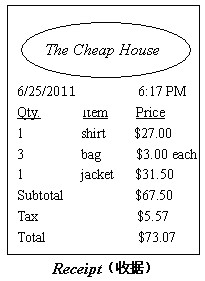
Peter:   Look. The price on this shirt is $17. But the receipt says $27.
  Salesman: You are right. The receipt is wrong.
  Peter:   And what is the $5.57 for?
  Salesman: That’s for tax(税).
【小题1】 The $5.57 is for the ___________.

A.taxB.bagsC.jacketD.shirt
【小题2】 When did Peter do some shopping?
      
A.On June 17.B.At noon.C.On June 25.D.In the morning

查看答案和解析>>


同步练习册答案