
题目列表(包括答案和解析)
“Are you happy?” The simple question usually makes people confused (迷惑的). Even Mo Yan, who won a Nobel Prize, replied to it by saying, “I don’t know.”
When a migrant worker (农民工) was asked, “Are you happy? (Ni Xing Fu Ma?)” by a CCTV reporter, he looked confused before replying, “My family name is Zeng. (Wo Xing Zeng.)” This has become a joke. But his answer showed migrant workers and TV reporters live in different worlds and they cannot even communicate with each other.
Similarly, when asked, “Are you happy?” a 73-year-old man, collecting used plastic bottles in a street in Zhejiang, said, “The bottles can be sold for 0.1 yuan each.” Asked again, he said, “The government is good.” The reporter went on, “My question is ‘Are you happy?’” The old man answered, “My hearing is not good.”
The reporter probably tried to reach the same answer that the interviewees(被采访者) including the migrant worker and the old man are “happy”.
In fact, when the question is asked, we should learn about people’s true situation and their true wishes and opinions but their “Yes” or “No”.
Luckily, the government has paid more attention to the importance. Now there are many TV programs giving common people the chance to give their opinions.
“Everything we do is aimed at letting people live more happily.” At last year’s National People’s Congress (人大), Wen Jiabao said and agreed that increasing happiness would be a top aim for the 12th five-year plan.
【小题1】Ten plastic bottles could be sold for ________ to the 73-year-old.
| A.0.1 yuan | B.1 yuan | C.10 yuan | D.20 yuan |
| A.learning about people’s true wishes and opinions |
| B.people’s different replies to “Are you happy?” |
| C.improving migrant workers’ education |
| D.keeping the old people’s health |
| A.The reporters wanted the people to say “Yes” when asked “Are you happy?” |
| B.Letting people live more happily is a top aim in the next five years. |
| C.The reporter asked the old man three different questions. |
| D.We can call the migrant worker Mr. Zeng. |
| A.the questions | B.the happiness |
| C.the popular songs | D.the education |
“Are you happy?” The simple question usually makes people confused (迷惑的). Even Mo Yan, who won a Nobel Prize, replied to it by saying, “I don’t know.”
When a migrant worker (农民工) was asked, “Are you happy? (Ni Xing Fu Ma?)” by a CCTV reporter, he looked confused before replying, “My family name is Zeng. (Wo Xing Zeng.)” This has become a joke. But his answer showed migrant workers and TV reporters live in different worlds and they cannot even communicate with each other.
Similarly, when asked, “Are you happy?” a 73-year-old man, collecting used plastic bottles in a street in Zhejiang, said, “The bottles can be sold for 0.1 yuan each.” Asked again, he said, “The government is good.” The reporter went on, “My question is ‘Are you happy?’” The old man answered, “My hearing is not good.”
The reporter probably tried to reach the same answer that the interviewees(被采访者) including the migrant worker and the old man are “happy”.
In fact, when the question is asked, we should learn about people’s true situation and their true wishes and opinions but their “Yes” or “No”.
Luckily, the government has paid more attention to the importance. Now there are many TV programs giving common people the chance to give their opinions.
“Everything we do is aimed at letting people live more happily.” At last year’s National People’s Congress (人大), Wen Jiabao said and agreed that increasing happiness would be a top aim for the 12th five-year plan.
1.Ten plastic bottles could be sold for ________ to the 73-year-old.
A.0.1 yuan B.1 yuan C.10 yuan D.20 yuan
2.The government has paid more attention to the importance of ________.
A.learning about people’s true wishes and opinions
B.people’s different replies to “Are you happy?”
C.improving migrant workers’ education
D.keeping the old people’s health
3.Which of the following is NOT true according to the passage?
A.The reporters wanted the people to say “Yes” when asked “Are you happy?”
B.Letting people live more happily is a top aim in the next five years.
C.The reporter asked the old man three different questions.
D.We can call the migrant worker Mr. Zeng.
4.This passage is mainly about ________.
A.the questions B.the happiness
C.the popular songs D.the education
| A.0.1 yuan | B.1 yuan | C.10 yuan | D.20 yuan |
| A.learning about people’s true wishes and opinions |
| B.people’s different replies to “Are you happy?” |
| C.improving migrant workers’ education |
| D.keeping the old people’s health |
| A.The reporters wanted the people to say “Yes” when asked “Are you happy?” |
| B.Letting people live more happily is a top aim in the next five years. |
| C.The reporter asked the old man three different questions. |
| D.We can call the migrant worker Mr. Zeng. |
| A.the questions | B.the happiness |
| C.the popular songs | D.the education |
阅读填空.
A reporter is interviewing a person in the cafe, and they are having a talk. Now fill in the personal information form about Robby White according to the following dialogue.
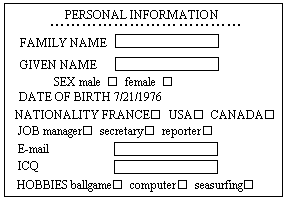
Reporter:Hi, may I ask you some questions?
Man:Sure, if you wish.
Reporter:What's your name and where are you from?
Man:My name's Robby White, and I'm from the city of Toronto. I was born in an English-speaking country, but my family all speak French.
Reporter:What do you usually do when you are out of your work?
Man:I work as a secretary in a company, and after work I like to play football, basketball. But surfing on the Internet is my favorite. I spend too much time on it.
Reporter:So you learn a lot from the Internet.
Man:Yes. And I make friends through the Internet by ICQ, If you have time, we can have a chat and you can ask me more questions.
Reporter:I like chatting on the Internet, too. Of course I will. How do you communicate with your friends, by writing letters?
Man:I used to do that. Now we use different ways, such as mobile phones, ICQ, E-mails, chatting-rooms through the Internet. By the way, my phone number is 10-0234-6752, my ICQ number is 99745632 and my E-mail is
johny white @ hotmail Com.
Reporter:You must have great fun in your life.
Man:Yes. Thanks.
Reporter:Oh, sorry. I've got something to do now. Let's meet later.
Man:No problem.
湖北省互联网违法和不良信息举报平台 | 网上有害信息举报专区 | 电信诈骗举报专区 | 涉历史虚无主义有害信息举报专区 | 涉企侵权举报专区
违法和不良信息举报电话:027-86699610 举报邮箱:58377363@163.com