
题目列表(包括答案和解析)
用方框中所给词语的适当形式填空,使短文正确、通顺、连贯(每词限用一次)。

The mobile phone is a useful thing, but maybe I don't know 1 to use it.Sometimes it makes things difficult for me.
One day I wanted to see my friend nearby.I could 2 at his house in five minutes, but I looked at my mobile phone and thought 3 would be better to ring him up(打电话给他).I 4 him for the first time, but the line was busy.Five minutes later, there was an answer, but it was the wrong number.Then I tried 5 and this time I got an answer from him.
I asked him if he was at home in the afternoon.And he said-at 6 I thought he said-he would be at home all afternoon.So I went to his house, but then I found 7 in.I called him for the fourth time.This time I got so angry that I 8 , "You are not at home? But you just told me over the telephone that you would be at home all afternoon!"
Here 9 his answer, "No, I said:'I will NOT be at home all afternoon.'"
I went back to my room, sat down in front of the mobile phone and looked at it.What 10 could I do? Nothing!
听力(共二节,计25分)
第一节(共9小题;第小题1分,满分9分)
听下面9段对话.每段对话后面有一个小题,从题后所给的A、B、C三个选项中选出最佳选项.听完每段对话后,你都有10秒钟的时间来回答有关小题和阅读下一小题.每段对话仅读一遍.
1.A.pandas
B.elephants
C.penguins
2.A.watched TV
B.bought food
C.bought books
3.A.bikes
B.buses
C.cars
4.A.a singer
B.a cook
C.a nurse
5.A.Red
B.Blue
C.Yellow
6.A.7∶20
B.7∶40
C.8∶00
7.A.The post office
B.The hospital
C.The bookstore
8.A.It was very good.
B.It was too long.
C.It was hard to understand
9.A.Because she doesn't like it at all.
B.Because the dress is too big for him.
C.Because she only likes its color.
第二节(共16小题,每小题1分,满分16分)
听下面5段对话或独白,每段对话或独白后面有几个小题,从题后所给的A,B,C三个选项中选出最佳选项.听每段对话或独白钱,你将有时间阅读各个小题,没小题5秒钟.听完后,各题将给出5秒钟的答题时间.每段对话或独白读两遍.
听第10段材料,完成第10-11小题.
10.Where's the raincoat?
A.Behind the chair.
B.Behind the door.
C.Behind the wall.
11.Can Lucy see the boy\s cap?
A.Yes, she can.
B.No, she can't.
C.We don't know.
听第11段材料,回答第12-14小题.
12.Where does this dialogue happen?
A.At home.
B.At school.
C.In the open air.
13.What does Jack want to eat?
A.A chicken sandwich.
B.A tomato sandwich.
C.A potato sandwich.
14.Which is Jack's favorite?
A.Coke
B.Tomato sandwiches.
C.Potato sandwiches.
听第12段材料,回答第15-17小题.
15.What's the dialogue about?
A.About Jim's school.
B.About Jim's trouble.
C.The food for breakfast.
16.Where are they talking?
A.At Jim's home.
B.At doctor's.
C.At Jim's school.
17.What's the matter with Jim?
A.He's got a headache.
B.He's got a cold.
C.Both A andB.
听第13段材料,回答第18-21小题.
18.Why is the boy unhappy?
A.Because he failed his math test.
B.Because he doesn't feel well.
C.Because he doesn't like his clothes.
19.What does the girl advise him to do to get money?
A.Ask his parents for help.
B.Find a part-time job.
C.Raise money in his School.
20.What does his mother want him to do every night?
A.Be at home.
B.Study.
C.Play outside.
21.How did the boy deal with his problem?
A.He did nothing.
B.He argued his mother.
C.He talked with his mother about his problem.
听第14段材料,回答第22-2 5小题.
22.Jamie is a famous ________.
A.TV host
B.film actor
C.school teacher
23.People like Jamie's programs about food because his food ________.
A.is always healthy
B.is easy to make
C.is good for kids
24.One day, Jamie visited a school and ________.
A.surveyed the students' diet
B.showed the students how to cook
C.made a program about healthy food
25.At first the children didn't want to eat his food because ________.
A.there wasn't meat
B.they didn't like fruit or vegetables.
C.it wasn't for children.
汉译英,使用所给的词或短语翻译句子,把答案写在每小题后的横线上。
1.中国是一个具有悠久历史的国家。(with)
2.你过去害怕独自一人呆着吗?(be afraid of)
3.我们正在尽力挽救一头处境危险的大象。(try to)
4.公共汽车太拥挤了而不能上车。(too…to)
5.三十年以后地球上将会有更少的树木。(there be)
听力理解
一、听对话,选择与对话内容相符的图片,将代表图片的字母填写在相应序号后的括号内。每段对话读两遍。(共6分,每小题1分)
请看第一组的四幅图片,听三段对话,回答第1~3小题。

请看第二组的四幅图片,听三段对话,回答第4~6小题。

二、听对话或独白,根据对话或独白内容,从下列各题所给的选项中,选择正确答案。对话或独白朗读两遍。(共12分,每小题1.5分)
听第一段对话,回答第7~8小题。
7.Where are the two speakers?
A.In a classroom.
B.In a bank.
C.In a shop.
8.What does the woman want to do?
A.To change a sweater.
B.To borrow a sweater.
C.To wash a sweater.
听第二段对话,回答第9~11小题。
9.How does the man go to Chicago?
A.By air.
B.By train.
C.By sea.
10.Which meal does the man want to have?
A.Breakfast.
B.Lunch.
C.Supper.
11.How soon will the man be at home?
A.In two hours.
B.In three hours.
C.In four hours.
听一段独白,回答第12~14小题。
12.What’s the new problem in the country?
A.“Left-behind”children seldom get care from the government.
B.“Left-behind”children seldom get together with their parents.
C.“Left-behind”children cannot get any love from their parents.
13.Who probably look after the children whose parents have moved to work in cities?
A.Their teachers.
B.Their neighbours.
C.Their grandparents.
14.What does Wen Jiabao require local(当地的)governments to do?
A.To do more for“left-behind”children and their parents.
B.To let the schools in cities receive“left-behind”children.
C.To make the local people stop going to work in cities.
三、听下面的一段独白,根据题目要求在相应题号后的横线上记录关键信息。独白读三遍。(共8分,每小题2分)(注:生词manners礼貌,礼节)

听力理解(24分)
一、听对话,选择与对话内容相符的图片。(共4分,每小题1分)
请听四段对话,根据对话内容,从下列各题所给的A、B、C三个选项中选择最佳答案。(每段对话读两遍)
1.
A.
B.
C.
2.
A.
B.
C.
3.
A.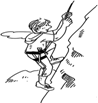
B.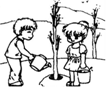
C.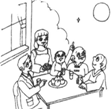
4.
A.
B.
C.
二、听对话或独白,选择最佳答案。(共12分,每小题1分)
请听对话或独白,根据对话或独白内容,从下列各题所给的A、B、C三个选项中选择最佳答案。(每段对话或独白读两遍)
请听一段对话,回答第5至第6小题。
5.Who will have dinner with Jack?
A.Mike.
B.Jane.
C.Susan.
6.What will they have for dinner?
A.Chinese food.
B.Italian food.
C.Japanese food.
请听一段对话,回答第7至第8小题。
7.How does the man go to Japan?
A.By ship.
B.By train.
C.By plane.
8.How soon will the man be at home?
A.In three hours.
B.In four hours.
C.In five hours.
请听一段对话,回答第9至第10小题。
9.When did Tony lose his schoolbag?
A.When he played soccer.
B.When he watched a football match.
C.When he bought a football.
10.What’s NOT in Tony’s schoolbag?
A.Some pictures.
B.A pencil-box.
C.An MP3.
请听一段对话,回答第11至第13小题。
11.Where is the man going?
A.To a police station.
B.To a repair shop.
C.To a book store.
12.What does a “town guide” mean in the conversation?
A.A shop.
B.A book.
C.A person.
13.How does the man go there?
A.On foot.
B.By bike.
C.By bus.
请听一段独白,回答第14至第16小题。
14.What is the speaker mainly talking about?
A.Memory development.
B.Food importance.
C.Sleeping problems.
15.If we don’t drink enough water, we will ________ according to the speaker.
A.feel a little tired
B.have difficulty in thinking
C.have difficulty in concentrating
16.Why is sleep important to memory?
A.Because it can control the senses.
B.Because it can make people much more relaxed.
C.Because it helps the brain to revise and store information.
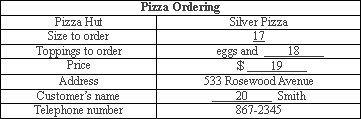
三、听对话,记录关键信息。(共8分,每小题2分)
请听对话,根据对话内容,将所缺的关键信息补全。(对话读两遍)
湖北省互联网违法和不良信息举报平台 | 网上有害信息举报专区 | 电信诈骗举报专区 | 涉历史虚无主义有害信息举报专区 | 涉企侵权举报专区
违法和不良信息举报电话:027-86699610 举报邮箱:58377363@163.com