
(复习食物名.呈现目标语言.) T:They’ll prepare many kinds of foods for the food festival. If you come to the food festival.what will you prepare? (让学生说出要准备的各种食物名称.) T:Can you tell me how to cook the food? Please work in groups.and then write down the ways. (分组讨论如何做好一种菜.将步骤记录下来.如果用英语表达不出来可用汉语.准备2-3分钟.) T:Are you ready? (请几个同学将记录读出来.老师将其中的一份记录在黑板上.并补充完整.) T:When you cook. you must work very carefully. You may add salt slowly. (呈现在黑板上.注意carefully与slowly.解释这两个词的用法.这些词就是教学生如何将菜做得更好.) T:“Carefully tells how to cook. or how to cook well. “Slowly tells how to add salt. 教学过程设计 教学过程: Step 1 Review 【查看更多】


题目列表(包括答案和解析)

Ⅰ.听对话,选出你所听到的食物名,并在图画下面打√.
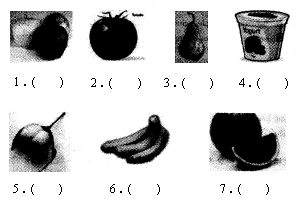
Ⅱ.听对话和对话后的问题,选择正确的答案.

8.

[  ]

A.Library.  B.Shop.  C.Cinema.

9.

[  ]

A.Friday.  B.Saturday.  C.Sunday.

10.

[  ]

A.She got up late.

B.She was ill.

C.She felt better.

11.

[  ]

A.He worked in Shanghai.

B.He worked in Beijing.

C.He worked in Nanjing.

12.

[  ]

A.Because she got up too early this morning.

B.Because she went to bed too late last night.

C.Because she got ready for her lessons last night.

Ⅲ.根据录音,判断对错.

13.Mrs Jackson is an Australian.

(  )

14.She is 45 years old.

(  )

15.She has black hair.

(  )

16.She often reads on the weekends.

(  )

17.She likes watching movies on the weekends.

(  )

18.She wants to be a science teacher.

(  )

查看答案和解析>>

根据首字母提示和句子意思,写出所缺单词。
【小题1】People often go to the  r__________ to eat and drink things .(饭馆)
【小题2】This car is very e_______ , it’s not cheap .(昂贵的)
【小题3】No one will write on a blackboard w______ chalk.(用)
【小题4】he will r_______ for the test this weekend.(复习)
【小题5】Don’t get in, they are getting d____________(穿衣服)

查看答案和解析>>

根据首字母提示和句子意思,写出所缺单词。
【小题1】People often go to the  r__________ to eat and drink things .(饭馆)
【小题2】This car is very e_______ , it’s not cheap .(昂贵的)
【小题3】No one will write on a blackboard w______ chalk.(用)
【小题4】he will r_______ for the test this weekend.(复习)
【小题5】Don’t get in, they are getting d____________(穿衣服)

查看答案和解析>>

阅读下列短文,根据短文内容选择最佳答案。
     There is a man. He has a son. He loves him very much. Every day after work the man comes home
and plays with the little boy.
     When the man comes home from work one night, he has other things to do. And he can't play with his
little son. He wants to give the boy something to keep him busy. Then, he has an idea. He sees a magazine
with a large map of the world on the cover (封面). He tears (撕) the map up into pieces (片). He puts the
pieces on the table in the dining room. He tells the boy it is a map of the world. He asks the boy to put
them back together and they can play together when he finishes. He thinks it can keep the boy busy for
hours.
      After about thirty minutes, the boy comes to the man and says, " I finish the map. Dad, can we play
now?" The man is surprised (惊讶的), saying, "How do you do that?" The boy says, "It's easy. On the
back (背面) of the page is a picture of a man. When I put the man together, the world appears completely
(完整地呈现)."
1. Why can't the man play with his son one night?
A. He wants to read a magazine.
B. He has other things to do.
C. He must learn something about a map.
D. He must stay at his office.
2. What does the man ask his son to do?
A. To read the magazine to find a map.
B. To tear the map of the world up into pieces.
C. To put the pieces of the map of the world together.
D. To read the map of the world.
3. How long does the boy do it?
A. Two hours
B. About an hour
C. About half an hour
D. The night
4. What do you think of the boy?
A. Clever
B. Polite
C. Helpful
D. Lazy
5. Which of the following is TRUE (正确的)?
A. It's about a father's work.
B. It's a story between a father and his son.
C. It's an advertisement(广告) for the map of the world.
D. It's a poster about how to read a map.

查看答案和解析>>

冠军,曾“输在起跑线上”
①在日本大阪世界田径锦标赛男子110米栏决赛中, “飞人”刘翔以12秒95夺冠。比赛记录表明:刘翔的起跑反应时间是0.161秒,列8名选手中第五位。其实,在以往的许多国际赛事中,刘翔的起跑反应都慢于别人,可以说,有好几次,刘翔都是“输在起跑线上,却赢在终点”的世界冠军。
②起跑慢,刘翔依然赢了冠军。可见,输在起跑线上并不可怕,决定一个人、一家企业、一个地方最终成败的,往往不是起跑线上的谁先谁后。重要的是,输,不能输掉希望、输掉信念、输掉干劲,不能因输一时而输一生、输过去而输将来、输局部而输全局。对起跑线上的输,只要不悲观失望、自暴自弃,不自惭形秽、怨天尤人,而且奋起直追,一样能够变“起跑线上的输”为“终点上的赢”。
③能赢在“起跑线上”,当然好,但输在“起跑线上”,不一定就输了比赛、输了人生。同理,赢在了“起跑线上”,却输了比赛、输了人生的也不少。王安石曾在《伤仲永》中讲了一个叫方仲永的孩子,天资聪慧,很小就会作诗,便有人花钱请他作诗,他的父亲认为有利可图,就天天带着他作诗赚钱,不让他好好读书,结果长大后“泯然众人矣”!如果把当官也算是一种人生“起跑线”,许多贪官当初大权在握,何等威风神气,但后来“权为己用,利为己谋”,终因贪欲毁掉了前程,甚至断送了生命,在事业、人生的“终点”上输得一塌糊涂。
④现如今,为了“不让孩子输在起跑线上”,许多父母不顾孩子的实际,非得让孩子学这学那,甚至“赶着鸭子上架”,或者因为孩子“起跑”不好,就沮丧地认为输掉了一切。毫无疑问,要达到同样的目标,“起跑”慢的,肯定要比“起跑”快的付出更大的代价,但只要方法得当,锲而不舍,一样能够“赢在终点”。世界冠军刘翔就是最好的例证!
【小题1】请用自己的语言概括本文的中心论点。(2分)
【小题2】第③段运用了什么论证方法?证明了什么道理?(2分)

查看答案和解析>>


同步练习册答案