Brainstorming:Students sum up the names of different types of clothes. For example: jeans, scarf, coat, etc. 【查看更多】


题目列表(包括答案和解析)

  If you want to work more on writing, we suggest(建议)that you read throngh the passage below.That will help you learn how to improve your writing.

  Choosing a Writing Topic(题目,话题)

  Your teacher and your group members may help you choose a topic sometimes.We suggest that you try if possible to choose or make up a topic that is interesting to you because it will be easier for you to write about something you are interested in.

  Getting Started

  Once you have chosen a topic, you have to get started writing.Getting started is the hardest part of writing for most people.However, there are ways of making this job easier, and we would like to introduce you some of these techniques(技巧)at this time.

  Brainstorming helps you get ideas for your writing.Here is how to do it.First, take a pen and piece of paper and write down your topic on it.Read your topic over a few times to yourself.Then let your mind go freely.And then write down any ideas that come to your mind.Now let’s suppose your topic is blue jeans.Please do as suggested.

  blue jeans  youth/young people  clothing

  freedom  comfortable  enjoyable

  Listing is useful for exploring something where you are trying to look at two sides of a subject, the advantages(good points)and disadvantages(bad points)of something, reasons for doing and not doing something.

  Another useful technique is mapping.You start by writing your topic in the center of your page in a box.And then as you brainstorm for ideas, you write your ideas around the topic.As you write one idea down, you may think of another idea related to(与……有关的)it, so you could write this second idea close to the first one.Mapping can be useful for helping you see relationship between ideas and also showing important events in relation to each other.Here are two examples of mapping.
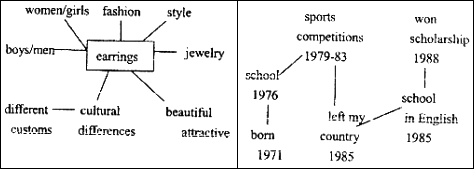
  Another way to get started and to explore your ideas on a topic is to do some free-writing at the beginning.You can do free-writing after or in place of brainstorming.You write for 10~15 minutes about your topic.You should write anything that comes into your mind.Keep on writing even if nothing comes into your mind.When you free-write, don’t think about grammar, spelling, or punctuation(标点).Just write!And don’t stop writing until your time is up.After you finish, read over what you have written.Draw a line under anything that seems interesting to you.You can free-write again beginning with the part you underlined.You can free-write several times.Each time you bring your ideas more and more closely to your topic.

(1)

There’re ________ writing techniques mentioned in the passage.

[  ]

A.

2

B.

3

C.

4

D.

5

(2)

When we write, which order should we follow?

a.map b.free-writing c.brainstorm d.choose a topic e.list f.get started

[  ]

A.

bce

B.

dce

C.

cea

D.

fcb

(3)

Which is NOT TRUE according to the passage?

[  ]

A.

We can find ideas not related to the topic on a map.

B.

We can try different ways when we are mapping.

C.

We learn listing is a very useful technique.

D.

We either brainstorm or free-writing when getting started.

(4)

What does the writer write the article for?

[  ]

A.

The writer wants to help us write our composition.

B.

The writer wants to show he is more knowledgeable than others.

C.

The writer wants to tell us the methods of writing.

D.

The writer wants to write a good article.

(5)

What does the underlined word “explore” mean in the passage?

[  ]

A.

勘探

B.

探究

C.

侦探

D.

考察

查看答案和解析>>

阅读理解。
     Mr. Ma, a famous mental doctor (心理医生) from  Beijing once said at an important meeting, "Now
many young students can have problems with their minds. Some  students become worried because they
have to study very hard. Others have trouble getting on well with  people  around  them like their parents
and classmates. Parents and teachers should care more about this problem."
     Then Mr. Ma gave   some examples.  A  middle  school   studen t from  Xi'an   was doing badly in his
lessons. He thought his teachers and friends often laughed at him, and he became so nervous and worried
that one night he left his home without telling  his  parents. Another student, a 14-year-old schoolgirl from
Shanghai, was very afraid of exams. While she was reading the exam paper, she couldn't think of anything
to write.
     A recent report from a newspaper says  about  18%  of the young students in Shanghai have mental
problems. They often feel worried and very unhappy. Unluckily many of them won't go and ask for help.
Some think they will look stupid if they go to see a doctor. Others won't talk about their secrets.
     At the end of the meeting, Mr. Ma gave some good ideas to young people:
Talk to your parents or teacher often.
Join in group activities.
Try to get on well with the people around you.
Go to see a doctor if you often feel unhappy.
1. The students who often become worried or have trouble getting on with others may have _______.
A. no parents
B. no secrets
C. poor families
D. mental problems
2. Some of those with mental problems won't ask for help because _______.
A. they don't want to tell their secrets to others
B. their parents are too busy to look after them
C. doctors can't help them with the problems
D. they can do with the problems themselves
3. The underlined word "stupid" in this passage means _______.
A. pretty
B. happy
C. not clever
D. not friendly
4. According to the last part, which of the followings is a good idea?
A. It's important for children to live with their parents.
B. It's helpful for people to see doctors every day.
C. It's useful for students to keep quiet in class.
D. It's necessary for young people to have group activities.

查看答案和解析>>


同步练习册答案
