
题目列表(包括答案和解析)
| A.30 | B.50 | C.100 | D.130? |
| A.Water | B.Wind | C.The sun | D.The kite? |
| A.在……范围内变动 | B.按……顺序排列 |
| C.向……方向延伸 | D.根据……归类? |
| A.its price is getting lower and lower? |
| B.more and more people are enjoying its excitement? |
| C.its equipment progress makes it easier and safer? |
| D.all people can learn and take part in it? |
| A.the way of operating kitesurfing |
| B.the progress of kitesurfing equipment? |
| C.the history of kitesurfing in China |
| D.the development of kitesurfing |
Kitesurfing as a water sport began in the 1980s, but didn't get popular until the end of last century. It is also known as kiteboarding, and in some European countries as flysurfing. Kitesurfing works through wind power(动力) by using a large kite to pull a rider on the water at high speed.
At first, kitesurfing was a difficult and dangerous sport. Now it is becoming easier and safer because of the safer kite design. For an able and strong person, kitesurfing can be a very fun, extremely exciting sport, just like skating on the water with a feeling of flying. It has become more and more popular.
Compared with other water sports, kitesurfing is easier to learn. A beginner can understand how to operate the kite with 5--10 hours of training. And anybody aged from 13 to 65 can learn. It is not expensive to get the equipment for kitesurfing, which costs $1,000 to 82,500. Training lessons range from $200 to $500 for two or three hours. With the development of its equipment progress, kitesurfing is becoming even safer. After some training, you can enjoy its excitement and challenging feeling.
With the rising popularity of kitesurfing, most major seaside cities have kitesurfing clubs. In China, Xiamen is the only place that has the kitesurfing club, which provides professional kitesurfing training and equipments.
1.Kitesurfing has a history of about________years.
A.30 B.50 C.100 D.130
2.________is mentioned in the passage as the power of kitesurfing.
A.Water B.Wind C.The sun D.The kite
3.The underlined word“range”in the passage means “________”in Chinese.
A.在……范围 B.按……顺序排列
C.向……方向延伸 D.根据……归类
4.The most important reason for the popularity of kitesurfing is that _______.
A.its price is getting lower and lower
B.more and more people are enjoying its excitement
C.its equipment progress makes it easier and safer
D.all people can learn and take part in it
5.The main idea of this passage is about _______.
A.the way of operating kitesurfing B.the progress of kitesurfing equipment
C.the history of kitesurfing in China D.the development of kitesurfing
Kitesurfing as a water sport began in the 1980s, but didn't get popular until the end of last century. It is also known as kiteboarding, and in some European countries as flysurfing. Kitesurfing works through wind power(动力) by using a large kite to pull a rider on the water at high speed.
At first, kitesurfing was a difficult and dangerous sport. Now it is becoming easier and safer because of the safer kite design. For an able and strong person, kitesurfing can be a very fun, extremely exciting sport, just like skating on the water with a feeling of flying. It has become more and more popular.
Compared with other water sports, kitesurfing is easier to learn. A beginner can understand how to operate the kite with 5--10 hours of training. And anybody aged from 13 to 65 can learn. It is not expensive to get the equipment for kitesurfing, which costs $1,000 to 82,500. Training lessons range from $200 to $500 for two or three hours. With the development of its equipment progress, kitesurfing is becoming even safer. After some training, you can enjoy its excitement and challenging feeling.
With the rising popularity of kitesurfing, most major seaside cities have kitesurfing clubs. In China, Xiamen is the only place that has the kitesurfing club, which provides professional kitesurfing training and equipments.
【小题1】Kitesurfing has a history of about________years.
| A.30 | B.50 | C.100 | D.130 |
| A.Water | B.Wind | C.The sun | D.The kite |
| A.在……范围 | B.按……顺序排列 |
| C.向……方向延伸 | D.根据……归类 |
| A.its price is getting lower and lower |
| B.more and more people are enjoying its excitement |
| C.its equipment progress makes it easier and safer |
| D.all people can learn and take part in it |
| A.the way of operating kitesurfing | B.the progress of kitesurfing equipment |
| C.the history of kitesurfing in China | D.the development of kitesurfing |
阅读短文,根据要求完成下面各小题。
When children are faced with problems, they may not be able to deal with them. Children need to learn how to solve problems. You can help them to learn it. The best way is to take the time to talk about problems as they happen. Of course, this is not easy to do. Problems have a way of bursting upon (突然发生) someone at the worst time. But even if the time is not the best, you should try to help.
There are many things you can do to help children learn problem-solving skills. One good way is to find out what made the problem happen. This is a skill that children won’t learn without help. A child may knock over a glass of milk at the dinner table, but he may not realize that the glass was too close to the edge. You can show the child what the problem is. Then it can be solved.
The next step for children is to learn how to solve the problem alone. This step takes courage. 83 Some of them are so afraid of being wrong that they cannot solve problems. You can help them by talking about some possible answers. Then two of you can decide which answer is the best. Let the children try it out. Now the children will see that problems can be solved, and you can praise them for choosing an answer.
Another step to problem-solving is to help children see the laws of cause and effect(因果规律). If a glass is knocked over, it will fall and break. If children might like to write on the wall, the pencil always leaves a mark. Soon the children will see the link between cause and effect, and then they are on the road to growth. When children see someone else knock over a glass. They now know that it will break. When they see writing on the wall, they can tell how it got there.
84 The ability to solve problems is not easy for children to learn. It is not easy for adults either. It takes patience for you, and it takes practice for the child. But problem-solving can be taught. All you need is time and effort.
A. 根据短文内容简要回答问题。
81. How many steps are mentioned in the passage to help children learn to solve problems?
____________________________________________________________________
82. Is it easy for adults to learn the ability to solve problems?
____________________________________________________________________
B. 短文中划线的句子译成汉语。
83. _______________________________________________________________________
84. _______________________________________________________________________
请给短文拟一个适当的英文标题。
85._______________________________________________
听力选择(共20个小题,满分20分)
第一部分听对话回答问题(计10分,每小题1分)
本部分共有10道小题,每小题你将听到一段对话,每段对话听两遍。在听每段对话前,你将有5秒钟的时间阅读题目;听完后,你将有5秒钟的时间选出你认为最合适的各选答案。
1.How does Mr.Huang go to work?
A.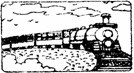
B.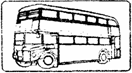
C.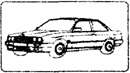
2.What is John looking for?
A.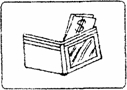
B.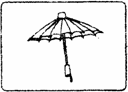
C.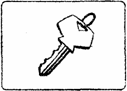
3.What did Ben use to do on weekends?
A.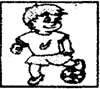
B.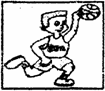
C.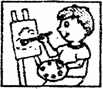
4.How does Tom learn English?
A.
B.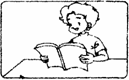
C.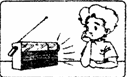
5.Where are they?
A.At a shop
B.At a bus stop
C.At a post office
6.Why is David feeling sad?
A.new term has begun
B.he could no longer watch TV
C.his teacher dislikes him
7.What programme does mum watch to learn it is going to rain?
A.Weather Report
B.Today's news
C.Radio Programme
8.When does Andy usually leave in the afternoon?
A.At about 6∶30
B.At about 6∶00
C.At about 5∶30
9.What was Jack doing at 11∶30 last night?
A.He was watching a match
B.He was going to bed
C.He was doing homework
10.What is CCTV5 about?
A.Sports
B.Music
C.Films
第二部分听对话和独白回答问题(计10分,每小题1分)
你将听到两段对话和一段独自,各听两遍。每段对话或独自后各有几道小题。听每段对话或独白前,你将有时间阅读相关小题,每小题5秒钟;听完后,每小题你将有5秒钟的时间选出你认为最合适的被选答案。
听下面一段材料,回答第11-12题。
11.How did they go to Beijing Wildlife Park?
A.By train.
B.By bus.
C.By bike.
12.Who did the boy visit Beijing Wildlife Park with?
A.His family.
B.His sister.
C.His classmates.
听下面一段材料,回答第13-15题。
13.What kind of class does the woman have?
A.Beginner's class.
B.Easier class.
C.Dancing class.
14.What does the man think of the dancing lesson?
A.It's easy.
B.It's hard.
C.It's interesting.
15.How long does she exercise every day?
A.Half an hour.
B.An hour.
C.Sixteen minutes.
听下面的独白,独后白有五个小题,从题中所给的A、B、C三个选项中选出最佳选项。独白读两遍。
16.Which was Miss Brown's best idea?
A.The first thing
B.The second thing.
C.The third thing
17.What was the weather like that night?
A.It was windy
B.It was cloudy
C.It was raining
18.Where was Miss Brown going?
A.She was going home.
B.She was going to her friend's house.
C.She was going to her office.
19.Why was Miss Brown afraid?
A.Because it was raining and the traffic was bad.
B.Because she couldn't find her glasses.
C.Because she couldn't find her friend's house
20.What was Miss Brown's first thing to do?
A.She turned off the radio.
B.She drove slowly.
C.She read the road signs.
湖北省互联网违法和不良信息举报平台 | 网上有害信息举报专区 | 电信诈骗举报专区 | 涉历史虚无主义有害信息举报专区 | 涉企侵权举报专区
违法和不良信息举报电话:027-86699610 举报邮箱:58377363@163.com