the best time 最佳时间 16. enter someone’s home 进入某人家里 【查看更多】


题目列表(包括答案和解析)

根据短文内容选择最佳答案。(Choose the best answers according to the passage.)

  Science fiction is a popular kind of writing, and many people think of Jules Verne as the father of science fiction.He was born in France in 1828.His father wanted him to become a lawyer(律师), but from his early twenties Verne decided to become a writer.At first he wrote plays for the theater.Then, in 1863, he wrote a story called Five Weeks in a Balloon.The success of the book encouraged him to write more stories such as A Journey to the Center of the Earth(1864)and From the Earth to the Moon(1865).

  In the 19th century, many people were interested in science and inventions.Jules Verne wrote about scientific subjects in his stories and, as a result, they were very popular.Verne's writing included many predictions(预言)for the 20th century and many of them came true.He described space flight, movies, and very successful and they made Verne rich.

  Jules Verne's books have been the subjects for many movies.20, 000 Leagues Under the Sea was a successful movie for Walt Disney.It was the first Disney movie to use real actors instead of cartoon drawings.Around the World in Eighty Days is another famous movie based on one of Verne's books.The main character is an Englishman called Phileas Fogg.For him, the most important thing is to be always on time!

(1)

The phrase“the father of science fiction”means ________.

[  ]

A.

the father who has several children

B.

the man who loves science and inventions

C.

the writer whose father wrote science fiction

D.

the man who first started writing science fiction successfully

(2)

What encouraged Jules Verne to write more stories?

[  ]

A.

The plays he wrote for the theater.

B.

The encouragement from his father.

C.

The success of Five Weeks in a Balloon.

D.

The scientific subjects in his stories.

(3)

Jules Verne's books were very popular in the 19th century because ________.

[  ]

A.

his books made him rich and famous

B.

he wrote many plays for the theater at that time

C.

his books have been the subjects for many movies

D.

many people were interested in science and inventions

(4)

Which of the following has the main character called Phileas Fogg?

[  ]

A.

Five Weeks in a Balloon.

B.

Around the World in Eighty Days.

C.

A Journey to the Center of the Earth.

D.

From the Earth to the Moon.

(5)

Which of the following is TRUE according to this passage?

[  ]

A.

Jules Verne only wrote plays in the 19th century.

B.

Many of the predictions in Verne's stories came true.

C.

The main characters in Verne's books are always on time.

D.

The space flight Verne described was different from others.

查看答案和解析>>

根据短文内容选择最佳答案。

  The British are known as people who love to stand in line, but a new research(调查)shows that the British are only about average at waiting politely in a queue.The French are the best.It's the Germans who don't have a good habit(习惯)of standing in line.They can't stand to wait for anything.They begin to shout loudly and noisily if the line doesn't seem to be moving fast enough.Sadly it never moves fast enough for them.

  The experts studied 940 people across Europe.They watched secretly as they waited in line-to get tickets, to order fast food and to wait for the bus.They found people who are good at forming(排成)queues feel that they move along faster.For example, in Britain, the average waiting at a queue needs about three and a half minutes.In Germany or Sweden people hate waiting in line.In fact, people spend double the time as the British in queues.They get to the front of the queue without thinking about others, so they waste others' time.

  The expert who did the research had asked a person to break into a queue to see what people would do.In Britain, people shouted loudly at him, but when he said,“I am terribly sorry.I didn't realize there was a queue.Do go before me.”People smiled and said,“oh, that's all right, one more won't matter much.”It was also found in France, where 80%of the people didn't mind standing in line, only if they were treated politely.While in Germany everyone was angry and wore an unhappy face.The expert said,“If only they could learn from the British and the French to think of queuing as an exercise in making the best of an unhappy thing, they might find that the queue then moves faster.”

(1)

The research shows that the people in ________ are the most polite in standing in line.

[  ]

A.

Sweden

B.

Britain

C.

France

D.

Germany

(2)

The Germans spend more time than the British in queues because they ________.

[  ]

A.

always talk a lot with others

B.

like waiting in line

C.

don't follow the rule of queuing

D.

don't know the rule of queuing

(3)

According to the research, which of the following is TRUE?

[  ]

A.

The British didn't care about the queue jumper.

B.

The Germans were angry with the queue jumper.

C.

The French treated the queue jumper badly.

D.

The Swedish enjoyed themselves while queuing.

(4)

From the last sentence we know the expert wished the Germans could ________.

[  ]

A.

have a good habit of standing in line

B.

save others' time while queuing

C.

move quickly when queuing

D.

take exercise in queues

(5)

The result of the research shows that ________.

[  ]

A.

people in Europe hate waiting in line

B.

standing in line is a kind of exercise

C.

there are always queue jumpers all over the world

D.

people good at standing in line think they move along faster

查看答案和解析>>

阅读下面短文,然后根据短文内容选择最佳答案。

  An office meeting starts at 10 a. m.Hans, a German, is already waiting at 9∶55.Na-than, an American, arrives right at 10 o'clock.In the next five minutes a few others hurry in.But Raul, the visitor from Brazil, walks in at 10∶30.He doesn't even think he' s late.

  How different the understanding of time is around the world! Germans like arriving early.Americans plan to arrive just on time.Brazilians think it OK to be half an hour late.

  In 1884, a clock in Greenwich, England, set the standard(标准的)time around the world, which is known as GMT(Greenwich Mean Time).But it couldn't standardize(使标准化)when people will arrive for a 10 a.m. meeting.

  As people have different understanding of time, all cultures(文化)can be put into one of the two groups:time-oriented(导向的)and event-oriented.Time goes first in time-oriented culture.In event-oriented culture, what happens is more important than when.Such knowledge is important for today's world travelers.

  Not understanding these different ideas about time can sometimes bring trouble.For example, American students often quickly exchange “how are you?”and “fine”as they rush to make class on time.But event-oriented students see this exchange as impolite.Before they can say anything more than “fine”, the American student has already hurried past them.

  What can the world traveler do to avoid(避免)such time related trouble? Follow the age-old rule:When in Rome, do as the Romans do.

(1)

If the school starts at 8∶30 a.m. what time does your German friend probably arrive?

[  ]

A.

Around 8∶25 a. m.

B.

Right at 8∶30 a. m.

C.

Around 9∶00 a. m.

D.

After 9∶00 a. m.

(2)

Which of the following does not belong to the time-oriented culture?

[  ]

A.

People care about time more than anything else.

B.

People don't really mind whether they are late.

C.

People often hurry past you with short greetings.

D.

Everything usually takes place at the planned time.

(3)

What does the underlined sentence“When in Rome, do as the Romans do.”mean in this passage?

[  ]

A.

You should do everything as the Romans do when you go to Rome.

B.

You should do what the Romans tell you to if you are in Rome.

C.

You should know the time-idea of the local people and do as they do.

D.

You should do everything as the local people do when you are in a new place.

(4)

Which of the following is true?

[  ]

A.

People from different cultures have the same idea about time.

B.

It's quite usual for a time-oriented person to be late.

C.

Different understandings of time never bring any trouble.

D.

An event-oriented person may feel uncomfortable in the USA.

(5)

Which of the following is the best title?

[  ]

A.

Greenwich Mean Time

B.

How to avoid time-related trouble

C.

Different cultures, different understandings of time

D.

Time-oriented culture

查看答案和解析>>

阅读下文内容,从各小题所给的四个选项中选出能回答所提问题或完成所给句子的一个最佳答案。

  How do you pay for things?Do you usually use cash(现金), or do you like to pay by credit card(信用卡)?If you are like a lot of people, you probably have at least one credit card.Also, you might use it more often than you probably should.

  Credit cards first became popular in the 1920s, At that time, businesses, such as hotels and companies, gave credit cards to their best customers(顾客).Unlike today's credit cards, customers could only use these cards at the Store or business that gave out the card.Customers had to pay for things in full.They couldn't pay for something a little at a time.

  In 1950, a businessman named McNamara started a credit card company - Diners Club.Unlike earlier credit cards, this card could be used by customers at many restaurants.Customers liked the card because they didn't have to carry a lot of cash with them.Restaurant owners liked the card, too.Why?They found out that customers usually spent more money when they could pay by credit card.

  In its first year of business, Diners Club issued 200 cards, The customers who got the cards from the Diners Club could use them at 27 different restaurants.Today, Diners Club has about 8 million customers, and they can use their cards in over 7.6 million businesses in more than 200 countries.

(1)

What can we know about the earlier credit cards from the passage?

[  ]

A.

They could be used everywhere.

B.

Customers had to pay for things in full.

C.

They were very popular before the 1920s.

D.

Everyone could get this kind of credit card.

(2)

The underlined word "issued" here probably means "________".

[  ]

A.

showed

B.

took

C.

borrowed

D.

provided

(3)

This passage is mainly about ________.

[  ]

A.

part of the development of credit cards

B.

how to use cash

C.

the number of people who use credit cards in the world

D.

how credit cards help businessmen

查看答案和解析>>

  We use the Internet for many things: business, shopping, writing letters, talking to people, finding information mid so on. In recent years, a new kind of English.has grown on the Internet. There’s no real word for it yet, so we’ll call it E-talk. People don’t like typing too much. To save time, they turn phrases into a few letters (alled acronyms). Acronyms are often used in chat rooms(聊天室). Some of them are: BTW (by the way) BRB (be right back) LOL (laughing out loud) IMO (in my opinion). People also use many abbreviations. They are shortened forms of words. Some common abbreviations are: info (information), puter (computer), pic (picture), sec (second). We usually don’t see people when we communicate(交流)on the Net, so people have new ways to show feelings. Most people use their keyboards to draw “feelings”, such as:

  :-)(happy) ;-)(joking) :-((sad) :-O (surprised)

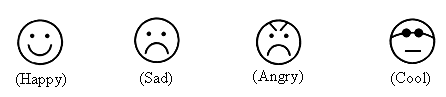
  These days, many forums(论坛)have picture feelings. For example:

  There are even whole new words, like“newbies”(someone who is new on a chat board or forum). When you write something bad about someone else, it’s called“flaming”the person. It takes time for people to get used to(适应)E-talk. Also, different groups on the Net have their own special ways of communicating. Newbies sometimes have to ask other people what they mean. As the Intemet grows, E-talk will continue to grow and change.

根据短文内容选择最佳答案。

(1) Why do people type acronyms?

[  ]

A.To show their feelings.

B.To make jokes.

C.Because people can type them quickly.

(2) What does, BTW, my purer is not working well. :-(mean?

[  ]

A.The person is happy about getting a new computer.

B.The person has to go away from their computer.

C.The person is sad that his computer is having problems.

(3) If someone is angry, what may he type?

[  ]
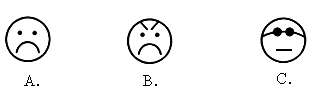
(4) E-talk will probably ________.

[  ]

A.keep changing

B.stay the same

C.be used by people on the telephone

(5) The best title for this passage is ________.

[  ]

A.E-talk

B.Pictnm Feelings

C.How to Use Abbreviations

查看答案和解析>>


同步练习册答案