题目列表(包括答案和解析)
( A )
Cut the Carbon Footprint
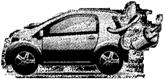 Everything you do leaves a “ carbon footprint”(碳足迹). For example, When you travel in a taxi, the car gives off (排放) CO2 into the air. CO2 is a greenhouse gas. Greenhouse gases make the earth become warm. To protect our environment, we need to leave less of a “carbon footprint”. How big is your carbon footprint? To get an idea, take a look at the following numbers.
Living areas
l TV sets and DVD players produce 723kg of CO2 a year.
l If you turn them off when you’re not using them, you can cut that number by 108kg.
Laundry room (洗衣房)
Drying clothes in a dryer produces a lot of CO2
l If you use your dryer five times per week, you produce 185kg of CO2 per year.
l Dry your clothes in the sun instead.
Bathroom
l If you take an eight-minute shower every day, you produce 616kg of CO2 a year.
l If you only use six minutes to take a shower, you can cut that number by 154kg a year.
根据短文内容,判断下列句子的正误,正确的用“T”,错误的用“F”。 1 CO2 is a greenhouse gas that can make the earth warm.
2 Watching TV and traveling in a taxi can produce little CO2.
3 If we use a dryer five times per week, we produce 154kg of CO2 per year.
4 If we spend less time taking a shower, we can cut the number of CO2.
5 The less of a “ carbon footprint” we leave, the better our environment will become.
( B )
The students of Grade 9 at the Clean City School collect empty bottles. In June, they are going to take them to a recycling centre. They’re going to sell the bottles and buy some books for the school library.
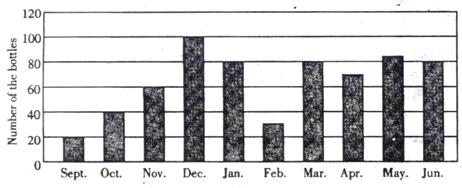
Jimmy has started a graph (图表) to show the number of the bottles they have collected. This is the graph.
|
请根据短文内容,选择最佳答案。
6 How many bottles did the students collect in October?
A. 40 B. 60 C. 75 D. 85
7 The students collected more bottles in December than in February.
A. 60 B. 30 C. 20 D. 70
8 The students collected the same number of bottles in March and .
A. January and November B. January and June
C. May and June D. April and May
9 In which month did the students collect the fewest bottles?
A. September B. October C. February D. December
10 Why do the students collect the empty bottles?
A. Because they are in the Clean City School.
B. Because they are in Grade 9.
C. Because they wanted to start a graph.
D. Because they want to do something good for the school library.
( C )
The world is becoming smaller by using modern traffic, TV, telephone and so on. Life today is easier than it was hundreds of years ago, but it has also brought new problems. One of the biggest is pollution. Pollution comes in many ways. We see it, smell it, drink it and even hear it.
The more people, the more pollution. Many years ago, the problem was not so serious because there were not so many people. Man is now slowly polluting the whole world.
Air pollution is still the most serious. It’s bad to all living things in the world. Water pollution kills our fish and pollutes our drinking water, noise pollution makes us become angry more easily. The pollution of SO2 is now the most dangerous problem of air pollution. It is caused by heavy traffic. It is true that if there are fewer people driving, there will be less air pollution.
Many countries are making rules to fight pollution. They stop people from burning coal in houses and factories in the city. So the less pollution there is, the better life people will have.
请根据短文内容,选择最佳答案。
11Our world is becoming much smaller__________.
A. because of science development B. because there are fewer people
C. because there are more people D. Because the earth is being polluted day and night
12 Hundreds of years ago, life was _________ it is today.
A. easier than B. as easy as C. harder than D. as hard as
13 Pollution comes in many ways . We can even hear it. Here “it” means_______.
A. air pollution B. noise pollution C. water pollution D. soil pollution
14 Air pollution is the most serious kind of pollution because________.
A. it makes much noise B. it’s bad to all living things in the world
C. it has made our rivers and lakes dirty D. it causes unhealthy food
15 Which of the following is NOT true?
A. Many countries are making rules to fight pollution.
B. The pollution of the earth grows as fast as the world’s population does.
C. There will be less air pollution if fewer people drive cars.
D. The problem of pollution is not so serious because there are so many people.
People have used pigeons to carry messages to one another for hundreds of years. In the 12th century, the royal palaces of Iraq and Syria included pigeon houses so the kings could be kept informed of their generals’ victories and defeats on the battlefield. In fact, pigeons were a common way to send messages right up through World War II.
Many countries, such as the United States, England, France, Germany, and Italy, in both World War I and World War II, used carrier pigeons. Not only were the birds often the fastest, most reliable way to send messages, they could also be used to reach soldiers far behind enemy lines, where radios and field telephone lines were useless. Since they could easily be released (释放) from airplanes or ships, every branch of the armed services used the birds. In World War II, more than 3,000 soldiers and 150 officers were needed to care for and train the tens of thousands of birds in the U.S. Pigeon Service.
Carrying messages could be a dangerous job. Some pigeons performed with such bravery that they became famous and were even awarded medals, such as England’s Dicken Medal of Gallantry. In a few cases, pigeons even became prisoners of war. In 1918 American forces captured a pigeon named Kaiser, which had been trained to fly special missions for Germany during battle. He was taken to America, where he lived to the age of 32. The most famous pigeon of all may have been Cher Ami. Stationed in France during World War I, he carried twelve important messages for American forces. On his last mission, though wounded, he carried a message that saved the lives of 194 American soldiers. For his extraordinary service, he was awarded the French “Croix de Guerre.”
Carrier pigeons are a slightly different breed (品种) from the kind of pigeons you see on city streets. They are much thinner and taller, with longer legs. Many people find carrier pigeons ugly because of their big wattle, a bent buildup of skin on the beak(鸟嘴); however, people who raise pigeons often enjoy this strange appearance and consider carriers the best of their breed.
Today, modern communication methods can carry information from one place to another hundreds of times faster than a pigeon could do. However, few people would argue with the fact that carrier pigeons—especially those that served in the military—have earned their place in history. Stories about brave pigeons such as Cher Ami, President Wilson, and Colonel’s Lady have the power to inspire us as no fax machine or high-speed Internet connection could ever do.
【小题1】Many countries used carrier pigeons in the war because_______.
| A.they could be believed in |
| B.they were easily raised |
| C.they could reach the enemy lines |
| D.they could hardly be found by airplanes |
| A.Carrier pigeons could fly to places where radios and telephone lines were useless. |
| B.For his extraordinary service, Cher Ami was awarded the French “Croix de Guerre”. |
| C.In World War II, more than 3,000 soldiers were needed to care for and train the pigeons. |
| D.In the 12th century, kings in Iraq were kept informed of the victories and defeats by pigeons. |
| A.how carrier pigeons developed in history |
| B.how to train carrier pigeons to get victory |
| C.carrier pigeons played an important role in the wars in the old days |
| D.pigeons inspired soldiers to fight before high-speed Internet invented |
People have used pigeons to carry messages to one another for hundreds of years. In the 12th century, the royal palaces of Iraq and Syria included pigeon houses so the kings could be kept informed of their generals’ victories and defeats on the battlefield. In fact, pigeons were a common way to send messages right up through World War II.
Many countries, such as the United States, England, France, Germany, and Italy, in both World War I and World War II, used carrier pigeons. Not only were the birds often the fastest, most reliable way to send messages, they could also be used to reach soldiers far behind enemy lines, where radios and field telephone lines were useless. Since they could easily be released (释放) from airplanes or ships, every branch of the armed services used the birds. In World War II, more than 3,000 soldiers and 150 officers were needed to care for and train the tens of thousands of birds in the U.S. Pigeon Service.
Carrying messages could be a dangerous job. Some pigeons performed with such bravery that they became famous and were even awarded medals, such as England’s Dicken Medal of Gallantry. In a few cases, pigeons even became prisoners of war. In 1918 American forces captured a pigeon named Kaiser, which had been trained to fly special missions for Germany during battle. He was taken to America, where he lived to the age of 32. The most famous pigeon of all may have been Cher Ami. Stationed in France during World War I, he carried twelve important messages for American forces. On his last mission, though wounded, he carried a message that saved the lives of 194 American soldiers. For his extraordinary service, he was awarded the French “Croix de Guerre.”
Carrier pigeons are a slightly different breed (品种) from the kind of pigeons you see on city streets. They are much thinner and taller, with longer legs. Many people find carrier pigeons ugly because of their big wattle, a bent buildup of skin on the beak(鸟嘴); however, people who raise pigeons often enjoy this strange appearance and consider carriers the best of their breed.
Today, modern communication methods can carry information from one place to another hundreds of times faster than a pigeon could do. However, few people would argue with the fact that carrier pigeons—especially those that served in the military—have earned their place in history. Stories about brave pigeons such as Cher Ami, President Wilson, and Colonel’s Lady have the power to inspire us as no fax machine or high-speed Internet connection could ever do.
1.Many countries used carrier pigeons in the war because_______.
A.they could be believed in
B.they were easily raised
C.they could reach the enemy lines
D.they could hardly be found by airplanes
2.Which is the best example to show the bravery of carrier pigeons?
A.Carrier pigeons could fly to places where radios and telephone lines were useless.
B.For his extraordinary service, Cher Ami was awarded the French “Croix de Guerre”.
C.In World War II, more than 3,000 soldiers were needed to care for and train the pigeons.
D.In the 12th century, kings in Iraq were kept informed of the victories and defeats by pigeons.
3.From the passage, we can learn _________.
A.how carrier pigeons developed in history
B.how to train carrier pigeons to get victory
C.carrier pigeons played an important role in the wars in the old days
D.pigeons inspired soldiers to fight before high-speed Internet invented

| A.they could be believed in |
| B.they were easily raised |
| C.they could reach the enemy lines |
| D.they could hardly be found by airplanes |
| A.Carrier pigeons could fly to places where radios and telephone lines were useless. |
| B.For his extraordinary service, Cher Ami was awarded the French “Croix de Guerre”. |
| C.In World War II, more than 3,000 soldiers were needed to care for and train the pigeons. |
| D.In the 12th century, kings in Iraq were kept informed of the victories and defeats by pigeons. |
| A.how carrier pigeons developed in history |
| B.how to train carrier pigeons to get victory |
| C.carrier pigeons played an important role in the wars in the old days |
| D.pigeons inspired soldiers to fight before high-speed Internet invented |
湖北省互联网违法和不良信息举报平台 | 网上有害信息举报专区 | 电信诈骗举报专区 | 涉历史虚无主义有害信息举报专区 | 涉企侵权举报专区
违法和不良信息举报电话:027-86699610 举报邮箱:58377363@163.com