Anthropologists have discovered that fear, happiness, sadness, and surprise are universally reflected in facial expressions.人类学家们已经发现.恐惧.快乐.悲伤和惊奇都会行之于色.这在全人类是共通的. 【查看更多】


题目列表(包括答案和解析)

阅读理解

阅读下列短文,从每题所给的四个选项(A、B、C和D)中,选出最佳答案。

  Although earliest men had little difficulty in judging quantities by naming individual members or items of a group, they weren't, as such, able to count them and would be unable to make the connection between saying three leaves and three apples.

  Anthropologists (人类学家) say that counting methods were extremely basic, with words for “one” and “two”and then a word which just meant “many” (much the same as today we talk about “crowds” of people, “herds” of animals and “handfuls” of sweets.) As recently as 1972, a tribe of cave - dwellers in the Philippines couldn't answer the question “How many people are there in your tribe?”, although they could individually list all 24 members of their group. And one tribe who lives on the edge of the Amazon jungle, even today, has no system of numbers, simply a verb meaning “to be two alike”.

  Some languages still remain some difference between one, two and many, in what is grammatically known as the “dual form”. in Arabic for example “bait” means “house” and “baiten” means “two house”. Similar forms exist in the pronoun “you”, where there is a distinction (区别) between you singular, you two and you many.

  The earliest counting system, binary, was also based on this one two system. Hands and fingers were used to express both numbers and measurements, and the fact that we have ten fingers probably answers the development of the decimal system (十进制), though this doesn't explain the English and American aversion (厌恶) to such a system (one theory is that theyoriginally had 12 fingers!)

  The actual writing of numbers progresses from using notch (刻痕计数) through to symbols. The Arabic system of numbers is now the most widely used, with Roman numerals being for more specialized use.

1.What does the text mainly tell us?

[  ]

A.The origin of counting.

B.The way of counting.

C.The development of counting.

D.The counting and measurement.

2.From the text we know that until now some tribes have been unable to ________.

[  ]

A.judge quantities by naming individual members

B.know how to count in numbers

C.tell their members from those in the other tribes

D.answer the easy questions about leaves and apples

3.The two examples given in the text to show what is grammatically known as the “dual form” are ________.

[  ]

A.English and Arabic
B.house and pronoun
C.similar forms
D.baiten and singular

4.The earliest way to count numbers is to use ________.

[  ]

A.hands and fingers
B.Arabic system.
C.Roman numerals
D.notches

查看答案和解析>>

阅读理解

  If the eyes are the romantic's window into the soul, then the teeth are an anthropologist's(人类学家)door to the stomach.

  Peter Ungar of the University of Arkansas and his partner.Matt Sponhenner of the University of Colorado, US, examined the teeth of ancient hnman beings to find out what they were really eating, according to a.study published in the journal Science.

  They already knew that different foods cause different marks on teeth.Some cause scratches, while others cause pits(坑).The carbon left on teeth by different foods is also different.Tropical(热带的)grasses, for example, leave one kind of carbon, but trees and bushes leave another kind because they photosynthesize(光合作用)differently.

  Traditionally, scientists had looked at the size and shape of teeth and skulls(头骨)to figure out what early humans ate.Big flat teeth were taken to be signs that they ate nuts and seeds, while hard and sharp teeth seemed good for cutting meat and leaves.But this was proven wrong.

  The best example was the Paranthropus(傍人)one of our close cousins, some of which lived in eastern Africa.Scientists used to believe that Paranthropus ale nuts, fruits and seeds because they had big crests(突起)on their skulls, suggesting that they had large chewing muscles(咀嚼肌)and big teeth.If this had been true, their teeth should have been covered with pits like the surface of the moon.They would also have had a- particular type of carbon on their teeth that typically comes from tree products, such as nuts and seeds.

  However, when the two scientists studied the Paranthropus, it turned out to have none of these characteristics.The teeth had a different kind of carbon, and were covered with scratches, not pits.This suggested they probably ate grass, not nuts and fruit stones, it was the exact opposite of what people had expected to find.

  Carbon "footprints" give us a completely new and different insight into what different species ate and the different environments they lived in.If a certain species had the kind of carbon on its teeth that came from grasses, it probably lived in a tropical grassland, for example.

(1)

The underlined sentence in Paragraph 1 probably means that anthropologists can ________.

[  ]

A.

study the structure of human stomachs by studying their teeth

B.

learn whether humans were healthy by looking at their teeth

C.

study the diet of early humans by studying their teeth

D.

get the most useful information about humans from their teeth

(2)

According to Paragraphs 3 to 5, which of the following statements is TRUE?

[  ]

A.

Different foods leave different marks and carbon on teeth.

B.

Early humans with hard and sharp teeth ate meat and leaves.

C.

Pits on teeth are caused by eating grass or leaves.

D.

Scratches on teeth are caused by eating nuts or seeds.

(3)

The example of the Paranthropus was mentioned in the article in order to ________.

[  ]

A.

tell readers that they are one of our dose cousins living in eastern Africa

B.

tell readers they had different eating habits from modern humans

C.

tell readers that living environment makes a difference to skull structure

D.

prove the size and shape of skulls does not show accurately what early humans ate

(4)

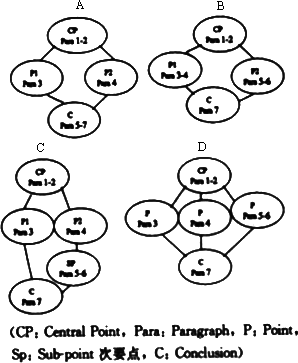
Which of the following shows the best organization of the article?________

查看答案和解析>>

完形填空

  If winning is everything, British anthropologists(人类学家)have some advice:Wear red.Their survey of four sports at the 2004 Olympic Games in Athens shows competitors were more   1   to win their contests   2   they wore red uniforms or red body armor.

  “Across a   3   of sports, we find that wearing red is consistently associated with a higher probability of winning,”report Russell A.Hill and Robert A.Barton of the University of Durham in England.Their findings are in Thursday's   4   of the journal Nature.

  Red is   5   with emotions.When people get   6  , their faces turn red.It’s also a reason why stop signs are red.

    7  , the color’s effect may also subconsciously threaten opponents   8   athletic contests, especially when the athletes are   9   in skill and strength, the researchers suggest.

  In their   10  , the anthropologists analyzed the results of four combat sports at the summer games:boxing, tae kwon do, Greco-Roman wrestling and freestyle wrestling.

  In those  11  , the athletes were randomly(随机地)assigned   12   protective gear and other sportswear.Athletes  13   red gear won more often in 16 of 21 rounds of competition in all four events.

  The effect was the same   14   weight classes, too:19 of 29 classes had more red winners, and only four rounds had more blue winners.The red   15   might also come into play in team sports.

  The anthropologists analyzed the Euro 2004 International Soccer Tournament,   16   which teams wore jerseys of different colors in different matches.They found that five teams   17   more goals and won more often when they wore shirts that were predominantly red, as   18   to blue or white jerseys.

  Scientists don't exactly know how wearing red might give athletes a(n)  19  .But the color delivers hidden messages of vigor and   20  .

(1)

[  ]

A.

possible

B.

probable

C.

likely

D.

like

(2)

[  ]

A.

if

B.

as

C.

until

D.

unless

(3)

[  ]

A.

list

B.

range

C.

bunch

D.

reach

(4)

[  ]

A.

issue

B.

report

C.

magazine

D.

story

(5)

[  ]

A.

regarded

B.

treated

C.

come

D.

associated

(6)

[  ]

A.

angry

B.

pleased

C.

depressed

D.

sad

(7)

[  ]

A.

Naturally

B.

Fortunately

C.

Similarly

D.

Strangely

(8)

[  ]

A.

on

B.

in

C.

with

D.

to

(9)

[  ]

A.

match

B.

different

C.

equal

D.

special

(10)

[  ]

A.

finding

B.

explanation

C.

survey

D.

information

(11)

[  ]

A.

affairs

B.

events

C.

incidents

D.

matters

(12)

[  ]

A.

red

B.

blue

C.

white

D.

colorful

(13)

[  ]

A.

pulling on

B.

putting on

C.

dressing

D.

wearing

(14)

[  ]

A.

because of

B.

instead of

C.

regardless of

D.

as a result of

(15)

[  ]

A.

effect

B.

affect

C.

result

D.

side

(16)

[  ]

A.

on

B.

for

C.

in

D.

about

(17)

[  ]

A.

completed

B.

scored

C.

received

D.

kept

(18)

[  ]

A.

fought

B.

opposed

C.

competed

D.

beat

(19)

[  ]

A.

achievement

B.

chance

C.

comfort

D.

advantage

(20)

[  ]

A.

danger

B.

pleasure

C.

surprise

D.

disappointment

查看答案和解析>>

阅读理解

  The British psychoanalyst John Bowlby argues that separation from the parents during the sensitive“attachment”period from birth to three may scar a child’s personality and be likely to cause emotional problems in later life.Some people have drawn the conclusion from Bowlby’s work that children should not be made to experience day care before the age of three because they have to be separated from their parents if they go to the day care center and many people do believe this.But there are also arguments against such a strong conclusion.

  Firstly, anthropologists(人类学家)point out that the separation between children and parents found in modern societies does not usually exist in traditional societies.For example, in some tribal(部落)societies, such as the Ngoni, the father and mother of a child did not raise their baby alone-far from it.Secondly, common sense tells us that day care would not be so widespread today if parents, care-takers found their children had problems with it.Statistical studies of this kind have not yet been carried out, and even if they were, the results would be certain to be complicated and controversial.Thirdly, in the last decade there have been a number of careful American studies of children in day care, and they have all reported that day care had a neutral or slightly positive effect on children’s development.But tests that have had to be used to measure this development are not widely enough accepted to settle the argument.

  But Bowlby’s analysis raises the possibility that early daycare had delayed effects.The possibility that such day care might lead to, say, more mental illness or crime 15 to 20 years later can only be found out by the use of statistics.Whatever the long-term effects, parents sometimes find the immediate effects difficult to deal with.Children under three are likely to refuse to leave their parents and show unhappiness.At the age of three or three and a half almost all children find the changing from home to nursery(kindergarten)easy, and this is undoubtedly why more and more parents make use of day care at this time.The matter, then, is far from clear, though experience and available evidence indicate that early day care is reasonable for babies.

(1)

In which of the following statements does“scar”have the same meaning as the word“scar”in the first paragraph?

[  ]

A.

Harry Potter is an ordinary boy with a scar on his forehead.

B.

The divorce of his parents scarred the boy, which he couldn’t get over for many years.

C.

The cut on his face scarred over very soon.

D.

After the students’ graduation, the school usually finds the tables scarred with their names.

(2)

Which of the following can be inferred from Bowlby’s work?

[  ]

A.

Mothers should not send their children to day care centers before the age of three.

B.

Day care nurseries have positive effects on a child’s development

C.

A child sent to a day care centre before the age of three may have emotional problems in later life

D.

Day care would not be so popular if it has noticeable negative effects on a child’s personality.

(3)

It is suggested that modern societies differ from traditional societies in that ________.

[  ]

A.

The separation between parents and children happens more often in modern societies.

B.

A child more often grows up with his/her brothers or sisters in traditional societies.

C.

Mother brings up children without the help of her husband in traditional societies

D.

Children in modern societies are more likely to develop mental illness in later years

(4)

Which of the following best expresses the writer’s attitude towards early day care?

[  ]

A.

Children under three should stay with their parents.

B.

Early day care has positive effects on children’s development

C.

There are two different opinions and its settlement calls for the use of statistics.

D.

The effects of early day care on children are exaggerated(夸大)and parents should ignore the problem.

查看答案和解析>>

根据短文内容,从短文后的选项中选出能填入空白处的最佳选项。选项中有两项为多余选项。

  We can read of things that happened 5.000 years ago in the Near East, where people first learned to write.  1   The only way that they can preserve their history is to recount it as sagas-  2   These legends are useful because they can tell us something about migrations of people who lived long ago, but none could write down what they did.Anthropologists(人类学家)wondered where the remote ancestors of the Polynesian peoples now living in the Pacific Islands came from.  3  

  But the first people who were like ourselves lived so long ago that even their sagas, if they had any, are forgotten.  4  

  Fortunately, however, ancient men made tools of stone, because this is easier to shape than other kinds.  5   Stone does not decay, and so the tools of long ago have remained when even the bones of the men who made them have disappeared without trace.

A.They may also have used wood and skins, but these have rotted away.

B.descriptions of what important events happened in ancient times.

C.But there are some parts of the world where even now people can’t write.

D.legends handed down from one generation of story-tellers to another.

E.So scientists have neither history nor legends to help them to find out where the first “modern men” came from.

F.But there is some doubt who began to write.

G.The sagas of these people explain that some of them came from Indonesia about 2,000 years ago.

查看答案和解析>>


同步练习册答案