
3.教育学生要在培养自己的独立思想的同时注意遵守规章制度。
教学重点及难点:
2.通过目标语言的学习,学生学会谈论自己平时需要遵守的规则,并能发表自己的看法或独特见解。
1.词汇:allow, pierce, silly, stay up, drivers’ license earring, strict, concentrate, volunteer,
目标语言:I think sixteen-year-olds should be allowed to drive.
I disagree. I think sixteen is too young.
Do you think thirteen-year-olds should be allowed to have part-time jobs?
No, I don’t.
3. Helping and learning
At our school, we sometimes have a special day/ to help others. Last year/ we went to an old people’s home/ and sang songs/ and performed a play /for them. The old people were very happy. We should be allowed/ to take time/ to do things/ like that/ more often. For example, we should visit primary schools/ and help teach young students. I want to be a teacher/ when I'm older/ so it would be a great experience/ for me. Other students would like to do other jobs. For example, my friend Tian Ge wants/ to write for a newspaper. She should be allowed/ to volunteer/ at the newspaper office/ once a week. On Friday afternoons, many students are sleepy/ after a long week of classes. Some students should be allowed/ to have Friday afternoons off/ to volunteer and help others.
|
Dear Editor, I would like to reply to the article “Helping and Learning” in your last newspaper. I agree with some ideas and disagree with others. The article said that students should be allowed to go to an old people’s home and sing songs and perform a play for them. That is very good for us. We should be allowed to take time to do things like that more often. We should be allowed to visit primary schools and help teach young students. Your article said that helping teach young students would be a great experience for us. I disagree with you on that. Some of us would like to do other jobs than teaching in the future. So helping teach young students at primary schools would be a waste of time for them. For example, my friend Tian Ge wants for a newspaper. People like her should be allowed to volunteer at the newspaper office more often. You said also that students should be allowed to have sleepy Friday afternoons off to volunteer and help others. I do not agree with you on that. We have worked the whole working days. On Friday afternoons we have to take a rest first. We need time to relax ourselves first and then we can do some volunteering work helping others. Sincerely yours, John F. Ken |
Just for fun
To end this busy period we shall take time to learn and read aloud an English poem for kids.
My Feet
My feet, my feet,
I love my feet.
I think they're great,
I think they're neat.
They're pretty, pink,

and picturesque.
They look so perfect
on my desk.
Unfortunately,
sad to tell,
they also have
a funny smell.
So though I'm fast,
and though I'm fleet,
and though at sports
I can't be beat,
no team will pick
me to compete,
because they always
smell defeat.
--Kenn Nesbitt
Reading: Should I be allowed to make my own decisions?
Before you read, go over the new words for this part on 148.
While you read, listen to the recording and underline all the expressions.
Many teenagers have hobbies. But sometimes these hobbies can get in the way of schoolwork, and parents might worry about their child's success at school. Teenagers often think they should be allowed to practice their hobbies as much as they want. Do you agree?
Liu Yu, a fifteen-year-old from Shandong, is a running star. He is in his school running team, and has always wanted to be a professional athlete. However, his parents won't allow him to train as much as he would like to. "Of course we want to see Liu Yu achieve his dreams,” says Mr Liu, “and we know how much he loves running. That's great, and my wife and I watched him in every one of his races. We have nothing against running! But we do think that our son needs to be realistic. Now he is getting older, he needs to think about what will happen if he doesn't become a professional runner in the end.”
Liu Yu doesn't really agree. “Well, I think I should be allowed to make decisions for myself,” he says. “ My parents have always taught me the importance of working hard and not just to do what I enjoy. I understand this. But I'm serious about running. Being a professional runner is the only thing I have ever wanted to do.”
Mr and Mrs Liu believe that Liu Yu should study hard in the evenings, and so they don't allow him to practice running on school nights. “I know this might seem strict,” says Mrs Liu, “but we think we're doing the right thing. He has to understand that very few people can become professional athletes. It's a very difficult dream to achieve. We don't allow him to practice every day because we think he needs to spend time on his homework.”
But Liu Yu still doesn't agree. “I know my parents care about me,” he says. “But they are always talking about what will happen if I don't succeed. But I will succeed! I think I should be allowed to make this decision myself. Only then will I have a chance of achieving my dream.”
After you read, read aloud the text again, to yourself, or to the tape and copy down all the expressions, too.
Part 2: Teaching Resources(第二部分:教学资源)
The Trouble with Teenagers
People now care more about what teenagers are thinking about and feeling because they know there are hard moments in the life of teenagers.
Varieties of troubles are seriously puzzling teenagers, such as hard study, the gap between parents and kids, relationship between themselves and their classmates, teachers and friends.
Among them, the problem of "the generation gap" has become more and more obvious. The argument on this is widely spread. Different people hold different views. But we cannot fail to admit the fact that there are no hearts as delicate as those of teenagers, as everything is happening to them for the first time. Teenagers are certainly different from adults in many ways. They don't know the right way in which they can make everyone happy and satisfied. They are certainly lack of experience. That's why parents are always complaining about their being misunderstood. They say, they love their kids so much as to do everything for them. Is that the true love their children want? No, teenagers say, the true love which they long for should contain courage, correct guide and support instead of endless complaints about marks, marks, marks and strong pressure. So the teenagers are now even said to have been leading a harder life.
The trouble with teenagers is that they haven't learned how to be controlled. Living life right down the middle, with all its attendant landmines, is all they know. It hasn't occurred to them to run in a zigzag pattern.
They are more emotional than people think. If something serious happens to them, they will be deeply hurt. You can always hear the voice from a teenager that they haven't learned enough how to appear to be fine.
The adults have recognized that they should show more care for the teenagers, especially their school life. Teenagers have their own special way of thinking.
I have also got my own troubles. My grandpa passed away in September last year, which has greatly changed my life. He was even one of my best friends ever since I was born. He lived with my family for the past 18 years, the happiest time in his eyes. I have never admitted his death as a fact till now.
Things which happened between us have come to my mind. All over again, I felt those powerful losses crisscrossing my own heart, and I know that when you say goodbye to a beloved grandparent, you say goodbye to something happy, something young in yourself. And that something never really returns and the pain never really goes away.
No matter how hard a life the teenagers are leading, they will forever stand still and march forward straight and bravely.
18.
|
Tapescript Woman:So, what are you doing this afternoon, Anna?  Girl:I’m going to the mall with John. He just got his
driver’s license. Girl:I’m going to the mall with John. He just got his
driver’s license.Woman:I’m sorry. You can’t go with John. I don’t think sixteen-year-olds should be allowed to drive. They aren’t serious enough at that age. Girl:But I have to go to the mall. Gaby’s getting her ears pierced and I want to watch. Woman:I don’t think sixteen-year-olds should be allowed to get their ears pierced. They might be sorry later. Girl:I agree, but it’s fun to watch. Is it OK if we take the bus? Woman:Well, I guess so. Girl:Great! I want to buy a new blouse at the mall, too. Woman:What kind are you going to buy? Maybe I should go with you. Girl:Aw, Mom. I’m not a child. I think teenagers should be allowed to choose their own clothes. Woman:Well, I just want to be sure you get something nice. |
Now try to copy the expressions from the listening tapescript on the blackboard into your notebook.
|
go to the mall
with…, get one’s driver’s license, go with…, allow… to drive, be not serious
enough, at that age, get one’s ears pierced, be allowed to get one’s ears
pierced, be sorry later, it’s fun to watch, it is OK if…, take the bus, guess
so, buy a new blouse at the mall, go with…, should be allowed to choose one’s
own clothes, get something nice |
1c Doing pairwork
In pairs look at the statements in activity 1a and make
conversation. You may use the phrases in the box on page 18
 A: I think teenagers should be allowed to go out with
their friends.
A: I think teenagers should be allowed to go out with
their friends.
B: I agree. They are old enough.
A: I think teenagers should be allowed to go to the mall with their classmates.
A: I think teenagers should be allowed to get their driver’s license.
A: I think teenagers should be allowed to drive.
A: I think teenagers should be allowed to get their ears pierced.
A:I think teenagers should be allowed to watch TV at weekends.
A: I think teenagers should be allowed to take the school bus.
A: I think teenagers should be allowed to buy a new blouse at the mall
A: I think teenagers should be allowed to choose their own clothes.
B: I agree. They are old/ clever/ strong/ bright/ serious/ kind/ careful/ lucky/ enough.
2a Listening and checking
Next we are going to listen and check on page 19 what Kathy thinks. You may circle “Agree”, “Disagree”, or “Doesn’t know” to show what Molly thinks.
|
Tapescript Molly: Larry is working late again tonight, Kathy. Kathy: I know, Molly. I don’t think sixteen-year-olds should be allowed to work at night. Young people need to sleep.  Molly:
I disagree with you.
Teenage boys never get tired. Molly:
I disagree with you.
Teenage boys never get tired.Kathy: Well, maybe. But Larry shouldn’t work every night. Molly: Oh, I agree. He needs time to do homework. Kathy: You know, Molly… he should really cut his hair. Molly: Oh, I disagree. I kind of like it. It looks cool! Kathy: You know what worries me-Larry doesn’t seem to have many friends. Molly: Yeah, I know. I think he shouldn’t work on weekends. Kathy: Oh I agree, Molly. He needs to spend time with friends. Molly: Like you and me? Kathy: Maybe. |
2b Listening and numbering
You are going to listen again to the recording just now to
number Kathy’s and Molly’s reasons in the correct order on
page 19.
Now you shall copy all the important expressions from the listening script.
|
work late, sixteen-year-olds,
be allowed to work at night, disagree with…, get tired, work every night, do homework, cut one’s hair, kind of like…, looks cool, have many friends, work on weekends, spend time with … |
 2c
Doing pairwork
2c
Doing pairwork
Next you are going to make in pairs a list of things teenagers
should and should not be allowed to do. Discuss your list
with your partner.
A: Do you think teenagers should be allowed to drive?
B: Yes, I think so.
A: Do you think teenagers should be allowed to work late at night?
B: No, I don’t think so. I don’t think they should be allowed to work late at night. They need to get enough sleep.
A: Do you think teenagers should be allowed to disagree with their teachers?
B: Yes, I think so.
A: Do you think teenagers should be allowed to get tired doing their homework?
B: No, I don’t think so.
A: Do you think teenagers should be allowed to work every night?
B: Yes, I think so.
A: Do you think teenagers should be allowed to cut one’s hair?
B: Yes, I think so. I kind of like my own style. It looks cool.
A: Do you think teenagers should be allowed to have many friends?
B: No, I don’t think so. They may meet bad people if they have too many friends.
A: Do you think teenagers should be allowed to work on weekends?
B: It depends on what they do. They may spend time with parents on weekends.
 3a Reading and writing
You are to read a dialogue between Sun Fei and Wu Yu on page 20. After reading you shall write in the chart Sun Fei’s and WuYu’s rules. Use “Don’t…” and “You can” to express your ideas.
Jot down all the useful phrases form their dialogue.
|
have a lot of rules, at
one’s house, for example, stay at home, on school nights, study at a friend’s
house, go to the movies, on Friday nights, to be home by 10:00 pm, on
Saturday afternoons, go shopping with…, choose one’s own…, get one’s ears
pierced |
3b Doing pairwork
 In pairs role play the conversation in 3a using the
information in the chart on page 20.
In pairs role play the conversation in 3a using the
information in the chart on page 20.
A: What rules do you have at home?
B: Well, I’m not allowed to go out on school nights. How about you?
A: I’m not allowed to go out on school nights either. But I can watch TV with my sister.
A: What rules do you have at school?
B: Well, We’re not allowed to go out to movies on school nights. How about you?
A: We’re not allowed to go out to movies on school nights either. But We can watch VCD with our teachers on the school playground.
4 Doing groupwork
Turn to page 20 and find someone in your group who has to go home after school, who is allowed to stay up until 11:00 pm, who has to stay at home on school nights, who is allowed to watch TV every night, who had to clean up his room every morning.
 Write
their names in the chart on page 20
Write
their names in the chart on page 20
Closing down by reciting a kid poem
Another kid's poem
There is nothing under the bed
Or on your closet floor,
The monster is inside your head
Don't worry anymore.
 It'll be there every night
In your dreams to give you fright
Every time you turn off the light
As long as you believe it.
There is no monster on the stairs
Nor anywhere down the hall
This old house just settles at night
You hear the creaks, that's all
You think you see a dragon peek
Through the window with a fang-ed beak
And that's why you can't go to sleep
As long as you believe it.
Mama loves you, daddy, too
And you will grow up tall
Nothing's going to happen to you
We'll take care of it all.
You will be a fine young man
A brave little boy who never ran
Whatever you want to do, you can
As long as you believe it.
So listen to me now, you pooh
It's off to sleep right now with you.
Daddy knows what you can do
As long as you believe it.
 SECTION
B
SECTION
B
Goals
●To read about rules of school
●To talk about rules of school
Procedures
Warming up by talking about rules
Hello, class. Are there any rules for us in this class? What are they? How were they made?
Now list some of them and talk about them in pairs.
1a Reading and checking
Read the questions on page 21 and write either “A” for always, “U” for usually, “S” for sometimes or “N” for never.
|
Do
you ever… 1.get to class late? 2.study with friends? 3.finish a test early? 4.worry that you’ll fail a test? 5.go home after school? 6.stay up until 11:00 pm? 7.stay at home on school nights? 8.watch TV every night? 9.clean up his room every morning? |
1b Doing pairwork
In pairs you are to talk about your answers in activity 1a.
|
Do you ever have
your ears pierced? |
Yes, I sometimes have my ears pierced. |
|
Do you ever stay up at weekends’ night? |
Yes, I sometimes stay up at weekends’ night. |
|
Do you ever drive alone? |
Yes, I sometimes drive alone. |
|
Do you ever lose
your driver’s license? |
Yes, I sometimes lose my driver’s license. |
2a Listening and circling
 I am going to play a
dialogue to you. It is between a man and a boy called Peter. They are talking
about a math test. You are to listen and circle the things in activity 1a you
hear. While listening try to note the expressions used.
I am going to play a
dialogue to you. It is between a man and a boy called Peter. They are talking
about a math test. You are to listen and circle the things in activity 1a you
hear. While listening try to note the expressions used.
 Tapescript TapescriptMan: What’s the matter, Peter? Boy: I think I’m going to fail a math test, Dad. Man: You are? Why? Boy: Well, I missed the bus and I had to walk to school. Man: So? Boy: I’m not allowed to get to class late, and there was a big test today. Man: And you weren’t allowed to take the test? Boy: That’s right. But I know I could pass that test. Man: Well, Peter, the school has to have rules, you know. Boy: I know. But I should be allowed to take the test later. It’s not fair. Man: I agree. Maybe you could talk to the teacher after school. Boy: Yeah. Maybe if I explain what happened, she’ll understand. |
 2b Listening and matching
Listen again to the dialogue and match the sentence parts in the box on page 21.
Now copy down the expressions from the dialogue into your notebook. They are shown on the blackboard.
2c Doing group work
Read the statements and discuss them with your group members.
|
1.Peter should be allowed to take the test later. A: I think Peter should not be allowed to take the test later. B: I don’t agree. C: I think he could take it with Class 2 tomorrow. |
|
2.Students need strict rules. … |
|
3.Parents should not be too strict with teenagers. … |
|
4.Mary should not fail a math test. … |
|
5.We will miss the bus. … |
|
6.I have to walk to school. … |
|
7.We can talk to the teacher after school. … |
3a Reading and answering
Next it’s reading time. Let’s read the article on page 22 and answer the questions following it. Try to put the sentences into parts and underline the expressions.
 The other day, my friends
and I/ talked about the rules/ that we have/ in school. At
our school, we have to wear uniforms/ every day. The
problem is that/ all my classmates/ think/ the uniforms are ugly. We think/
young people should look smart/ and so/ we would like to wear our
own clothes. Our teachers believe that/ if we did that, we would concentrate
more on our clothes/ than our studies. We disagree. We would feel more
comfortable/ and that is good/ for studying. If we can't do that, we
should be allowed/ to design our own uniforms. That would be a good
way/ to keep both teachers and students/ happy. It’s also probably a
good idea /for parents/ to allow teenagers/ to study/ in groups/
during evening. I know/ we get noisy sometimes, but/ we learn
a lot /from each other. We also think that/ vacations should be longer. At
present/ they're too short. Longer vacations/ would give us
time/ to do things/ like volunteering. Last summer/ I had
an opportunity/ to volunteer/ at the local hospital, but/ I
couldn’t/ because/ I had to go back to schools. It would be a good experience/
for me/ because I want to be a doctor/ when I'm older. The other day, my friends
and I/ talked about the rules/ that we have/ in school. At
our school, we have to wear uniforms/ every day. The
problem is that/ all my classmates/ think/ the uniforms are ugly. We think/
young people should look smart/ and so/ we would like to wear our
own clothes. Our teachers believe that/ if we did that, we would concentrate
more on our clothes/ than our studies. We disagree. We would feel more
comfortable/ and that is good/ for studying. If we can't do that, we
should be allowed/ to design our own uniforms. That would be a good
way/ to keep both teachers and students/ happy. It’s also probably a
good idea /for parents/ to allow teenagers/ to study/ in groups/
during evening. I know/ we get noisy sometimes, but/ we learn
a lot /from each other. We also think that/ vacations should be longer. At
present/ they're too short. Longer vacations/ would give us
time/ to do things/ like volunteering. Last summer/ I had
an opportunity/ to volunteer/ at the local hospital, but/ I
couldn’t/ because/ I had to go back to schools. It would be a good experience/
for me/ because I want to be a doctor/ when I'm older. |
3b Doing pairwork
 Role play a conversation
using information from 3a.
Role play a conversation
using information from 3a.
A: I think our school rules of always wearing school uniforms at school should be changed.
B: Well, Mary and I talked about the rules the other day.
A: At our school, we have to wear uniforms every day. That is bad for us.
B: Yes, I agree. The problem is that all of us think the uniforms are ugly.
A: I think young people should look smart and so we should be allowed to wear our own clothes.
B: But our teachers believe that if we did that, we would concentrate more on our clothes than our studies.
A: I disagree with them. We would feel more comfortable and that is good for studying. If we can't do that, we should be allowed to design our own uniforms. That would be a good way to keep both teachers and us happy.
B: It’s also probably a good idea for parents to allow us to study in groups during evening.
A: I think so. I know we get noisy sometimes, but we learn a lot from each other.
B: I also think that vacations should be longer.
 A: I agree with you
on that. At present they're too short. Longer vacations would give us time to
do things like volunteering.
A: I agree with you
on that. At present they're too short. Longer vacations would give us time to
do things like volunteering.
B: Last summer I had an opportunity to volunteer at the local hospital, but I couldn’t because I had to go back to schools. It would be a good experience for me because I want to be a doctor when I'm older.
A: Let’s go to talk to our teachers about the school rules after school.
B: OK! I agree with you!
4 Making a list of rules
Suppose you and your friend are starting an English club. Make a list of rules about what should and should not be allowed.
|
1. Members are allowed to work with a group. |
|
2. Members are allowed listen to English. |
|
3. Members are allowed play games with their classmates. |
|
4. Members are allowed do actions such as coloring, matching. |
|
5. Members are allowed sing English songs. |
|
6. Members are allowed to write letters and emails. |
|
7. Members are allowed act out simple dialogues. |
|
8. Members are allowed listen to and understand stories. |
|
9. Members are allowed to
write simple sentences. |
|
10. Members are allowed to imitate from the recording. |
Closing down by learning an English poem
 Get Up! Get Up!
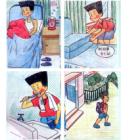
"Get up! Get up! Get out of bed
you lazy bum, you sleepyhead."
Yes, that is what my mother said
at eight-oh-five today.
She left the house and drove to work.
She'll soon be feeling like a jerk
when she finds out -- I have to smirk --
Today is Saturday.
--Kenn Nesbitt
SELF CHECK
1 Filling in blanks
To test your study this week you are to fill in each blank on page 23 with a correct word given. Change the form if it is necessary.
2 Reading and writing
You are going to read the article on page 23 first and then write a letter to the editor agreeing or disagreeing. Explain your reasons.
While you are reading cut the sentences into thought groups and underline the expressions.
8.You have to ______________ (be) 18 before you are allowed to drive.
任务V. 朗读下面的文章。
Should Students Wear School Uniforms?
As we know, wearing school uniforms is indispensable for Japanese students, whereas for American students, it is not such a case, so should Chinese students wear school uniforms?
Some believe in the advantages of wearing school uniforms. Firstly, uniforms can cultivate collective spirit, which is typical of Japanese students. Secondly, schools can be kept in good order with uniform since the outsiders will be recognized immediately. Beside, wearing school uniform can help students develop simple life habits. However, others don’t think so. They claim that wearing school uniform will deprive students of individuality, which is always the source of amazing creativity. As for collective spirit, attending sports games seems to be more effective, and wearing school uniform doesn’t result in simple life habit as we expect.
根据文章,写出赞成与不赞成穿校服的理由。
|
Pro |
con |
|
|
|
任务VI. 针对初三这一年的学习生活,结合自己的理想,谈谈在饮食、健康、学习等方面自己的打算,并给家长或老师写一封信,谈谈自己应该被允许和不被允许做的事情,并阐明理由。
_____________ ,
___________________________________________________________
___________________________________________________________
___________________________________________________________
___________________________________________________________
_______________________________________
_______________

7. I think your father _________________ (be) strict with you!
6. We have a lot of ___________________ (rule) at school.
5. We should pass the test instead of _______________ (fail) the test.
4. Young people need _______________ (sleep) about 8 hours at least.
湖北省互联网违法和不良信息举报平台 | 网上有害信息举报专区 | 电信诈骗举报专区 | 涉历史虚无主义有害信息举报专区 | 涉企侵权举报专区
违法和不良信息举报电话:027-86699610 举报邮箱:58377363@163.com