
2007年5月北京市朝阳区初三年级综合练习(一)
英语试卷
第I卷 选择题(共67分)
第一部分 听力
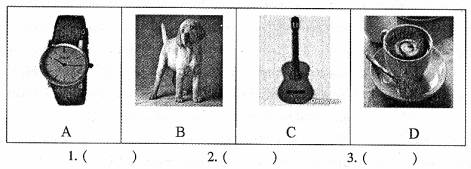
一、听对话,选择与对话内容相符的图片,将代表图片的字母填在相应的序号后。每段对话读两遍。(共6分,每小题1分)
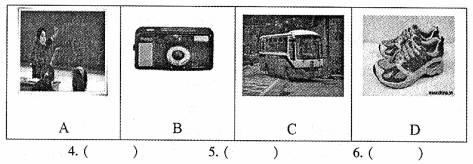
听第二组对话,完成第4~6小题。
听第一段对话,判断第7~8小题。
二、听对话,根据对话内容,判断第7~10小题所给句子的正误。正确的写A,错误的写B。每段对话读两遍。(共4分,每小题1分)
7. The two speakers are in a park.
8. They only want to buy some pictures at the gift shop.
听第二段对话,判断第9~10小题。
9. Linda’s birthday is on Saturday.
10. The party will probably be held in Tony’s house.
听第一段对话,回答第11~12小题。
三、听对话,根据对话内容,从下列各题所给的A、B、C三个选项中,选择最佳选项。每段对话读两遍。(共5分,每小题1分)
11. Where does Kate’s father work?
A. In a bank. B. At school. C. In a company.
12. What does the girl like to do first?
A. Do her homework. B. Go to a concert. C. Practice the guitar.
听第二段对话,回答第13~15小题。
13. Where are the two speakers talking?
A. In an office. B. On the phone. C. At a station.
14. What kind of trip does the man prefer?
A. Five-day trips in spring.
B. Five-day trips in autumn.
C. Ten-day trips in summer.
15. How much will the man pay for the trip?
A. $800. B. $1600. C. $2400.
第二部分 基础知识运用
从下列各题所给的四个选项中,选择正确的一项。
四、单项填空(共18分,每小题1分)
16. ―Hi, John! Please show your new watch.
―Here you are.
A. I B. me C. my D. mine
17. ―When do you usually get up on weekends, Betty?
― eight o’clock in the morning.
A. On B. In C. For D. At
18. ― did you come to school late yesterday, Jim?
―Because my bike was broken.
A. Why B. Where C. What D. Which
19. My mother always wants me more vegetables for dinner.
A. eat B. eating C. eats D. to eat
20. I lost my yesterday, so I didn’t get into my house until my mother came back.
A. bag B. ticket C. key D. money
21. It’s getting dark. You’d better home at once.
A. go B. to go C. went D. going
22. The students will plant trees if it tomorrow.
A. didn’t rain B. hasn’t rained C. won’t rain D. doesn’t rain
23. ―May I put my bike here?
―No, you . Put it over there, please.
A. needn’t B. won’t C. mustn’t D. wouldn’t
24. Mary is a good student. She studies hard she also likes to help others.
A. so B. and C. but D. or
25. The math problem is too hard. students can work it out.
A. Little B. A little C. Few D. A few
26. ―We don’t have enough meat in the fridge.
―I some more in the supermarket soon.
A. buy B. will buy C. buys D. has bought
27. ―I think Tiantan Park is as as Chaoyang Park.
―I agree with you.
A. beautiful B. more beautiful C. most beautiful D. the most beautiful
28. The match is going to begin. Please your sports shoes quickly.
A. put up B. put off C. put on D. put away
29. ―What are the kids doing?
―They flowers in the garden.
A. grow B. will grow C. grew D. are growing
30. Mr. Smith is our English teacher. He in our school since 2002.
A. worked B. has worked C. works D. will work
31. ―Excuse me! Is Mr. Brown in?
―Sorry, I don’t know.
― .
A. You are wrong B. Thank you very much
C. You are welcome D. Thank you all the same
32. ―What did Mr. Wang say to you, Mike?
―He asked me .
A. where my father worked B. where my father will work
C. where did my father work D. where will my father work
33. ―How clean your car is!
―It every day.
A. cleans B. has cleaned C. cleaned D. is cleaned
五、完形填空(共12分,每小题1分)
通读下面短文,掌握其大意,然后从短文后各题所给的四个选项中选择最佳的一项。
When I arrived at Pudong Airport four weeks ago, I took a taxi to the Shanghai Bus Station. The taxi driver 34 very little English but understood that I needed to get to Jiangyin (a city three hours outside Shanghai) that same night. He had picked me up a little after 7 pm. 35 racing through traffic on the road, we arrived at the bus station at 8 pm.
To my surprise, instead of just dropping me off, 36 ran inside to make sure I could make the bus. The station had closed. I didn’t know what to 37 ! My driver spoke with some people outside and then rushed me over to the train station at once. I was to take a train to Wuxi (which is only one half hour away from Jiangyin). From Wuxi I 38 take a taxi to Jiangyin. It was my only hope.
We arrived at the train station minutes later. Again, my driver parked the car and ran inside to get my ticket. When he 39 , we took down my bags and began running to my platform (站台). Suddenly, a police officer appeared and told my driver he could not stay parked where he was. My driver had to stay with 40 . So, I started down the road alone. 200 feet later I was lost, 41 my ticket to strangers, asking in English where I was 42 to go. My train was about to leave. Suddenly there was my taxi driver! He had come back to make sure I had made it safely…which I hadn’t! He showed me where to go and I managed (设法), with his direction, to make it to my platform 43 on time! Only after I was sitting in my seat on the train to Wuxi did I have time to think about what a nice person this taxi driver is. I had only paid for a 44 from the airport to the bus station but, for some reason, he went to a lot of 45 effort (努力) to make sure I got to where I needed to go ---Jiangyin. Without him, my first night in China would have been very terrible.
34. A. read B. spoke C. wrote D. heard
35. A. After B. Before C. Since D. Until
36. A. I B. we C. he D. they
37. A. see B. make C. have D. do
38. A. might B. could C. should D. must
39. A. arrived B. began C. returned D. left
40. A. other drivers B. my bags C. the policeman D. his car
41. A. showing B. giving C. leaving D. sending
42. A. expected B. considered C. supposed D. believed
43. A. still B. also C. even D. just
44. A. ride B. trip C. tour D. distance
46. How many suggestions does the writer give us?
A. One. B. Two. C. Three. D. Four.
47. To buy things we use every day in the supermarket, we have to .
A. pick up a basket B. look up and down
C. walk along the aisles D. keep away from BOGOFs
48. The most expensive things are placed in the places.
A. middle B. high C. low D. near
(B)
Randy Kraus was paralyzed (瘫痪). His left side was useless. But his right hand was good enough to lift a handbag over his head. Once, he had been a police officer in Fresno, California, and owned a small shop. Once, he had been strong and able. Now, he felt he was nothing.
His trouble started with Parkinson’s disease (帕金森病), but it didn’t end there. In July 2002, the 60-year-old Kraus had an operation (手术) to stop him from shaking (抖动). But after the operation he was paralyzed. The man could think but couldn’t move.
“You may never walk again,” the doctor told him. “Maybe you won’t even be able to talk.” At home, he found he couldn’t lift a fork or take a drink by himself. What did he have to live for? So now Kraus held the gun (枪) against his head. Feeling the cold metal on his skin, he began to consider not his pain (疼痛), but the pain he would cause to his wife, daughters and grandchildren. He didn’t pull the trigger (扳机).
And his exercise teacher, Andrew Garud, didn’t let him down. The progress would be slow, but the pain would be real. “As long as you are alive, you are able to get better.”
After three months of work, Kraus wanted to see if he could stand. He could. Then he took three steps, sat down and cried like a baby. One step, as they say, led to another. Next he managed a short walk along the side of a boxing ring in the health club where they worked out. It was the hardest fight of Kraus’ life.
Now, Kraus can brush his teeth, wash his face and get around the house with a walker. Little success only the paralyzed can fully understand.
49. Randy Kraus became paralyzed because of .
A. his work B. his illness C. his shaking D. his age
50. Who stopped Kraus from killing himself?
A. His family members. B. The doctor.
C. The exercise teacher. D. He himself.
51. What does the underlined (划线的) sentence mean?
A. Andrew Garud was praising Kraus.
B. Andrew Garud wanted to make Kraus relaxed.
C. Andrew Garud was encouraging Kraus.
D. Andrew Garud wanted to make Kraus calm.
52. How Kraus is now tells us .
A. he has achieved all he can
B. he has become a little better
C. he has been as slow as before
D. he has got as much as possible
(C)
Few builders or scientists can describe what the house of the future might be like. But Grace can tell you. Grace is a talking house. Her high-tech parts and creative uses of everyday things along with advantages in design will change the way we think about our homes ?and live in them. Grace isn’t the only one study how technology (技术) can make our homes more safe, comfortable and fun. Here are some best ideas of home.
Grace is not a real house. More exactly known as the Microsoft Home, she is set inside an office building in Redmond, Washington. But once inside, it’s easy to imagine you’re in a future home.
Picture this: You enter the house, and Grace’s voice, from unseen speakers, retells your messages. In the kitchen, you put down a bag of flour (面粉) on the top of a stone table. Grace sees what you’re doing and projects a list of flour-based food on the tabletop. Once you choose one, Grace tells a list of ingredients (配料). There’s also a notice board in the kitchen that works like a computer. You can stick up postcards or invitations and look through the Internet with a finger (手指).
“The day when your home will be like a family member is not that far off,” says Pam Heath, a leader at Microsoft. This technology is everywhere yet nowhere (except when we want it). At the Andersen window company in Minnesota, new technology leader, Jay Libby, shows windows made of smart glass that can be changed into a television. “Nobody wants a TV set,” says Libby. “You want the service it provides.” If he gets his way, the term “picture window” will be used instead of usual television.
Home entertainment (娱乐) is just one consideration. At the Georgia University of Technology in Atlanta, scientists are designing systems (系统) that will allow older people to continue living alone. So Grandma’s home can be of different parts, such as waking, sleep and movement; any changes of family members would be noticed by computers.
If we’re going to live in our houses longer, they’ll need to be more flexible (可变的). The Partnership for Advancing Technology in Housing (PATH) is working on houses that can be easily rebuilt. “As family changes, we want to achieve that, so older parents aren’t stuck with a house made for four kids,” says PATH engineer Glen Salas.
53. What is Grace, in fact?
A. A new kind of house in future.
B. A company to make houses.
C. A scientist who designs houses.
D. A built-in computer system.
54. Who probably invented “picture windows”?
A. Andersen. B. Libby. C. Heath. D. Salas.
55. Future homes will be like a family member because .
A. they can make us safe and comfortable
B. they can offer to help us when possible
C. they can look after us in many ways
D. they can do everything a real person does
56. Which of the following can be the greatest character of future houses?
A. Fit for their owners’ need only.
B. Flexible for all kinds of uses.
C. Useful to anybody at any time.
D. Similar to somebody we know.
第II卷 非选择题(共53分)
第四部分 语言运用
Larry is an inventor,
sometimes he works 1 days a week when he’s got an idea.
In the morning,
he makes some 2 after he gets up.
During the daytime,
he doesn’t 3 anything until the evening while working.
In the evening,
he usually 4 at about nine o’clock.
The text mainly tells us
that Larry is good at 5 .
我们班有一个叫Frank的学生。他是个什么样的男孩?他有哪些爱好?他经常帮助父母做哪些家务?请根据所给的提示,选择方框中的词语,并写在答题纸相应的位置上。(只写字母,其中有两个多余选项。)
A. collecting stamps B. water the flowers C. join an English club
D. flying kites E. tall F. having breakfast
G. skating H. sweep the floor I. do the dishes
J. friendly K. hard-working L. wash the clothes
二、词汇(共10分,每空1分)
1. Frank is my classmate. He is , and boy.
2. His hobbies are , and .
四、任务型阅读(共8分,每小题2分)
湖北省互联网违法和不良信息举报平台 | 网上有害信息举报专区 | 电信诈骗举报专区 | 涉历史虚无主义有害信息举报专区 | 涉企侵权举报专区
违法和不良信息举报电话:027-86699610 举报邮箱:58377363@163.com