
Mark often plays football with his classmates. 查看更多


题目列表(包括答案和解析)

Mark began to introduce the guest speaker to the listeners, but then stopped for a while. He had forgotten her name.
Barbara hid her valuable things when she went on vacation. When she came back, she couldn’t remember where she’d put them.
Perhaps you’ve had such experiences like these. Most people have. But most of them haven’t realized that they have a memory problem. Neither do they know a simple but important fact: Memory can be improved. If you just accept that, the following will show you how.
First, relax. If you are over worried about something, you’ll forget it. If you keep telling yourself that your memory is bad, your mind will come to believe it and you won’t remember things. When you forget something, don’t follow up with saying like “Oh, my god! I always forget things! ” Such words will have a bad result on you and your memory.
But relaxing isn’t enough. To improve your memory, you’ll need to take an active role. Like your body, your memory can be made strong through exercise. Look for opportunities to exercise your memory. For example, if you’re learning a language, try to actively remember a lot of new words.
If you don’t take notice of things actively, you won’t remember them. So, you can make pictures of what you see in your mind every day. For example, don’t just put your keys down! If you want to find them again, make a mind picture of the place where you’re putting them.
小题1:The first two paragraphs just tell us ________.
A.examples of memory problems
B.Barbara was a very rich person
C.language problems of two persons
D.Mark often forgot his friends’ names
小题2:When you forget things, you ________.
A.must be too careless
B.must accept the fact
C.shouldn’t lose confidence in your memory
D.should keep telling yourself that your memory is bad
小题3:The underlined word “opportunities” in the fifth paragraph means “________.”
A.chancesB.doctorsC.placesD.projects
小题4:According to the article, ________ can make your memory better.
A.doing sports every day
B.talking to your friends
C.realizing your memory problems
D.making mind pictures of what you see
小题5:The purpose of the article is to help you________.
A.introduce the guest
B.improve your memory
C.remember new words
D.forget unhappy things

查看答案和解析>>

阅读理解。
     Mark Hartmann still couldn't read or write when he was in the third grade. He made loud sounds from his
chair and waved his hands around his head all the time. He couldn't listen for more than two minutes at a time.
Sometimes, he hit the other children. Sometimes, he also hit his teachers.
     Mark Hartmann had autism (孤独症). His brain could not organize (组织) and manage information clearly.
He did not understand the world or the people around him.
     The school principal (校长) said that the other children lost two much learning time when Mark was in
their classroom. She thought Mark could get a better education at a special program nearby. There, teachers
knew how to take care of students with autism.
    But Mark's parents did not want him to go there. In fact, a law was made in 1988. It says that students with
disabilities (残疾) can be in regular (正常的) classes. This gives them the same chances for success as
everyone else.
    The Hartmann used to live in Chicago. Mark went to regular classes there. Mark had help from some special
teachers, and the program was very good for him. "He was part of the school," Mrs. Hartmann told reporters.
"He also learned to hold hands with some of the children in his class."
1. Which of the following is NOT mentioned in the passage?
[     ]
A. Mark couldn't pay much attention in class.
B. He shouted in class.
C. He hit other children and even his teachers.
D. He hit the principal.
2. Paragraph 2 tells us ______.
[     ]
A. Mark often had a bad headache
B. Mark had got a good brain
C. what kind of disease Mark had
D. what Mark's school life was like
3. The principal thought ______.
[     ]
A. Mark shouldn't stay with his class
B. Mark could get on well with his classmates
C. Mark himself wanted to leave school
D. the teachers were not kind enough to Mark
4. The 1988 law says that students with disabilities ______.
[     ]
A. can not have any education
B. can have the same chances as everyone else
C. mustn't stay in regular class
D. should be kept at home by their parents
5. Which is true?
[     ]
A. All teachers were good at teaching children like Mark.
B. Only students with autism could get help from special teachers.
C. Mark still wasn't friendly to the other children.
D. Mark's parents were pleased with Mark's school program in Chicago.

查看答案和解析>>

听力

第一节:听句子,选出与句子内容相关的图画或句子。注意听两遍。(共7小题,每小题1分,满分7分)

1.
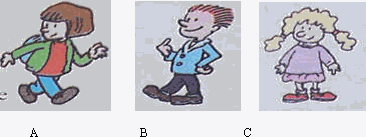
2.
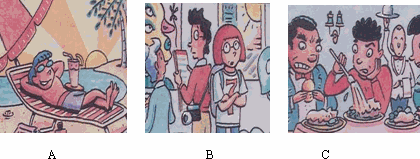
3.
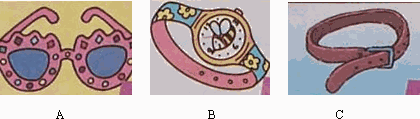
4.
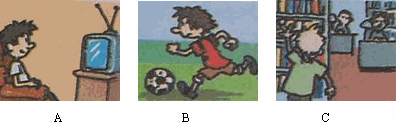
5.A.Linda loves her dog very much.

B.Lily liked collecting stamps.

C.My sister loves bananas very much.

6.A.My friend has nicer clothes than I do.

B.My father wears the same clothes as I do.

C.Mr.Smith is a good teacher.

7.A.In five years, I'll be a doctor.

B.Five years ago, I was in high school.

C.Today, Sally plays the piano.

第二节:根据所听到的句子,选出恰当的应答语。注意听两遍。(共7小题,每小题1分,满分7分)

8.A.Yes, I'd like to.

B.Thanks a lot.

C.Sorry, I can't.

9.A.Sure, here you are.

B.Sorry, here you are.

C.Yes, you have to.

10.A.OK.You go!

B.Good idea!But I must finish my homework first.

C.That sounds boring.I like that.

11.A.At Tokyo.

B.Today is Sunday.

C.It's on the New Year's Day.

12.A.Dogs.

B.Chinese.

C.Apples.

13.A.By train.

B.I had a wonderful time.

C.I'm fine.

14.A.Yes, please.

B.Here you are.

C.It's my pleasure.

第三节:听对话,选择正确答案。注意听两遍。(共6小题,每小题1分,满分6分)

听第一段对话,回答第15-16小题。

15.Would Jack like some apples?

A.Yes, he wants some apples.

B.No, he wants some bananas.

C.Yes, he likes pears.

16.Does Jack like pears?

A.Yes, he does.

B.No, he doesn't.

C.No, he wants pears.

听第二段对话,回答第17-18小题。

17.What does the man want to buy?

A.A white sweater.

B.A yellow shirt.

C.A yellow sweater.

18.How much does the man pay for it?

A.Twenty yuan.

B.Twelve dollars.

C.Twenty dollars.

听第三段对话,回答第19-20小题。

19.What's the time now?

A.7∶00.

B.7∶10.

C.3∶00.

20.Where are the school clothes?

A.Under the chair.

B.On the chair.

C.We don't know.

第四节:听短文,根据短文内容回答问题。注意听三遍。(共5小题,每小题2分,满分10分)

21.Tom has ________ good friends.

A.four

B.two

C.three

22.Jack has been collecting ________.

A.CD players

B.CDs

C.VCDs

23.David thinks collecting stamps can ________.

A.make him feel comfortable

B.help him know about the world

C.make him strong and healthy

24.________ doesn't like sports.

A.Jack and Mark

B.Jack and David

C.David and Tom

25.Mark often ________ when he is free.

A.draws some pictures

B.publishes his photos in newspapers

C.takes some pictures

查看答案和解析>>

Dick and Mark often play table tennis in the school g________.

查看答案和解析>>

阅读下面的短文,然后将划线部分的句子译成汉语或英语。

Mr. and Mrs. Smith come from Sydney(悉尼). 1.They teach English in a school in China. They like their work. 2.They have a son Jim and a daughter Sue. They are all in China now. Mr. Smith can speak Chinese. He likes swimming and reading. Mrs. Smith likes swimming in the afternoon and cooking(做饭). 3. Jim Sue喜欢打网球。They often play tennis with Chinese boys and girls.

Jim’s uncle, Mark, works on a farm(农场)near Sydney. 4.He likes swimming, too. He wants to work in China. 5.但是他不会说中文。 So he is still(仍然) there and goes to Chinese classes every week.


查看答案和解析>>


同步练习册答案