
题目列表(包括答案和解析)
In many countries around the world May 1 is a holiday. Labour Day, or Workers’ Day, is an international holiday that honours working men and women, and the jobs they do.
During the late 1880s, in many parts of the world, people worked for fourteen to sixteen hours a day in factories, and earned very little money. In the United States and Canada, working people got together to try to make their workplaces better. These groups of people formed unions (团体). The union leaders asked company directors for shorter work days and higher salaries (工资), but many of them refused to accept their ideas.
On May 1, 1886, men and women in the United States and Canad a stopped work and marched through cities and towns to try and force bosses to let them work an eight-hour day. In the city of Chicago, several people died in fights with the police. Over the next few years, people in cities around the world stopped working every May 1 to honour workers everywhere. By the early twentieth century, the first of May was a national holiday in many countries.
In the United States and Canada, May 1 is not a holiday. North Americans celebrate Labour Day on the first Monday in September. Today in the Unites States, Labour Day is mostly about having fu n. People enjoy a long weekend, and often celebrate by having barbecues or picnics with friends or family. In many parts of the Unites States, Labour Day is also the last day of summer vacation, and the students return to school the next day.
42. People celebrate Labour Day to honour .
A. union leaders B. working people
C. people died in fights D. workers and their jobs
43. People had to work for over fourteen hours a day.
A. in 1886 B. in the 1880s
C. in the 19th century D. in the early 20th century
44. In Paragraph 2, the underlined word “them” refers to (所指) “ ”.
A. workers B. union leaders C. company directors D. policemen
45. Workers in USA and Canada stopped work for on May 1, 1886.
A. shorter work days B. higher salaries
C. better workplaces D. an eight-hour working day
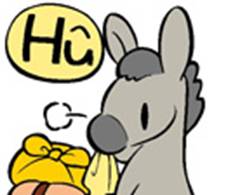
A man bought a donkey at the market one day and took him home. Now the man owned several donkeys already and he knew each one’s character very well. One of the donkeys was very strong and brave. Another always wanted to make people happy by working quickly but soon got tired. One donkey was very lazy. He hated going to work in the morning and he did as little as he possibly could all day long. When the other animals were being loaded up(装载), he always tried to be the last so that he would get the lightest load.
The man led the new donkey into the yard. For a moment the new donkey stood sniffing(闻,嗅) at his new friends. Then, without hesitation, he came up to the lazy donkey and began eating comfortably at his side.
Though it was late in the day, the man immediately led the new donkey out of the yard, straight back to the market.
“You can’t have given him a fair trial yet,” said the seller, “It is only ten minutes since you bought him.”
“I don’t need to try him any more,” replied the man, “I know just what he is like from the friend he chose for himself. Take him away and give me my money back. I can do without donkeys like him.”
1.Why did the man buy a new donkey in the market?
A. Because he liked it.
B. Because he knew the donkey very well.
C. Because he needed another donkey to help him with his work.
D. Because the new donkey wasn’t lazy at all.
2.The man led the new donkey to the yard in order to _______.
A. see if he is lazy
B. let him choose a new friend
C. let the new donkey eat something
D. let him work
3.What’s the meaning of the underline phrase “without hesitation” ?
A.没有吃饭 B.未经许可 C.毫不犹豫地 D. 很不乐意地
4.How did the man know the character of the new donkey?
A. By letting him work
B. By watching how he chose his new friend
C. By leading him to the yard
D. by pleasing people
5.What’s the best title of the story?
A. How To Buy Donkeys B. The Owner and The Donkeys
C. The lazy Donkey D. The Man and The Donkey
Excep t for a few times, Americans are not big present-givers. There's no exchange of presents among business people, and if one American tries to give another a present, it may look like that he wants to bribe (贿赂) him. Americans have learned that in some other countries people like to give presents to others, but among ourselves we don't see the need for presents.
Even friends may never exchange presents. When I go to foreign countries, I try to bring back little things for close friends, but nobody would feel unhappy if I didn't. I don't often remember a friend's birthday, and few people outside of my family remember mine. If someone gave me presents too often, I'd get unpleasant. But a present from a foreigner - that kind from his or her homeland — won't go wrong, except to government employees (政府职员) who can't be given presents.
You usually open a present at once and in front of the person who gives it except Christmas and birthday presents . You should only say, "It's so nice. Thanks…" when you get Christmas or birthday presents.
You may want to bring a bottle of wine (葡萄酒) or flowers to a dinner party, but you're never asked to. Nobody will mind if you bring wine, but your friend may not use it that evening.
At Christmas we often give presents to our family and sometimes our friends. We also give presents to people who have been helpful during the year- doormen, babysitters, housecleaners, newspaper senders— anyone who has often helped us.
( )11. What does "close friends" mean in the passage?
A. The friends who are very kind.
B. The friends who live close to each other.
C. The friends who were once classmates.
D. The friends who you like most.
( )12. What kind of presents don't Americans usually open in front of the givers?
A. The small presents. B. Christmas or birthday presents.
C. The expensive presents. D. The presents for dinner party.
( ) 13. Why do Americans also give presents to housecleaners at Christmas?
A. To pay them. B. To help them.
C. To thank them. D. To make them work harder.
( )14. Which of the following do you think is right?
A. American business people don't want presents because they are rich enough.
B. The w riter of this passage must be an American.
C. Everyone must give presents to one's family and friends at Christmas.
D. Government employees can get little presents from a foreigner.
( )15. What is the main idea of the passage?
A. Present-giving in the United States.
B. Customs (习俗) in the United States.
C. American people and present-giving.
D. When and how to give presents.
(补全单词)Today some film fans always c________ the movie stars that they like.
 not a holiday. North Americans celebrate Labour Day on the first Monday in September. Today in the Unites States, Labour Day is mostly about having fun. People enjoy a long weekend, and often celebrate by having barbecues or picnics with friends or family. In many parts of the Unites States, Labour Day is also the last day of summer vacation, and the students return to school the next day.
湖北省互联网违法和不良信息举报平台 | 网上有害信息举报专区 | 电信诈骗举报专区 | 涉历史虚无主义有害信息举报专区 | 涉企侵权举报专区
违法和不良信息举报电话:027-86699610 举报邮箱:58377363@163.com