
题目列表(包括答案和解析)
A Brown University sleep researcher has some advice for people who run high schools: Don’t start classes so early in the morning. It may not be that the students who nod off at their desks are lazy. And it may not be that their parents have failed to enforce(确保) bedtime. Instead, it may be that biologically(生物学上)these sleepyhead(贪睡者)students aren’t used to the early hour.
“Maybe these kids are being asked to rise at the wrong time for their bodies,” says Mary Carskadon, a professor looking at problem of adolescent (青春期的)sleep at Brown’s School of Medicine.
Carskadon is trying to understand more about the effects of early school time in adolescents. And, at a more basic level, she and her team are trying to learn more about how the biological changes of adolescence affect sleep needs and patterns(方式).
Carskadon says her work suggests that adolescents may need more sleep than they did at childhood, no less, as commonly thought.
Sleep patterns change during adolescence, as any parent of an adolescent can prove. Most adolescents prefer to stay up later at night and sleep later in the morning. But it’s not just a matter of choice---their bodies are going through a change of sleep patterns.
All of this makes the transfer(迁移)from middle school to high school---which may start one hour earlier in the morning----all the more difficult, Carskadon says. With their increased need for sleep and their biological clocks set on the “sleep late, rise late” pattern, adolescents are up against difficulties when they try to be up by 5 or 6 a.m. for a 7:30 a.m. first bell. A short sleep on a desktop may be their body’s way of saying. “I need a timeout.”
1.Carskadon suggests that high schools should not start classes so early in the morning because _______.
A.it is really tough for parents to enforce bedtime
B.it is biologically difficult for students to rise early
C.students work so late at night that they can’t get up early
D.students are so lazy that they don’t like to go to school early
2.The underlined phrase nod off most probably means _______.
A.turn around B.agree with others C.fall asleep D.refuse to work
3.What might be a reason for the hard transfer from middle school to high school?
A.Adolescents depend more on their parents.
B.Adolescents have to choose their sleep patterns.
C.Adolescents sleep better than they did at childhood.
D.Adolescents need more sleep than they used to.
4.What is the test mainly about?
A.Adolescent health care.
B.Problems in adolescent learning.
C.Adolescent sleep difficulties.
D.Changes in adolescent sleep needs and patterns.
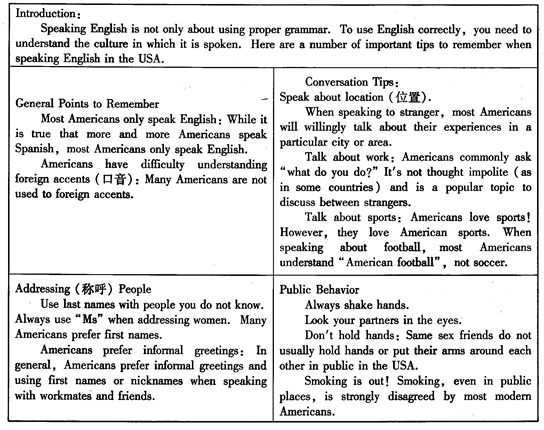
【小题1】 What is necessary to know when we speak English besides using grammar?
| A.Introduction. | B.The culture. | C.Grammar. | D.Topics. |
| A.speak about location | B.talk about sports |
| C.address people | D.talk about work |
| A.Americans shake hands when greeting same sex friends |
| B.different sex friends should hold hands when first meeting |
| C.when you speak to others, it's polite to look into their eyes |
| D.smoking is not allowed in the modem United Sates |
| A.American English Tips. | B.Language Differences. |
| C.The Different Language Culture. | D.American Customs. |
 ⑦
⑦ 和
和 ; ⑧ 和;
My School Day in London
Tim Hunt is telling 1 Chinese classmates about his school day in London.
My school day in London is different 2 my school day here in China. School starts 3 nine o’clock. I get up at 7:00 4 weekdays. I go to school 5 underground(地铁). It 6 about forty–five minutes. I have 7 at school. Classes are over at 3:15. It is early, 8 I stay at school and play games 9 my friends. I am 10 the basketball team. We practice(联系)on Monday 11 Wednesday. We have a match 12 Friday afternoon.
On Saturday 13 I get up late. Then I 14 my parents tidy(弄整洁)the house and the garden. In the evening I often go to film or a club(俱乐部).On Sunday I have a good rest and of course, I do 15.
1. A.he B.him C.his D.their
2. A.from B.in C.of D.at
3. A.for B.at C.on D.in
4. A.for B.of C.on D.in
5. A.in B.on C.by D.with
6. A.goes B.stands C.wants D.takes
7. A.breakfast B.lunch C.dinner D.supper
8. A.and B.but C.or D.so
9. A.and B.but C.with D.about
10. A.in B.on C.at D.of
11. A.to B.and C.at D.with
12. A.on B.in C.at D.for
13. A.morning B.afternoon C.evening D.night
14. A.want B.help C.ask D.tell
15. A.my homeworks B.the homeworks C.my homework D.mine homewok
| 【小题1】 |
|
| 【小题2】 |
|
| 【小题3】 |
|
| 【小题4】 |
|
| 【小题5】 |
|
| 【小题6】 |
|
| 【小题7】 |
|
| 【小题8】 |
|
| 【小题9】 |
|
| 【小题10】 |
|
| 【小题11】 |
|
| 【小题12】 |
|
| 【小题13】 |
|
| 【小题14】 |
|
| 【小题15】 |
|
湖北省互联网违法和不良信息举报平台 | 网上有害信息举报专区 | 电信诈骗举报专区 | 涉历史虚无主义有害信息举报专区 | 涉企侵权举报专区
违法和不良信息举报电话:027-86699610 举报邮箱:58377363@163.com