
题目列表(包括答案和解析)
听力
第一节(共5小题;每小题1.5分,满分7.5分)
听下面5段对话。每段对话后有一个小题,从题中所给的A、B、C三个选项中选出最佳选项。听完每段对话后,你都有10秒钟的时间来回答有关小题和阅读下一小题。每段对话仅读一遍。
1.What does the man want to do?
A.To go out with Sally.
B.To see Sally.
C.To talk to Sally.
2.When will the man be free?
A.On Wednesday afternoon.
B.On Tuesday afternoon.
C.On Wednesday morning.
3.Why is the man so eager to post the letters?
A.He has already delayed posting them.
B.He is asked to post them next morning.
C.He will have no time to do them next morning.
4.What can we learn from the conversation?
A.The fire broke out suddenly.
B.Everything was burnt down in the fire.
C.No one died in the fire.
5.Why are they in such a hurry?
A.They are late for school.
B.They want to catch the train.
C.They don’t want to be late for the party.
第二节(共15小题;每小题1.5分,满分22.5分)?
听下面5段对话或独白。每段对话或独白后有几个小题,从题中所给的A、B、C三个选项中选出最佳选项。听每段对话或独白前,你将有时间阅读各个小题,每小题5秒钟;听完后,各小题将给出5秒钟的作答时间。每段对话或独白读两遍。
听第6段材料,回答第6~8题。
6.How long did the woman work in the travel agency?
A.Two weeks.
B.A few months.
C.A year.
7.Why did Joe go to Canada?
A.To find a job.
B.To spend his holidays.
C.To visit his relatives.
8.What can we learn from the conversation?
A.The man is leaving for Canada too.
B.The man has been in touch with Joe ever since Joe left for Canada.
C.Neither of them has seen Joe for a long time.
听第7材料,回答第9~11题。
9.Where was Colin Boyle born?
A.In Dublin.
B.In London.
C.In Paris.
10.Why wasn’t the woman able to get the tickets for the concert?
A.All tickets were sold out.
B.She is too poor to buy a concert ticket.
C.She couldn’t afford the expensive tickets.
11.How will the woman get the tickets?
A.The singer will give the woman the tickets.
B.The woman will get some tickets at the cheaper price.
C.The concert hall manager will let them in free of charge.
听第8段材料,回答第12~14题。
12.How does the man seem to feel after this interview?
A.Nervous.
B.Hopeful.
C.Sad.
13.How many people were NOT chosen for the second interview?
A.4.
B.8.
C.12.
14.What does the man’s girlfriend want?
A.She hopes to find a job near the man.
B.She hopes the man finds a job near her.
C.She hopes the man gets a job far away from her home.
听第9段材料,回答第15~16题。
15.Who will come to the airport to meet the woman?
A.Her daughter.
B.The managing director.
C.The manager.
16.What is the most probable relationship between the two speakers?
A.Boss and secretary.
B.Workmates.
C.Husband and wife.
听第10段材料,回答第17~20题。
17.Why are Martha’s eyes red?
A.She is sick in her eyes.
B.She is sorry to leave her children.
C.She’s been weeping.
18.What do you know about the children?
A.They still love their father.
B.They know nothing about their parents’ problems.
C.They don’t like to talk to their parents any more.
19.How often can Tony and George see their father in future?
A.Every summer.
B.Twice a month.
C.Every day.
20.What are the parents doing now?
A.They’re quarreling before the children.
B.They’re complaining to the children of their problems.
C.They’re telling the sons their future arrangement.
选做题:听取信息(共5小题;每小题1分,满分5分)?
听下面1段对话或独白。请根据题目要求,从所听到的内容中获取必要的信息,填入标号为*21~*25的空格中。录音读两遍。你有80秒钟的作答时间。
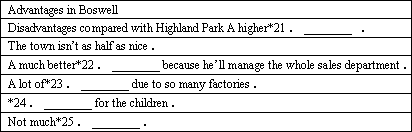
听下面5段对话。每段对话后有一个小题,从题中所给的A、B、C三个选项中选出最佳选项,并标在试卷的相应位置。听完每段对话后,你都有10秒钟的时间来回答有关小题和阅读下一个小题。每段对话仅读一遍。
1.Where does the conversation most probably take place?
[ ]
A.At home.
B.In a car.
C.At the doctor's
2.At what time is the man's flight leaving?
[ ]
A.10:15.
B.9:00.
C.10:50.
3.Why is the man so eager to do the letters?
[ ]
A.He has already delayed posting them.
B.He was asked to post them the next morning.
C.He will have no time to do them the next morning.
4.What can we learn from the conversation?
[ ]
A.The fire broke out suddenly.
B.Everything was burnt down in the fire.
C.No one died in the fire.
5.How much did the man spend for his lunch?
[ ]
A.$ 7.5.
B.$ 6.5.
C.$ 6.
听下面5段对话或独白。每段对话或独白后有几个小题,从题中所给的A、B、C三个选项中选出最佳选项,并标在试卷的相应位置。听每段对话或独白前,你将有时间阅读各个小题,每小题5秒钟;听完后,各小题将给出5秒钟的作答时间。每段对话或独白读两遍。
听第6段材料,回答第6~8题。
6.How long did the woman work in the travel agency?
[ ]
A.Two weeks.
B.A few months.
C.A year.
7.Why did Joe go to Canada?
[ ]
A.To find a job.
B.To spend his holidays.
C.To visit his relatives.
8.What can we learn from their conversation?
[ ]
A.The man is leaving for Canada too.
B.The man has been in touch with Joe ever since Joe left for Canada.
C.Neither of them has seen Joe for a long time.
听第7段材料,回答第9~11题。
9.Where was Colin Boyle born?
[ ]
A.In Dublin.
B.In London.
C.In Paris.
10.Why wasn't the woman able to get tickets for the concert?
[ ]
A.All tickets were sold out.
B.She is too poor to buy a concert ticket.
C.She couldn't afford the expensive tickets.
11.Which of the following is true?
[ ]
A.The singer will give the woman the tickets she needs.
B.The woman will get some tickets at the cheaper price.
C.The concert hall manager will let them in free of charge.
听第8段材料,回答第12~14题。
12.What is the probable relationship between the two speakers?
[ ]
A.A manager and an interviewee.
B.A boss and his secretary.
C.An ad designer and his customer.
13.Which is true of Miss Brown?
[ ]
A.She has just graduated from Peterson Secretary School.
B.She posted the ad in a newspaper.
C.She can do a lot of things besides phoning.
14.What was the result of the interview?
[ ]
A.Miss Brown was given the position.
B.Miss Brown was likely to be refused.
C.Miss Brown was likely to be given the position.
听第9段材料,回答第15~16题。
15.What's happening to Lisa?
[ ]
A.Her father has to go to work in Hangzhou.
B.An accident happened to a friend from Hangzhou.
C.Her family will have to move to Hangzhou.
16.How does Tom feel at the news?
[ ]
A.sad.
B.silly.
C.glad.
听第10段材料,回答第17~20题。
17.Where is Juan?
[ ]
A.in his country.
B.On a plane.
C.In a foreign country.
18.Why is she going abroad?
[ ]
A.To study.
B.To visit his friend.
C.His parents are abroad.
19.What is Juan worried about?
[ ]
A.Flying over an ocean.
B.His family and friends.
C.Whether he will learn enough English.
20.How long is Juan's flight?
[ ]
A.4 hours.
B.3 hours.
C.7 hours.
第一部分:听力(共两节,满分30分)
第一节(共5小题;每小题1.5分,满分7.5分)
听下面5段对话。每段对话后有一个小题,从题中所给的A、B、C三个选项中选出最佳选项。听完每段对话后,你都有10秒钟的时间来回答有关小题和阅读下一小题。每段对话仅读一遍。
1.What does the man want to do?
A.To go out with Sally.
B.To see Sally.
C.To talk to Sally.
2.When will the man be free?
A.On Wednesday afternoon.
B.On Tuesday afternoon.
C.On Wednesday morning.
3.Why is the man so eager to post the letters?
A.He has already delayed posting them.
B.He is asked to post them next morning.
C.He will have no time to do them next morning.
4.What can we learn from the conversation?
A.The fire broke out suddenly.
B.Everything was burnt down in the fire.
C.No one died in the fire.
5.Why are they in such a hurry?
A.They are late for school.
B.They want to catch the train.
C.They don't want to be late for the party.
第二节(共15小题;每题1.5分,满分22.5分)
听下面5段对话或独白。每段对话或独白后有几个小题,从题中所给的A,B,C三个选项中选出最佳选项。听每段对话或独白前,你将有时间听下面一段对话,回答第6至8三个小题。阅读各个小题,每小题5秒钟;听完后,每小题将给出5秒钟的作答时间。每段对话或独白读两遍。
听下面一段对话,回答第6至8三个小题。
6.How long did the woman work in the travel agency?
A.Two weeks.
B.A few months.
C.A year.
7.Why did Joe go to Canada?
A.To find a job.
B.To spend his holidays.
C.To visit his relatives.
8.What can we learn from the conversation?
A.The man is leaving for Canada too.
B.The man has been in touch with Joe ever since Joe left for Canada.
C.Neither of them has seen Joe for a long time.
听下面一段对话,回答第9至11三个小题。
9.Where was Colin Boyle born?
A.In Dublin.
B.In London.
C.In Paris.
10.Why wasn't the woman able to get the tickets for the concert?
A.All tickets were sold out.
B.She is too poor to buy a concert ticket.
C.She couldn't afford the expensive tickets.
11.How will the woman get the tickets?
A.The singer will give the woman the tickets.
B.The woman will get some tickets at the cheaper price.
C.The concert hall manager will let them in free of charge.
听下面一段对话,回答第12至14三个小题。
12.How does the man seem to feel after this interview?
A.Nervous.
B.Hopeful.
C.Sad.
13.How many people were NOT chosen for the second interview?
A.4.
B.8.
C.12.
14.What does the man's girlfriend want?
A.She hopes to find a job near the man.
B.She hopes the man finds a job near her.
C.She hopes the man gets a job far away from her home.
听下面一段对话,回答第15至16两个小题。
15.Who will come to the airport to meet the woman?
A.Her daughter.
B.The managing director.
C.The manager.
16.What is the most probable relationship between the two speakers?
A.Boss and secretary.
B.Workmates.
C.Husband and wife.
听下面一段对话,回答第17至20四个小题。
17.Why are Martha's eyes red?
A.She is sick in her eyes.
B.She is sorry to leave her children.
C.She's been weeping.
18.What do you know about the children?
A.They still love their father.
B.They know nothing about their parents'problems.
C.They don't like to talk to their parents any more.
19.How often can Tony and George see their father in future?
A.Every summer.
B.Twice a month.
C.Every day.
20.What are the parents doing now?
A.They're quarreling before the children.
B.They're complaining to the children of their problems.
C.They're telling the sons their future arrangement.
D
Parties, iPods, concerts, movies, TV shows, video games, traffic. All of these things of the modern world make life entertaining and enjoyable. But our 21st-century lifestyle is also loud and, if we don’t take notice, it can have an effect on our hearing.
Most teenagers don’t think about hearing loss. But if you experience any of the following symptoms(症状), you may already be hearing damaged: you make efforts to hear normal talk, you have to turn up the TV or radio so high that others complain, you watch other people’s expressions to understand what they are saying, you ask people to repeat themselves, you misunderstand what people are saying or you hear ringing in your ears.
iPods and other MP3 players are as common as the clothes you wear, and just as fashionable. But if you turn up an iPod to more than 60 percent of its maximum volume(最大音量), and listen to music for more than an hour, you are asking for trouble. And, it does not matter if the music you play is classical, rock or heavy metal.
Some researchers find that young people who break the so-called 60-percent/60-minute rule in listening to iPods are at the risk of suffering hearing loss.
Why is an iPod dangerous? With ear buds placed directly in the ear canal and high-volume music played over a long period of time, it’s like working in a loud factory all day, being a maintenance(修理)person under a jet airplane or using a jackhammer(手提钻)on a building site.
Similarly, iPod music can cause a short time or permanent(永久的)hearing damage. A loud iPod can cause a ruptured(破裂的)eardrum and, over time, may cause permanent damage to the tiny hairs in the inner ear. If these tiny hairs are damaged, they cannot effectively send sounds to the auditory nerves(听觉神经)that connect to the brain. If this happens, hearing loss becomes permanent.
1.Which of the following shows that you are suffering hearing loss?
A.You are interested to listen to others’ talking.
B.You have to read others’ expressions to understand them.
C.You can only understand others over the phone.
D.You always think you hear the ringing of the phone.
2. Which of the following is TRUE when you listen to music?
A.Listen at least an hour every time.
B.Turn up the volume to the highest level.
C.keep the sound lower than 60% of its highest volume.
D.Choose classical, rock or heavy metal music.
3.What is the correct order of causing permanent hearing loss?
a. The eardrum is broken.
b. The auditory nerves cannot receive sounds.
c. Tiny hairs are damaged.
d. Ear buds are placed directly in the ear canal.
e. High-volume music is played over a long time.
A.d-a-c-b-e B.e-c-a-b-d C.b-c-a-d-e D.d-e-a-c-b
4.This passage is mainly about .
A.music that teenagers like B.hearing problems caused by the loud world
C.ways that teenagers enjoy music D.dangerous modern lifestyles of teenagers.
It is obvious that doctors recognize obesity as a health problem. So why is it so hard for them to talk to their patients about it?
The results of two surveys, one of primary care physicians and the other of patients, found that while most doctors want to help patients lose weight and think it is their responsibility to do so, they often don’t know what to say.
“So while doctors may tell patients they are overweight, the conversation often ends there,” said Christine C. Ferguson, director of the Stop Obesity Alliance. “Patients are not told about the possibility of diabetes (糖尿病),” she said. “And doctors don’t feel they have good information to give. They felt that they didn’t have adequate tools to address this problem.
The lack of dialogue hurts patients, too. The patient survey, of over 1,000 adults, found that most overweight patients don’t even know that they’re too heavy. Only 39 percent of overweight people surveyed had ever been told by a health care provider that they were overweight.
Of those who were told they were obese, 90 percent were also told by their doctors to lose weight, the survey found. In fact most have tried to lose weight and may have been successful in the past—and many are still trying, the survey found. And many understand that losing even a small amount of weight can have a positive impact on their health and reduce their risk of obesityrelated diseases like hypertension and diabetes.
Dr. William Bestermann Jr., medical director of Holston Medical Group, in Kingsport, Tenn. , which ranks the 10th in obesity among metropolitan areas in the United States, said the dialogue had to be an ongoing one and could not be dropped after just one mention of the problem. “If you’re to be successful with helping your patients lose weight, you have to talk to them at actually every visit about their progress, and find something to encourage them and coach them,” he said.
He acknowledged that many doctors tend to be not optimistic.
“Part of this is that there's this common belief, and doctors are burdened by it, too, that overweight people are weak-willed and just don’t have any willpower and are selfindulgent and all that business,” he said. “If you think that way, you’re not going to spend time having a productive conversation.”
1.What is the Stop Obesity Alliance most probably in Paragraph 3?
A. An organization of doctors suffering from obesity.
B. An organization of patients suffering from obesity.
C. A research group that conducts special surveys about overweight people.
D. A research group dealing with doctor-patient relationship.
2.How many of the patients surveyed have been advised by their doctors to lose weight?
A. About 350. B. About 390.
C. About 900. D. About 1,000.
3.What can be inferred about obesity patients in Paragraph 5?
A. They are not as hopeless as doctors think they are.
B. Most of them have tried hard to lose weight, but in vain.
C. Without their doctors’ constant coaching, there is little chance of their succeeding in losing weight.
D. Most of them have just given up their hope of becoming less heavy.
4. According to the passage, which factor contributes to the lack of dialogue between doctors and patients?
A. Most doctors never think of warning their patients about their weight problem.
B. Many doctors find it difficult to persuade overweight people to lose weight.
C. Most patients are too weak-willed to do anything about their weight.
D. Many patients tend not to trust their doctors about their weight problem.
5.Which of the following is the best title of the passage?
A. Obesity in the U. S.
B. Trouble of overweight Americans.
C. Talk more, help better.
D. Doctors or patients---who to bear more blame?[
湖北省互联网违法和不良信息举报平台 | 网上有害信息举报专区 | 电信诈骗举报专区 | 涉历史虚无主义有害信息举报专区 | 涉企侵权举报专区
违法和不良信息举报电话:027-86699610 举报邮箱:58377363@163.com