
题目列表(包括答案和解析)
The dream of flying like Buzz Lightyear never dies. For years, space-age inventors have tested one wearable jet pack after another. And time after time, the designs have been grounded by dangerous fuels, excessive weight, or very loud noise levels. Now a Canadian inventor has sidestepped those weaknesses with an aquatic jet pack. Designed for travel over lakes or oceans, it’s driven by pressurized water, not burning rocket fuel.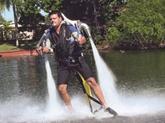
When Raymond Li first told the idea for the aquatic jet pack to his friends, they said he must be nuts. How could a jet pack carry that much water? Its thrust-to-weight rate would be so low and it would never become airborne. Thrust-to-weight rate is a measure of the forward force produced compared with the weight of the vehicle. A vehicle with a low thrust-to-weight rate is relatively heavy for the amount of force it generates.
Li's genius idea was to place the jet pack’s engine and its water pump in a separate boat. The pump would draw water from the lake the boat was floating on. It would then force the water under pressure through a hose connected to the jet pack. The hose would be long enough to let the pack go up as high as 8.5 meters (28 feet) in the air.
Today, Li's invention, the Jetlev-Flyer, is ready to go into production. The pack itself, complete with jet nozzles (管嘴) and handlebars, weighs just 14 kilograms. The  boat is a floating pod. To take off, the operator hits a trigger on a handlebar, which starts the pump, and then turns the throttle. Two streams of high-velocity water shoot through the hose and out the nozzles, lifting the operator into the air. The operator hovers there or pushes down on the handlebars, zooming forward at speeds of up to 64 kilometers per hour, pulling the pod behind.
【小题1】All the following factors contribute to the failure of inventing a wearable jet pack EXCEPT ______.
| A.excessive water | B.unbearable noise | C.unsafe fuels | D.too much weight |
| A.improved | B.reduced | C.avoided | D.solved |
| A.exciting | B.crazy | C.realistic | D.creative |
| A.His friends encouraged him to do the invention. |
| B.He put the engine and its water pump in the same boat. |
| C.The success of his invention lies in his bravery. |
| D.His invention finally succeeded and will go into production. |
| A.c, e, a, d, b | B.c, e, a, b, d | C.e, c, d, b, a | D.e, a, c, d, b |
Make Up Your Mind to Succeed
Kind-hearted parents have unknowingly left their children defenseless against failure. The generation born between 1980 and 2001 grew up playing sports where scores and performance were played down because “everyone’s winner.” And their report cards sounded more positive (正面的) than ever before. As a result, Stanford University professor Carol Dweck, PhD, calls them “the overpraised generation.”
Dweck has been studying how people deal with failure for 40 years. Her research has led her to find out two clearly different mind-sets that have a great effect on how we react to it. Here’s how they work:
A fixed mind-set is grounded in the belief that talent (才能) is genetic – you’re a born artist, point guard, or numbers person. The fixed mind-set believes it’s sure to succeed without much effort and regards failure as personal shame. When things get difficult, it’s quick to blame, lie, and even stay away from future difficulties.
On the other hand, a growth mind-set believes that no talent is entirely heaven-sent and that effort and learning make everything possible. Because the ego (自尊) isn’t on the line as much, the growth mind-set sees failure as a chance rather than shame. When faced with a difficulty, it’s quick to rethink, change and try again. In fact, it enjoys this experience.
We are all born with growth mind-sets. (Otherwise, we wouldn’t be able to live in the world.) But parents, teachers, and instructors often push us into fixed mind-sets by encouraging certain actions and misdirecting praise. Dweck’s book, Mind-set: The New Psychology of Success, and online instructional program explain this in depth. But she says there are many little things you can start doing today to make sure that your children, grandchildren and even you are never defeated by failure.
【小题1】What does the author think about the present generation?
| A.They don’t do well at school. |
| B.They are often misunderstood. |
| C.They are eager to win in sports. |
| D.They are given too much praise. |
| A.doesn’t want to work hard |
| B.cares a lot about personal safety |
| C.cannot share his ideas with others |
| D.can succeed with the help of teachers |
| A.Admitting failure is shameful. |
| B.Talent comes with one’s birth. |
| C.Scores should be highly valued. |
| D.Getting over difficulties is enjoyable. |
| A.Encourage them to learn from failures. |
| B.Prevent them from making mistakes. |
| C.Guide them in doing little things. |
| D.Help them grow with praise. |
Attention to detail is something everyone can and should do — especially in tight job market. Bob Crossley, a human-resources expert notices this in the job applications that come across his desk every day. “It’s amazing how many candidates cross out themselves,” he says.
“Resumes (简历)arrive with faults. Some candidates don’t bother to spell the company’s name correctly. Once I see a mistake, I cross out the candidates,” Crossley concludes. “If they cannot take care of these details, why should we trust them with a job?”
Can we pay too much attention to details? Perfectionists struggle over little things at the cost of something larger they work toward. “To keep from losing the forest for the trees,” says Charles Garfield, the professor at the University of California, San Francisco, “We must constantly ask ourselves how the details we’re working on fit into the larger picture. If they don’t, we should drop them and move to something else.”
Garfield compares this process to his work as a computer scientist at NASA. “The Apollo II moon launch was slightly off course 90 percent of the time,” says Garfield. “But a successful landing was still likely because we knew the exact position of our goal. This allowed us to make adjustments as necessary.” Knowing where to go helps us judge the importance of every task we undertake.
Too often we believe what accounts for others’ success is some special secret or a lucky break. But rarely is success so mysterious. Again and again, we see that by doing little things within our grasp well, large rewards follow.
【小题1】According to the passage, some job applicants were rejected because .
| A.they failed to present resumes that are free of mistakes |
| B.they failed to give a detailed description of their background |
| C.they crossed out their names from the applicants list themselves |
| D.their handwriting on the resume was hard to recognize |
| A.neglect | B.recommend | C.wipe | D.introduce |
| A.trees are as important as forests |
| B.we should pay much attention to details |
| C.we shouldn’t go too far in details to lose our goals |
| D.perfectionists are capable of achieving perfect results |
| A.minor mistakes can be ignored |
| B.failure is the mother of success |
| C.adjustments are the key to the successful completion of any work |
| D.keeping one’s goal in mind helps decide which details can be overlooked |
People who are outdoors in cold weather should avoid actions like suddenly lifting a heavy basket full of snow. Even walking through heavy, wet snow can strain a person’s heart.
Many people aren’t conditioned to the physical stress of outdoor activities and don’t know the dangers of being outdoors in cold weather. Those who like winter sports can suffer accidental hypothermia if they don’t make certain preparations.
Hypothermia means the body temperature has fallen below normal. It occurs when your body can’t produce enough energy to keep the internal (内部的) body temperature warm enough. It can kill you. Heart failure causes most deaths in hypothermia.
Children, the elderly and those with heart disease are at special risk. As people age, their ability to keep a normal internal body temperature often decreases. Elderly people can suffer hypothermia without knowing they’re in danger because they can’t notice the cold conditions as quickly as the young.
Besides cold temperatures, high winds, snow and rain can also steal body heat. Wind is especially dangerous because it removes the layer of heated air from around your body. At 30 degrees Fahrenheit in a 20-mile-per-hour wind, the cooling effect is equal to calm air at four degrees. Similarly dampness (湿气) causes the body to lose heat faster than it would at the same temperature in drier conditions.
To keep warm, wear more clothes. This traps air between layers. Also, wear a hat or head scarf. Much of your body’s heat can be lost through your head. Keep your hands and feet warm, too, as they tend to lose heat rapidly.
Don’t drink alcohol before going outdoors or when outside. Alcohol makes you feel warm at first because blood vessels in the skin expand. But heat is then drawn away from the body’s important organs.
1. The underlined word “strain” in Paragraph 1 means ________.
A. injure B. warm C. control D. burn
2. What is implied in the passage about hypothermia?
| A. | It means the body temperature falls rapidly. |
| B. | Most heart attacks are caused by it. |
| C. | It is not as scary as people think. |
| D. | It can threaten a person’s life. |
| A. | they like exercising outside in cold mornings |
| B. | they can’t notice cold conditions if they are not told |
| C. | their body temperature is generally lower than young people’s |
| D. | their ability to keep a normal internal body temperature is not so good |
| A. | What causes the body to lose heat faster. |
| B. | The advantages of drier conditions. |
| C. | What else can steal body heat. |
| D. | Dangers of high winds. |
| A. | Feeling warm at first |
| B. | The body’s heat is taken away |
| C. | Blood vessels in the skin expand |
| D. | The risk of hypothermia is reduced |
It is difficult for parents of nearly every family to teach their children to be responsible for housework, but with one of the following suggestions, you really can get your children to help at home.
If you give your children the impression that they can never do anything quite right, then they will regard themselves as unfit or unable persons. Unless children believe they can succeed, they will never become totally independent.
My daughter Carla’s fifth grade teacher made every child in her class feel special. When students received less than a prefect test score, she would point out what they had mastered and declared firmly they could learn what they had missed.
You can use the same technique when you evaluate your child’s work at home. Don’t always scold and give lots of praise instead. Talk about what he has done right, not about what he hasn’t done. If your child completes a difficult task, promise him a Sunday trip or a ball game with Dad.
Learning is a process of trying and failing and trying and succeeding. If you teach your children not to fear a mistake of failure, they will learn faster and achieve success at last.
【小题1】The whole passage deals with ________.
| A.social education | B.school education | C.family education | D.pre - school education |
| A.praise his success | B.promise him a trip |
| C.give him a punishment | D.promise him a ball game |
| A.learn from himself, for he has a good way of teaching |
| B.take pride in Carla’s fifth - grade teacher |
| C.do as what Carla’s teacher did in educating children |
| D.follow Carla’s example because she never fails in the test |
| A.pride goes before a fall | B.practice makes perfect |
| C.no pains, no gains | D.failure is the mother of success |
湖北省互联网违法和不良信息举报平台 | 网上有害信息举报专区 | 电信诈骗举报专区 | 涉历史虚无主义有害信息举报专区 | 涉企侵权举报专区
违法和不良信息举报电话:027-86699610 举报邮箱:58377363@163.com