
题目列表(包括答案和解析)
LONDON —A British judge on Thursday sentenced a businessman who sold fake (假冒的)bomb detectors (探测器) to 10 years in prison, saying the man hadn’t cared about potentially deadly consequences.
It is believed that James McCormick got about $77. 8 million from the sales of his detectors — which were based on a kind of golf ball finder — to countries including Iraq, Belgium and Saudi Arabia.
McCormick, 57,was convicted (判罪) of cheats last month and sentenced Thursday at the Old Bailey court in London.
“Your cheating conduct in selling a great amount of useless equipment simply for huge profit promoted a false sense of security and in all probability materially contributed to causing death and injury to innocent people,’’ Judge Richard Hone told McCormick. “You have neither regret, nor shame, nor any sense of guilt.”
The detectors, sold for up to $ 42,000 each, were said to be able to find such dangerous objects as bombs under water and from the air. But in fact they “lacked any grounding in science” and were of no use.
McCormick had told the court that he sold his detectors to the police in Kenya,the prison service in Hong Kong, the army in Egypt and the border control in Thailand.
“I never had any bad results from customers,” he said.
39. Why was McCormick sentenced to prison?
A. He sold bombs. B. He caused death of people.
C. He made detectors. D. He cheated in business.
40. According to the judge, what McCormick had done ________ .
A. increased the cost of safeguarding
B. lowered people’s guard against danger
C. changed people’s idea of social security
D. caused innocent people to commit crimes
41. Which of the following is true of the detectors?
A. They have not been sold to Africa.
B. They have caused many serious problems.
C. They can find dangerous objects in water.
D. They don't function on the basis of science.
42. It can be inferred from the passage that McCormick _________ .
A. sold the equipment at a low price
B. was well-known in most countries
C. did not think he had committed the crime
D. had not got such huge profit as mentioned in the text
【语篇解读】本文是一篇记叙文,题材是新闻报道。本文报道了一条卖假冒炸弹探测器的商人被判10年徒刑的新闻。
| 段落 | 关键词、句 | 大意推测 |
| 第一部分(Para. 1-3) | McCormick, 57,was convicted of cheats last month and sentenced Thursday at the Old Bailey court in London | 新闻案件的简介:57岁的McCormick上月被起诉诈骗并于周三在伦敦的Old Bailey court法庭被判刑。 |
| 第二部分(Para. 4) | cheating conduct, promoted a false sense of security, contributed to causing death and injury to innocent people | 法官宣判:罪犯的欺骗行为增强了人们虚假的安全感并促使导致给无辜百姓带来死亡和伤害。 |
| 第三部分(Para. 5-7) | But in fact they “lacked any grounding in science” and were of no use, sold…to… , never had any bad results | 案件细节及当事人的反诉:假冒炸弹探测器被销往世界各地,但它根本没有科学依据,也毫无用处。罪犯狡辩假冒产品没有给用户带来任何不良后果。 |
【解析】
39. D。细节理解题。难度:中等。问题是“为什么McCormick被判刑入狱”。根据问题中的关键词sentenced to prison定位原文第一段。第一段说到McCormick是一位商人,生产了假冒的炸弹探测器,这是一种商业欺骗。选项D和其对应,为正确答案。
40. B。细节理解题。难度:难。问题是“根据法官的说法,McCormick的所为导致了什么样的结果”。根据问题中的关键词according to the judge定位第四段的第一句:your cheating conduct … promoted a false sense of security and … contributed to causing death and injury to innocent people(你的欺骗行为提高了人们虚假的安全感并助推给无辜百姓带来死亡和伤害)。由此可见,McCormick的行为让人们有了安全感,但这种安全并不真实。B “降低了人们防范危险的安全意识”符合此意,为正确答案。
41. D。判断题。难度:难。问题是“下面哪种说法对探测仪来说是正确的”。
解题思路:根据问题中的关键词detectors,把四个选项具体对应到原文中一处。A对应文章倒数第二段的最后一句he sold his detectors to the police in Kenya,the prison service in Hong Kong, the army in Egypt and the border control in Thailand。该句中的Kenya是非洲的肯尼亚,否定了A的说法。B对应第一段第一句“the man hadn’t cared about potentially deadly consequences”,法官只说罪犯没有关注潜在的致命后果,而不是已经导致严重的问题。C对应第五段的第一句话“were said to be able to find such dangerous objects as bombs under water and from the air”提示,探测仪的功能只是据说,而不一定真的具备找到水中危险物品的功能。选项D定位第五段的最后一句“in fact they ‘lacked any grounding in science’ and were of no use可知,这种探测仪没有科学根据,也毫无用途,和D“没有科学根据的工作原理”相吻合,故最佳答案是D。
42. D。推理判断题。难度:中等。
解题思路:返回原文,将选项与原文一一进行比较。
本题主要考查第四段和第七段。A“以低价销售设备”与原文第四段第一句不符,因为该句提到法官指控McCormick通过卖一些无用的设备来巨额利润。B“在大多数国家很有名”与文中提到的区区几个国家和地区Iraq,Belgium,Saudi Arabia,Kenya,Hong Kong,Egypt和Thailand购买他的探测仪不符。C“认为他没有犯罪”和第七段对应,其中他所说的“I never had any bad results from customers”和C符合,C是正确答案。D“他没有赚取文中提到的那么大利润”在原文没有语言根据。
做题时,先将答案划在试卷上。录音内容结束后,你将有两分钟的时间将试卷上的答案转涂到答题卡上。
第一节 (共5小题;每小题1分,满分5分)
听下面5段对话。每段对话后有一个小题,从题中所给的A、B、C三个选项中选出最佳选项,并标在试卷的相应位置。听完每段对话后,你都有10秒钟的时间来回答有关小题和阅读下一小题。每段对话仅读一遍。
1.Who is sick?
A.Both John and Jack. B.John. C.Jack.
2.What does the man think about those students?
A.He approves of them.
B.He thinks that they deserve the punishment.
C.He feels sorry for them.
3.What can we know from the conversation?
A.The man didn’t phone the woman.
B.The woman forgot to take the book.
C.The woman has taken the book with her.
4.What day is it tomorrow?
A.Thursday. B.Tuesday. C.Monday.
5.What does the man think about driving these days?
A.It is expensive. B.It is difficult. C.It is frightening.
第二节 (共15小题;每题1分,满分15分)
听下面5段对话或独白。每段对话或独白后有几个小题,从题中所给的A,B,C三个选项中选出最佳选项,并标在试卷的相应位置。听每段对话或独白前,你将有时间阅读各个小题,每小题5秒钟;听完后,每小题将给出5秒钟的作答时间。每段对话或独白读两遍。
听第6段材料,回答第6至8题。
6.What were Ben and Mike quarrelling about?
A.About a fighting. B.About Ben’s MP3. C.About Mike’s MP3.
7.What is Mike going to do?
A.He’s going to buy a new MP3.
B.He’s going to fix the broken MP3.
C.He’s going to talk about the MP3 with Ben’s parents.
8.Who may the woman most probably be?
A.Ben’s mother. B.Mike’s mother. C.Ben and Mike’s teacher.
听第7段材料,回答第9至10题。
9.What’s the purpose of the man’s visit?
A.To submit his job application.
B.To be interviewed for a job.
C.To design some children’s clothes.
10.What can we infer from the conversation?
A.The woman seems to be satisfied with the man.
B.The woman will have a further discussion with the man.
C.The woman is a designer in the company.
听第8段材料,回答第11至13小题。
11.Where may the two speakers most probably be?
A.In the office. B.In a clothing factory. C.At home.
12.Who gave the man this piece of cloth?
A.The man’s mother. B.The woman’s mother. C.Their friend’s mother.
13.What is the man going to do tomorrow?
A.To give a lecture. B.To attend a meeting. C.To go to the clothing factory.
听第9段材料,回答第14至17题。
14.What does the man want to do?
A.To return the book Art Theory.
B.To apply for a new library card.
C.To borrow some books.
15.Where does the man live?
A.In the school dorm.
B.At 1423 West Canal Street.
C.At this friend’s house.
16.Checking on her computer, what does the woman discover?
A.The man has changed his name.
B.The man recently moved to a new place.
C.There are two students with the same name.
17.What can we know from the conversation?
A.Books cannot be checked out of the school library.
B.This is the first time that the man has come to this library.
C.The man is doing some research on art.
听第10段材料,回答第18至20题。
18.In which year was the Nobel Prize first a warded?
A.In 1939. B.In 1919. C.In 1901.
19.When did Lessing know that she won the prize?
A.As soon as the news was announced.
B.A few hours after the news was announced.
C.The next day after the new was announced.
20.What are many of her books about?
A.Women’s rights and politics.
B.Science.
C.Her life in Africa.
听力部分(共两节,满分15分)
第一节(共5小题;每小题1分,满分5分)
听下面5段对话。每段对话后有-个小题,从题中所给的A、B、D(三个选项中选出最佳选项。听完每段对话后,你都有10秒钟的时间来回答有关小题和阅读一下小题。每段对话仅读一遍。
1.What is the weather like?
A.It's cloudy.
B.It's windy.
C.It's sunny.
2.What is Mr Jones doing now?
A.He is speaking to the man.
B.He is doing his business
C.He is away for travelling.
3.What does the woman expect Mike to do?
A.Work more on study.
B.Play basketball better.
C.Do more sports.
4.What does the man mean about the air in the city?
A.The air needs improving.
B.The government took actions.
C.The air is being improved.
5.Where does the conversation most probably take place?
A.In a restaurant.
B.In a hospital.
C.At home.
第二节(共10小题;每小题l分,满分15分)
听下面3段对话或独白。每段对话或独白后有几个小题,从题中所给的A、B、C三个选项中选出最佳选项。听每段对话或独白前,你将有时间阅读各个小题。每小题5秒钟;听完后,各小题将给出5秒钟的作答时间。每段对话或独白读两遍。
听第6段材料,回答第6至8题。
6.Where did they stay at night in the country?
A.In a hotel.
B.In farmers’ house.
C.In a camp.
7.How did they have meals every day?
A.Had meals in a hotel.
B.Cooked by themselves.
C.Had meals in farmers’.
8.What was the weather like while travelling?
A.Sunny
B.Rainy.
C.Windy.
听第7段材料,回答9至12题。
9.Why can't the man see clearly today?
A.Because of his bad eyes.
B.Because of bad memory.
C.Because of the sandstorm.
10.Where are the speakers now?
A.In Beijing.
B.In the west.
C.In the south
11.What should people do today when going out?
A.Take an umbrella.
B.Cover their faces.
C.Put on more coats.
12.What does the woman suggest people doing to stop the situation?
A.Keeping nature in balance.
B.Watering the drought(干旱)land.
C.Cutting down the old trees.
听第8段材料,回答第13至15题
13.When will the film at the Grassy Movie start tonight?
A.At 5∶20.
B.At 6∶30.
C.At 7∶00.
14.What does the man suggest doing tonight at last?
A.Stay at home and watch TV.
B.Go to the movie at 7∶00.
C.Have dinner with Ed and Jean.
15.What would they most probably do on Saturday evening?
A.Play tennis.
B.Meet Jean and Ed.
C.Go to the Cinema
听力(共两节,共15分)
第一节(共5小题;每小题1.5分,共7.5分)
听下面5段对话.每段对话后有一个小题,从题中所给的A、B、C三个选项中选出最佳选项,并标在试卷的相应位置.听完每段对话后,你都有10秒钟的时间回答有关小题和阅读下一小题.每段对话仅读一遍.
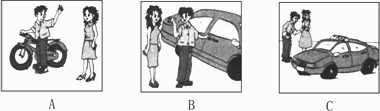
1.How will they go to the railway station?
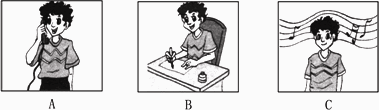
2.What's the man doing?
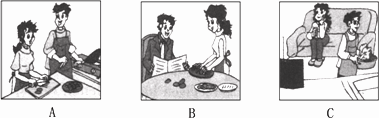
3.What will you see them doing after their talking?
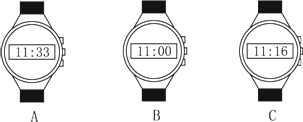
4.What's the correct time now?
5.Where did the woman go?
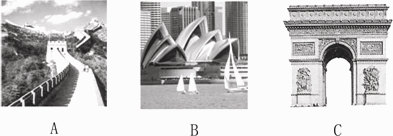
第二节(共5小题;每小题1.5分,共7.5分)
听下面2段对话或独白.每段对话或独白后有几个小题,从题中所给的A、B、C三个选项中选出最佳选项,并标在试卷的相应位置.听每段对话或独白前,你将有时间阅读各个小题,每小题5秒钟;听完后,各小题将给出5秒钟的作答时间.每段对话或独白读两遍.
听第6段对话,回答第6~7题.
6.Where are the speakers?
A.In a cave.
B.In a temple.
C.In a museum.
7.What are they talking about?
A.Some photos.
B.Some old pictures in a book.
C.Some paintings on the wall.
听第7段独白,回答第8~10题.
8.Who designed the Statue of Liberty?
A.A Frenchman.
B.An Englishman.
C.An American.
9.How long did it take to finish the statue?
A.8 years.
B.10 years.
C.12 years.
10.Where was the statue officially presented to America?
A.At the entrance of New York Harbour.
B.In the west of New York Harbour.
C.In the center of New York Harbour.
第一节(本节有5小题,共5分)
听下面5段对话。每段对话后有一个小题,从题中所给的A、B、C三个选项中选出最佳选项,并标在试卷的相应位置。听完每段对话后,你都有10秒钟时间来回答有关小题和阅读下一小题。每段对话仅读一遍。
1.What will the man do this weekend?
A.Go to the concert.
B.Go over his lessons.
C.Take part in a contest.
2.What do we know about the woman?
A.She does not like physics.
B.She's interested in physics.
C.She failed a physics exam.
3.Where will the man have to go to catch the bus?
A.At this bus stop.
B.Across the street.
C.At the next stop.
4.When should the man have arrived?
A.At 6∶00.
B.At 6∶30.
C.At 7∶00.
5.What happened to the woman?
A.She hurt her feet seriously.
B.The man knocked her down.
C.The man stepped on her foot.
第二节(共10小题;每小题1分,满分10分)
听下面3段较长的对话和一段独白。对话后有2-3个小题,独白后有3个小题。请从各题中所给的A、B、C三个选项中选出最佳选项。听对话或独白前,你将有5秒钟阅读每个小题;听完后,每小题将给出5秒钟的作答时间。对话和独白均听两遍。
听第6段材料,回答第6至7题。
6.Where does Mr.Suzuki work?
A.In Workman Company.
B.In Telephone Company.
C.In Video TV.
7.What is Mr.Suzuki's telephone number?
A.447-9662.
B.447-9626.
C.447-9262.
听第7段材料,回答第8至第9题。
8.What did the woman lose?
A.A button.
B.A bag.
C.A letter.
9.Where did the woman lose it?
A.In a shop.
B.In a restaurant.
C.In the street.
听第8段材料,回答第10至第12小题。
10.What topic are the two speakers talking about?
A.Sick animals.
B.Their future plans.
C.Their studies.
11.How soon is the woman going to leave school?
A.In a month.
B.In two months.
C.In two terms.
12.What is a vet?
A.A doctor who treats animals.
B.A stupid doctor.
C.A clerk.
听第9段材料,回答第13至第15小题。
13.Where exactly is the speaker's hometown?
A.On the east coast about 80 miles from Willington.
B.On the west coast about 18 miles from Willington.
C.On the east coast about 18 miles from Willington.
14.What's the population of the town?
A.More than 500, 000.
B.Less than 150, 000.
C.More than 150, 000.
15.What does the speakers do at the hotel?
A.He runs the hotel.
B.He lives at the hotel as a tourist.
C.He helps his father.
湖北省互联网违法和不良信息举报平台 | 网上有害信息举报专区 | 电信诈骗举报专区 | 涉历史虚无主义有害信息举报专区 | 涉企侵权举报专区
违法和不良信息举报电话:027-86699610 举报邮箱:58377363@163.com