
题目列表(包括答案和解析)
阅读理解。从ABCD中选出正确的答案。(每题2分,共40分)
It was a winter morning, just a couple of weeks before Christmas 2005. While most people were warming up their cars, Trevor, my husband, had to get up early to ride his bike four kilometers away from home to work. On arrival, he parked his bike outside the back door as he usually does. After putting in 10 hours of labor, he returned to find his bike gone.
The bike, a black Kona 18 speed, was our only transport. Trevor used it to get to work, putting in 60-hour a week to support his young family. And the bike was also used to get groceries(食品杂货), saving us from having to walk long distances from where we live.
I was so sad that someone would steal our bike that I wrote to the newspaper and told them our story. Shortly after that, several people in our area offered to help. One wonderful stranger even bought a bike, then called my husband to pick it up. Once again my husband had a way to get to and from his job. It really is an honor that a complete stranger would go out of their way for someone they have never met before.
People say that a smile can be passed from one person to another, but acts of kindness from strangers are even more so. This experience has had a spreading effect in our lives because it strengthened our faith in humanity(人性) as a whole. And it has influenced(影响) us to be more mindful(注意的,留神的)of ways we, too, can share with others. No matter how big or how small, an act of kindness shows that someone cares. And the results can be everlasting.
【小题1】Why was the bike so important to the couple?
| A.They used it for work and daily life. |
| B.It was their only possession. |
| C.It was a nice Kona 18 speed. |
| D.The man's job was bike racing. |
| A.go very far to see someone |
| B.walk out on foot to greet someone |
| C.help someone with one’s best |
| D.enjoy the moment with someone |
| A.the couple worked 60 hours a week |
| B.people were busy before Christmas |
| C.the stranger brought over the bike |
| D.life was hard for the young family |
| A.From a stranger. |
| B.From a newspaper. |
C.From TV  news. news. |
| D.From radio broadcasts. |
| A.Strangers are usually of little help. |
| B.One should take care of their bike. |
| C.News reports make people famous. |
| D.An act of kindness can mean a lot. |
阅读下列文,从每题所给的A、B、C、D四个选项中,选出最佳答案。
Rick Stevenson, l6 years old, spends every minute he can on the mountain. He and his friends go snowboarding every weekend. “It's great,” he says, “The winds are so strong, the boards go 50 miles an hour.” His friend Lauer Fields agrees. “No one goes skiing any more,” she says. “That's for the old folks.”
Rick and Laura are part of a new trend in sports. Its philosophy (宗旨) is to get as close to the edge as possible. And more and more young athletes are taking part in these risky (冒险的) activities called “extreme sports” or “X-sports.”
In the past, young athletes would play baseball. Today, they want risk and excitement -the closer to the edge, the better. They snowboard over cliffs and mountain-bike down steep mountains. They windsurf near hurricanes and bungy-jump from towers.
Extreme sports started as an alternative (选择余地) to more expensive sports such as golf. A city kid who didn't have the money to buy expensive sports equipment could get a skateboard and have fun. But now it has become a whole new area of sports, with specialized equipment and high levels of skill. There's even a special Olympics for extreme sports, called the Winter X-Games, which includes snow mountain biking and ice climbing.
What makes extreme sports so popular? “People love the risk,” says Murray Nussbaum, who sells sports equipment. “City people want to be outdoors on the weekend and do something challenging. The new equipment is so much better that people can take more risks without getting hurt.” An athlete adds, “Sure there's a risk. Once you go mountain biking or snowboarding, it's impossible to go back to bike riding or skiing. It's just too boring.”
Now even the older crowd is starting to join in. Every weekend a group of friends in their early 30s get together. During the week they work as computer programmers in the same office. On Sundays they rent mountain bikes that cost $ 2000 each and ride down steep mountains together. Extreme sports are certainly not for everyone.
Most people still prefer to play basketball or watch sports on TV. But extreme sports are definitely gaining in popularity. “These sports are fresh and exciting. It's the wave of the future,” says Nussbaum.
1.What would be the best title for the passage?
A. Rick Stevenson
B. People's Love for Risk
C. X-Sports
D. The Wave of the Future
2.It is clear from the passage that extreme sports are ________.
A. exciting but risky
B. popular but old
C. special but dangerous
D. inexpensive but challenging
3.Which of the four pictures does not describe extreme sports?
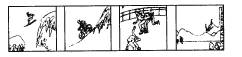
4.Generally speaking, ________ are unfit for extreme sports by inference from the passage.
A. city teenagers
B. the aged people
C. office workers
D. high school students
阅读下列文,从每题所给的A、B、C、D四个选项中,选出最佳答案。
The case for college has been accepted without question for more than a generation. All high school graduates ought to go, because college will help them earn more money, become “better” people, and learn to be more responsible citizens than those who don't go.
But college has never been able to work its magic for everyone. And now that close to half our high school graduates are attending, those who don't fit the pattern are becoming more and more, and more obvious. College graduates are selling shoes and driving taxis; college students get in the way of each other's experiments and write false letters of recommendation (推荐) in the competition for admission to graduate school. Others find no interest in their studies and drop out—often encouraged by college administrators (教导主任).
Some observers say the fault is with the young people themselves-they are spoiled and they are expecting too much. But that is a condemnation (谴责) of the students as a whole, and does not explain all campus unhappiness. Others blame the state of the world, and they are partly right. We've been told that young people have to go to college because our economy cannot take in an army of untrained eighteen-year-olds. But disappointed graduates are learning that it can no longer take in an army of trained twenty-two-year-olds, either.
Some adventuresome educators and campus watchers have openly begun to suggest that college may not be the best, the proper, the only place for every young person after the completion of high school. We may have been looking at all those surveys (调查) upside down, it seems, and thinking of the rosy glow of our own remembered college experiences. Perhaps college does not make people intelligent (clever) , ambitious, happy, liberal, or quick to learn things-maybe it is just the other way round, and intelligent, ambitious, happy, liberal, quick-learning people are only the ones who have been attracted to college in the first place. And perhaps all those successful college graduates would have been successful whether they had gone to college or not. This is heresy (异端邪说) to those of us who have been brought up to believe that if a little schooling is good, more has to be much better. But opposite evidence is beginning to mount up.
1.According to the passage all the following statements are true EXCEPT that ________.
A. about half of the high school graduates continue their studies in colleges
B. college graduates are believed to be able to earn more money
C. administrators often encourage college students to drop out
D. more and more young people are found unfit for college
2.Which of the following is one of some observers' opinions?
A. The students expect so much that they are not satisfied with the hard college life.
B. The economic situation is so discouraging that the youth have to attend college.
C. Colleges should improve because of so much campus unhappiness.
D. Colleges provide more chances of good jobs than anywhere else.
3.What does the underlined sentence in Paragraph 4 mean?
A. Our college experiences prove that those surveys are incorrect.
B. The surveys may remind us of our beautiful college experiences.
C. The surveys should all be reexamined according to our college experiences.
D. Our college experiences may make us misunderstand the results of the surveys.
4.What is the main purpose of this passage?
A. To value young people's further education in colleges.
B. To put forward an idea that college should not be the first choice.
C. To argue against the idea that college is the best place for all young people.
D. To persuade young people into working after the completion of high school.
阅读理解
阅读下列文,从每题所给的A、B、C、D四个选项中,选出最佳答案。
Rick Stevenson, l6 years old, spends every minute he can on the mountain. He and his friends go snowboarding every weekend. “It's great,” he says, “The winds are so strong, the boards go 50 miles an hour.” His friend Lauer Fields agrees. “No one goes skiing any more,” she says. “That's for the old folks.”
Rick and Laura are part of a new trend in sports. Its philosophy (宗旨) is to get as close to the edge as possible. And more and more young athletes are taking part in these risky (冒险的) activities called “extreme sports” or “X-sports.”
In the past, young athletes would play baseball. Today, they want risk and excitement -the closer to the edge, the better. They snowboard over cliffs and mountain-bike down steep mountains. They windsurf near hurricanes and bungy-jump from towers.
Extreme sports started as an alternative (选择余地) to more expensive sports such as golf. A city kid who didn't have the money to buy expensive sports equipment could get a skateboard and have fun. But now it has become a whole new area of sports, with specialized equipment and high levels of skill. There's even a special Olympics for extreme sports, called the Winter X-Games, which includes snow mountain biking and ice climbing.
What makes extreme sports so popular? “People love the risk,” says Murray Nussbaum, who sells sports equipment. “City people want to be outdoors on the weekend and do something challenging. The new equipment is so much better that people can take more risks without getting hurt.” An athlete adds, “Sure there's a risk. Once you go mountain biking or snowboarding, it's impossible to go back to bike riding or skiing. It's just too boring.”
Now even the older crowd is starting to join in. Every weekend a group of friends in their early 30s get together. During the week they work as computer programmers in the same office. On Sundays they rent mountain bikes that cost $ 2000 each and ride down steep mountains together. Extreme sports are certainly not for everyone.
Most people still prefer to play basketball or watch sports on TV. But extreme sports are definitely gaining in popularity. “These sports are fresh and exciting. It's the wave of the future,” says Nussbaum.
1.What would be the best title for the passage?
A. Rick Stevenson
B. People's Love for Risk
C. X-Sports
D. The Wave of the Future
2.It is clear from the passage that extreme sports are ________.
A. exciting but risky
B. popular but old
C. special but dangerous
D. inexpensive but challenging
3.Which of the four pictures does not describe extreme sports?
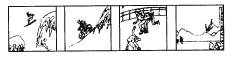
4.Generally speaking, ________ are unfit for extreme sports by inference from the passage.
A. city teenagers
B. the aged people
C. office workers
D. high school students
阅读理解
阅读下列文,从每题所给的A、B、C、D四个选项中,选出最佳答案。
The case for college has been accepted without question for more than a generation. All high school graduates ought to go, because college will help them earn more money, become “better” people, and learn to be more responsible citizens than those who don't go.
But college has never been able to work its magic for everyone. And now that close to half our high school graduates are attending, those who don't fit the pattern are becoming more and more, and more obvious. College graduates are selling shoes and driving taxis; college students get in the way of each other's experiments and write false letters of recommendation (推荐) in the competition for admission to graduate school. Others find no interest in their studies and drop out—often encouraged by college administrators (教导主任).
Some observers say the fault is with the young people themselves-they are spoiled and they are expecting too much. But that is a condemnation (谴责) of the students as a whole, and does not explain all campus unhappiness. Others blame the state of the world, and they are partly right. We've been told that young people have to go to college because our economy cannot take in an army of untrained eighteen-year-olds. But disappointed graduates are learning that it can no longer take in an army of trained twenty-two-year-olds, either.
Some adventuresome educators and campus watchers have openly begun to suggest that college may not be the best, the proper, the only place for every young person after the completion of high school. We may have been looking at all those surveys (调查) upside down, it seems, and thinking of the rosy glow of our own remembered college experiences. Perhaps college does not make people intelligent (clever) , ambitious, happy, liberal, or quick to learn things-maybe it is just the other way round, and intelligent, ambitious, happy, liberal, quick-learning people are only the ones who have been attracted to college in the first place. And perhaps all those successful college graduates would have been successful whether they had gone to college or not. This is heresy (异端邪说) to those of us who have been brought up to believe that if a little schooling is good, more has to be much better. But opposite evidence is beginning to mount up.
1.According to the passage all the following statements are true EXCEPT that ________.
A. about half of the high school graduates continue their studies in colleges
B. college graduates are believed to be able to earn more money
C. administrators often encourage college students to drop out
D. more and more young people are found unfit for college
2.Which of the following is one of some observers' opinions?
A. The students expect so much that they are not satisfied with the hard college life.
B. The economic situation is so discouraging that the youth have to attend college.
C. Colleges should improve because of so much campus unhappiness.
D. Colleges provide more chances of good jobs than anywhere else.
3.What does the underlined sentence in Paragraph 4 mean?
A. Our college experiences prove that those surveys are incorrect.
B. The surveys may remind us of our beautiful college experiences.
C. The surveys should all be reexamined according to our college experiences.
D. Our college experiences may make us misunderstand the results of the surveys.
4.What is the main purpose of this passage?
A. To value young people's further education in colleges.
B. To put forward an idea that college should not be the first choice.
C. To argue against the idea that college is the best place for all young people.
D. To persuade young people into working after the completion of high school.
湖北省互联网违法和不良信息举报平台 | 网上有害信息举报专区 | 电信诈骗举报专区 | 涉历史虚无主义有害信息举报专区 | 涉企侵权举报专区
违法和不良信息举报电话:027-86699610 举报邮箱:58377363@163.com