
题目列表(包括答案和解析)
At a primary school in a small town in the east of South Carolina, second-grade teachers Garneau and Lynne are convinced that separating elementary-age boys and girls produces immediate academic improvement in both genders(性别).
David Chadwell, South Carolina’s coordinator of single gender education says, “Boys and girls learn, hear and respond to their surroundings differently. We can teach boys and girls based on what we now know.”
Male and female eyes are not organized in the same way, he explains. The composition of the male eye makes it sensitive to motion and direction. “Boys interpret the world as objects moving through space,” he says.
The male eye is also drawn to cooler colors like silver and black. It’s no accident boys tend to create pictures of moving objects instead of drawing the happy colorful family, like girls do in their class.
The female eye, on the other hand, is drawn to warmer colors like red, yellow and orange. To attract girls, Chadwell says, the teacher doesn’t need to move as much as in boy’s class. Using descriptive phrases and lots of colors in presentations or on the blackboard gets their attention.
Boys and girls also hear differently. “When someone speaks in a loud tone, girls interpret it as yelling,” Chadwell says. “They think you’re mad and can shut down.” Girls are more sensitive to sounds. He advises girls’ teachers to watch the tone of their voices. Boys’ teachers should sound more forceful, even excited.
A boy’s nervous system causes him to be more cautious when he is standing, moving, and the room temperature is around 69 degrees Fahrenheit. Stress in boys, he says, tends to increase blood flow to their brains, a process that helps them stay focused. Girls are more focused when seated in a warmer room around 75 degrees Fahrenheit. Girls also respond to stress differently. When exposed to threat and conflict, blood goes to their guts(肠道), leaving them feeling nervous or anxious.
These differences can be applied in the classroom, Chadwell adds. “Single gender programs are about maximizing the learning.”
1.What is David Chadwell’s attitude toward separating elementary-age boys and girls
while learning?
A. Supportive B. Worried C. Concerned D. Uninterested
2. To engage boy in a class, the teacher ______.
A. must have a moving object in this hand B. needs to wear clothes in warm color
C. has to speak politely D. had better move constantly while teaching
3. Which of the following shows the organization of the passage?
(= Paragraph 1 ‚= Paragraph 2 ƒ= Paragraph 3 ….. ˆ= Paragraph 8)
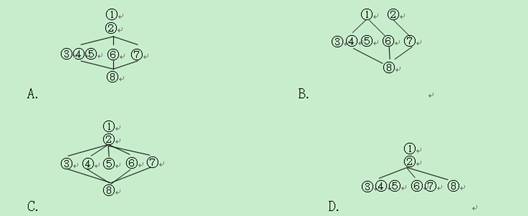

4. Which of the following is the best title of the passage?
A. Ways of teaching boys and ways of teaching girls
B. Boys and girls should be separated
C. How boys and girls learn differently
D. How to teach more effectively
At a primary school Manning, Carolina, second-grade teacher David Chadwell believed that segregating(隔离) elementary-age boys and girls produces immediate academic improvement—in both genders. “Although this is a tendency, we can teach boys and girls based on what we now know.”
“They see differently. Literally,” he begins. Male and female eyes are not organized in the same way, he explains. The composition of the male eye makes it attuned(协调) to motion and direction. “Boys interpret the world as objects moving through space,” he says. “The teacher should move around the room constantly and be that object.”
The male eye is also drawn to cooler colors like silver, blue, black, grey, and brown. It’s no accident boys tend to create pictures of moving objects like spaceships, cars, and trucks in dark colors instead of drawing the happy colorful family, like girls in their class.
The female eye, on the other hand, is drawn to textures and colors. It’s also oriented toward warmer colors—reds, yellows, oranges—and visuals with more details, like faces. To engage girls, Chadwell says, the teacher doesn’t need to move as much, if at all. Girls work well in circles, facing each other. Using descriptive phrases and lots of color in overhead presentations or on the chalkboard gets their attention.
Boys and girls also hear differently. “When someone speaks in a loud tone, girls interpret it as yelling,” Chadwell says. “They think you’re mad and can shut down.” Girls have a more finely tuned aural structure; they can hear higher frequencies than boys and are more sensitive to sounds. He advises girls’ teachers to watch the tone of their voices. Boys’ teachers should sound matter of fact, even excited.
A boy’s autonomic nervous system causes them to be more alert when they’re standing, moving, and the room temperature is around 69 degrees. Stress in boys, he says, tends to increase blood flow to their brains, a process that helps them stay focused. This won’t work for girls, who are more focused seated in a warmer room around 75 degrees. Girls also respond to stress differently. When they are exposed to threat and confrontation, blood goes to their guts(内脏), leaving them feeling nervous or anxious.
“Boys will rise to a risk and tend to overestimate their abilities,” he says. “Teachers can help them by getting them to be more realistic about results. Girls at this age shy away from risk, which is exactly why lots of girls’ programs began in the private sector. Teachers can help them learn to take risks in an atmosphere where they feel confident about doing so.”
Title: Primary students learn
David’s belief ,Once we segregate elementary-age students, they will have the tendency to learn . Differences between boys and girls, Sight ,Boys’ eyes are sensitive to . and are drawn to cooler colors.
It is textures and of objects that attract girls. Hearing ,Comparatively speaking, girls can hear and are more sensitive to sounds. They would interpret a loud tone as .Nervous system, Stress in boys tends to increase blood flow to their , which helps them keep . Boys often overestimate their abilities and are brave in face of the risk.
When girls are exposed to , blood goes to their guts, leaving them feeling . Girls at this age in many cases will shyly avoid dealing with risk. SECTION B (10 marks)
Jude, seated in a chair and lost in thought, gave me a sudden look, as if_______ , “Are you kidding?”
A. to say B. to have said C. said D. to be saying
At a primary school in a small town in the east of South Carolina, second-grade teachers Garneau and Lynne are convinced that separating elementary-age boys and girls produces immediate academic improvement in both genders(性别).
David Chadwell, South Carolina’s coordinator of single gender education says, “Boys and girls learn, hear and respond to their surroundings differently. We can teach boys and girls based on what we now know.”
Male and female eyes are not organized in the same way, he explains. The composition of the male eye makes it sensitive to motion and direction. “Boys interpret the world as objects moving through space,” he says.
The male eye is also drawn to cooler colors like silver and black. It’s no accident boys tend to create pictures of moving objects instead of drawing the happy colorful family, like girls do in their class.
The female eye, on the other hand, is drawn to warmer colors like red, yellow and orange. To attract girls, Chadwell says, the teacher doesn’t need to move as much as in boy’s class. Using descriptive phrases and lots of colors in presentations or on the blackboard gets their attention.
Boys and girls also hear differently. “When someone speaks in a loud tone, girls interpret it as yelling,” Chadwell says. “They think you’re mad and can shut down.” Girls are more sensitive to sounds. He advises girls’ teachers to watch the tone of their voices. Boys’ teachers should sound more forceful, even excited.
A boy’s nervous system causes him to be more cautious when he is standing, moving, and the room temperature is around 69 degrees Fahrenheit. Stress in boys, he says, tends to increase blood flow to their brains, a process that helps them stay focused. Girls are more focused when seated in a warmer room around 75 degrees Fahrenheit. Girls also respond to stress differently. When exposed to threat and conflict, blood goes to their guts(肠道), leaving them feeling nervous or anxious.
These differences can be applied in the classroom, Chadwell adds. “Single gender programs are about maximizing the learning.”
1.What is David Chadwell’s attitude toward separating elementary-age boys and girls while learning?
A. Supportive B. Worried C. Concerned D. Uninterested
2. To engage boy in a class, the teacher ______.
A. must have a moving object in this hand B. needs to wear clothes in warm color
C. has to speak politely D. had better move constantly while teaching
3.Which of the following shows the organization of the passage?
(= Paragraph 1 ‚= Paragraph 2 ƒ= Paragraph 3 ….. ˆ= Paragraph 8)
C. 
 D.
D.


4.Which of the following is the best title of the passage?
A. Ways of teaching boys and ways of teaching girls
B. Boys and girls should be separated
C. How boys and girls learn differently
D. How to teach more effectively
5.Which of the following students is most likely to be focused?
A. A boy sitting in a warm room B. A standing boy who is faced with stress
C. A girl standing in a cold room D. A girl who is facing a lot of pressure
Jude, seated in a chair and lost in thought, gave me a sudden look, as if _________, “Are you kidding?”
A. to say B. to have said C. said D. to be saying
湖北省互联网违法和不良信息举报平台 | 网上有害信息举报专区 | 电信诈骗举报专区 | 涉历史虚无主义有害信息举报专区 | 涉企侵权举报专区
违法和不良信息举报电话:027-86699610 举报邮箱:58377363@163.com
 B.
B.

