
题目列表(包括答案和解析)
Why are medical dramas so popular?
Why are we so fascinated by medical dramas? From the high drama of Casualty and ER to the squeamish reality of Embarrassing Bodies and One Born Every Minute, it is hard to look away. Books with a medical or health theme are equally popular on best-selling lists.
When it comes to how our bodies function and malfunction, we are hooked. Without doubt, medical science is a rich source of stories. The popularity of all forms of medical-based drama suggests that we love to watch and read about people dealing with pain and discomfort, facing problems we fear we might face too at some point in our lives. Prof George Ikkos, president of the Royal Society of Medicine’s psychiatry section, says it is more to do with learning about ourselves from other people. The integrity of our body is extremely important. We should be concerned about our own body and that lies at the heart of it. Programmes like Casualty are dramatic and exciting—they involve a lot of ordinary people we can relate to directly. "It’s not like watching something about nuclear physics or stamp collecting."
Prof Ikkos says: "Well-informed programmes can be helpful but people engage at different levels, from the highbrow to the lowbrow, depending on how people relate to what they are watching." There is, of course, no research to confirm whether these dramas improve our understanding of medical matters or change our knowledge of health issues. Some fly-on-the-wall medical shows may simply be a popular form of voyeurism(窥探者). "But they do give information that is helpful. I would not want to discourage them," Prof Ikkos adds.
The themes of health, medicine and science are also at the heart of many works of popular fiction and non-fiction. Best-selling novels such as Before I Go To Sleep by SJ Watson and Me Before You by Jojo Moyes tackle the subjects of long-term memory loss and life as a paraplegic(高位截瘫的人). Thomas Wright, whose new book Circulation—a biography of the 17th Century physician William Harvey—won the Wellcome Trust Book Prize this week, does not need to be convinced about the power of medical history. He was attracted to the story behind Harvey’s discovery that the heart was the principal organ of the body, pumping blood through veins and arteries with an incredible force. During an experiment, Wright says, Harvey cut the aorta(主动脉) of an animal and the blood dashed out with such force and quantity that it splattered the room. "It was so shocking to people who thought blood flowed slowly around the body. It’s an image that stayed in my mind."That dramatic scene opens Wright’s book and he returns to it at the end too. Back then, people did not have much faith in physicians and many did not believe that medicine would be able to help or cure them, if they could afford to go to them in the first place. As a result, Harvey had a tough time convincing people of his theories.
Wright says how we view doctors and their methods has changed greatly since then and that could explain the popularity of medical dramas."Now we look to doctors and scientists for answers—we hope that they can overcome illness and death. We put them on a pedestal. Just the act of going to a doctor makes me feel better, but that builds expectations and pressure too."Wright hopes his book will appeal to the same audience who watch the blood-stained medical dramas on TV.
63. People like to watch and read medical drama because________.
A. they want to form of medical-based drama
B. they want to read a rich source of stories.
C. they want to deal with pain and discomfort
D. they might face the similar situation in their life
64. According to prof Ikkos, which statement is right?
A. We can cure ourselves from dramas.
B. Pro Ikkos will improve medical drama show.
C. Different people can learn from the medical dramas.
D. There is no specific research to confirm medical matters.
65. Harvey’s experiment of cutting the aorta tells us_________.
A. the heart was the principal organ of the body
B. the heart in the animal can press the blood dash
C. in the 17th century, medical knowledge was convinced
D. in the 17th century, animal was used in medical operation
66. Which of the following shows the structure of the passage?
A. 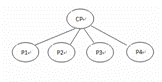 B.
B. 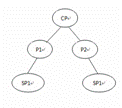
C. 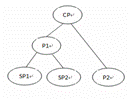 D.
D. 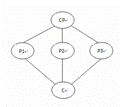
CP: central Point P: Point SP: Sun-point (次要点) C: Conslusion
Scientists in India have invented a new way to produce electricity. Their invention does not get its power from oil, coal or other fuels. It produces electricity with the power of animals. India has about eighty million bullocks. They do all kinds of jobs. They work in the fields. They pull vehicles through the streets. They carry water containers. Indian energy officials have been seeking ways to use less imported oil to provide energy. Scientists at the National Institute for Industrial Engineering in Bombay wondered whether the millions of bullocks could help. Many villages in India lack electricity, but they have many bullocks. And often the animals are not working. One job done by bullocks is to pump water out of the well. The animals do this by walking around and around in a circle. As they walk, they turn a heavy stick that makes the pump move. This simple technology is centuries old. Scientists thought that the same technology could be used to produce electricity. Bullocks walk in a circle only two or three times a minute. This is much too slow to produce electricity, but it can create enough power to turn a series of gears(齿轮). A large gear sits next to a smaller gear. As the large gear turns, it causes the smaller gear to turn. That gear turns an even smaller one. Each gear moves faster because it is a little smaller. The smallest gear may turn extremely fast. Clocks operate with gears. So do cars and so does the device invented by the Indian scientists to produce electricity.
According to the officials in the United Nations, the idea is being tested at several places in India. The device is easy to operate and repair. And it can be moved easily. It costs about three hundred and seven dollars now to make such a device, but production of large numbers of them could cut the cost of each to about two hundred dollars.
1.Who first thought of using bullocks to provide energy?
A.Indian energy officials. B.Scientists in India.
C.Officials in the United Nations. D.Researchers in Europe.
2.The jobs that bullocks do in India are mentioned in the passage except .
A.pulling vehicles B.harvesting crops
C.pumping water out of wells D.carrying food baskets
3.In the sentence “This simple technology is centuries old” in Paragraph One, “This simple technology” refers to_____.
A.using bullocks to produce energy
B.using pumps to draw water out
C.having bullocks walk around to make the pump move
D.connecting gears of different sizes to produce electricity
4.Which of the following can NOT be inferred from the passage?
A.Once widely used, this device can help reduce the use of oil to provide energy.
B.Indian government has decided to put the idea into practice at once.
C.This idea will make progress as it is environment-friendly to the people.
D.This device is designed in the way as clocks work with gears working on each other.
5.What is the U. N. officials’ attitude towards the idea?
A.Approving. B.Doubtful. C.Negative. D.Passive.
湖北省互联网违法和不良信息举报平台 | 网上有害信息举报专区 | 电信诈骗举报专区 | 涉历史虚无主义有害信息举报专区 | 涉企侵权举报专区
违法和不良信息举报电话:027-86699610 举报邮箱:58377363@163.com