
题目列表(包括答案和解析)
–If you like I can do some shopping for you.
–That’s a very kind _______.
A. offer B. service C. point D. suggestion
Taxis
Taxis are in the streets 24 hours a day.Simply raise your hand, and a taxi will appear in no time.They are usually red, and they display the price per kilometre on the window.You should check whether the cab has a business permit, and make sure you ask for a receipt.
Buses and trolleybuses
Public transport provides a cheap way to get around in Beijing.There are 20,000 buses and trolleybuses in Beijing, but they can get very crowded.It’s a good idea to avoid public transport during the rush hour(6∶30 a.m.~8∶00 a.m.and 5∶00 p.m.~6∶30 p.m.).Fares are cheap, starting at 1 yuan.Air-conditioned buses cost more.Buses numbered 1 to 100 are limited to travel within the city centre.Higher numbers have destinations in the suburbs.Tourists shouldn’t miss the 103 bus which offers one of the most impressive routes, past the Forbidden City and the White Pagoda in Beihai Park.If you get on a double-decker bus, make sure you sit upstairs.You’ll have a good view of the rapidly changing city.
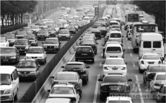
Most buses run from about 5∶00 a.m.to midnight.However, there is also a night bus service, provided by buses with a number in the 200s.
Minibuses
Minibuses with seats for 12 passengers offer an alternative to expensive taxis and crowded public transport in some areas.They run regular services and follow the same routes as large public buses.And in a minibus you always get a seat even in rush hours.
Underground
There are four underground lines in Beijing, and several lines are under construction.Trains are fast and convenient, but rush hours can be terrible.A oneway trip costs 3 yuan.Station names are marked in pinyin.The underground is open from 5∶00 a.m.to 11∶00 p.m..
Pedicabs
Tourists like these human-pedalled“tricycle taxis”, but they can be expensive.You should talk to the driver, and make sure you know the price before you begin the journey.For example, if it is per person, single or return.Tricycles are worth using if you want to explore the narrow alleys(hutong)of old Beijing.
Questions:
1.What’s the problem with buses?
2.What are the advantages of the underground?
3.What can you visit in a pedicab?
One day, a poor boy who was trying to pay his way through school by selling goods door to door found that he only had one dime (一角银币) left. He was hungry so he decided to 1 for a meal at the next house. However, he lost his nerve when a lovely young woman opened the door. 2 a meal he asked for a drink of water. She thought he looked 3 so she brought him a large glass of milk. He drank it slowly, and then asked, “How much do I 4 you?” “You don’t owe me anything,” she replied, “Mother has taught me never to accept 5 for a kindness.” He said, “Then I thank you from the bottom of my heart.” As Howard Kelly left that house, he not only felt stronger 6 , but it also increased his faith in God and the human race. He was about to give up and 7 before this point. Years later the young woman became critically ill. The 8 doctors were baffled (阻挡). They finally sent her to the big city, where specialists can be called in to study her 9 disease. Dr. Howard Kelly, now 10 was called in for the consultation (会诊). When he heard the name of the town she came from, a(an) 11 light filled his eyes. 12 , he rose and went down through the hospital hall into her room. Dressed in his doctor’s gown he went in to see her. He 13 her at once. He went back to the 14 room and determined to do his best to save her life. From that day on, he gave special 15 to her case.
After a long struggle, the battle was 16 . Dr. Kelly requested the business office to pass the final bill to him for approval. He looked at it and then 17 something on the side. The bill was sent to her room. She was 18 to open it because she was sure that it would take the rest of her life to pay it off. Finally she looked, and the note on the side of the bill 19 her attention. She read these words…
“Paid in full with a glass of 20 .”
(Singed) Dr. Howard Kelly
Tears of joy flooded her eyes as she prayed silently: “Thank you, God. Your love has spread through human hearts and hands.”
46.A. ask B. beg C. wait D. look
47. A. Because of B. In front of C. In case of D. Instead of
48. A. upset B. thirsty C. hungry D. sad
49. A. owe B. cost C. lend D. own
50. A. offer B. pay C. help D. thanks
51. A. quickly B. mentally C. physically D. warmly
52. A. quit B. continue C. retire D. surrender
53. A. local B. poor C. kind D. cruel
54. A. common B. ordinary C. rare D. scarce
55. A. old B. famous C. unknown D. retired
56. A. strange B. special C. poor D. angry
57. A. Suddenly B. Generally C. Unfortunately D. Immediately
58. A. called B. recognized C. remembered D. found
59. A. waiting B. treating C. information D. consultation
60. A. interest B. food C. attention D. effort
61. A. defeated B. won C. lost D. completed
62. A. changed B. read C. crossed D. wrote
63. A. excited B. afraid C. nervous D. surprised
64. A. caught B. called C. paid D. caused
65. A. water B. coffee C. milk D. ice cream
Would you like to be a king or queen? To have people waiting on you hand and foot? Many Americans experience this royal treatment every day. How? By being customers. The American idea of customer service is to make each customer the center of attention. Need proof? Just listen to the commercials. Most of them sound like the McDonald’s ad: “We do it all for you.” Actually, not all stores in America roll out the red carpet for their customers. But wherever you go, good customer service means making customers feel special.
People going shopping in America can expect to be treated with respect from the very beginning. Most places don’t have a “furniture street” or a “computer road” which allow you to compare prices easily. Instead, people often “let their fingers do the walking” through the store hot lines. From the first “hello”, customers receive a satisfying response to their questions. This initial contact can help them decide where to shop.
When customers get to the store, they are treated as honored guests. Customers don’t usually find store clerks sitting around watching TV or playing cards. Instead, the clerks greet them warmly and offer to help them find what they want. In most stores, the clear signs that label each department make shopping a breeze. Customers usually don’t have to ask how much items cost, since prices are clearly marked. And unless they’re at a flea market or a yard sale, they don’t bother trying to bargain.
When customers are ready to check out, they find the nearest and shortest checkout lane. But as Murphy’s Law would have it, whichever lane they get in, all the other lanes will move faster. Good stores open new checkout lanes when the lanes get too long. Some even offer express lanes for customers with 10 items or less. After they pay for their purchases, customers receive a smile and a warm “thank you” from the clerk. Many stores even allow customers to take their shopping carts out to the parking lot. That way, they don’t have to carry heavy bags out to the car.
By quoting (引用) the McDonald’s ad: “We do it all for you”, the author intends to_______.
A. suggest that customers believe what commercials say deeply
B. show readers the American idea on good customer service
C. express all the stores pay much attention to the customers
D. persuade readers to choose the stores with ads correctly
In the USA, what may you do at first if you want to do some shopping?
A. To visit a professional street with lots of similar stores.
B. To compare prices in many shops in the same street.
C. To make phone calls and get better shopping choices.
D. To receive other customers’ answers to the questions.
The underlined words “a breeze” in Para.3 most probably means _________.
A. an easy job B. a trouble C. a funny thing D. a boring task
Which of the followings shows American stores offer convenience to customers in this passage?
A. The store clerks don’t usually sit around watching TV or playing cards.
B. Some stores offer price bargain to the customers like a yard sale.
C. The clerks give customers a smile and a warm “thank you” after paying.
D. Some stores open new checkout lanes when the lanes are crowded.
Which of the following can be the best title of this passage?
A. Customer Service in America B. Excellent Stores in America
C. Shopping Rules in America D. Being King or Queen in America
Next time a customer comes to your office, offer him a cup of coffee. And when you’re doing your holiday shopping online, make sure you’re holding a large glass of iced tea. The physical sensation of warmth encourages emotional warmth, while a cold drink in hand prevents you from making unwise decisions—those are the practical lesson being drawn from recent research by psychologist John A. Bargh.
Psychologists have known that one person’s perception (知觉) of another’s “warmth” is a powerful determiner in social relationships. Judging someone to be either “warm” or “cold” is a primary consideration, even trumping (打败) evidence that a “cold” person may be more capable. Much of this is rooted in very early childhood experiences, Bargh argues, when babies’ conceptual sense of the world around them is shaped by physical sensations, particularly warmth and coldness. Classic studies by Harry Harlow, published in 1958, showed monkeys preferred to stay close to a cloth “mother” rather than one made of wire, even when the wire “mother” carried a food bottle. Harlow’s work and later studies have led psychologists to stress the need for warm physical contact from caregivers to help young children grow into healthy adults with normal social skills.
Feelings of “warmth” and “coldness” in social judgments appear to be universal. Although no worldwide study has been done, Bargh says that describing people as “warm” or “cold” is common to many cultures, and studies have found those perceptions influence judgment in dozens of countries.
To test the relationship between physical and psychological warmth, Bargh conducted an experiment which involved 41 college students. A research assistant who was unaware of the study’s hypotheses (假定), handed the students either a hot cup of coffee, or a cold drink, to hold while the researcher filled out a short information form. The drink was then handed back. After that, the students were asked to rate the personality of “Person A” based on a particular description. Those who had briefly held the warm drink regarded Person A as warmer than those who had held the iced drink.
“We are grounded in our physical experiences even when we think abstractly,” says Bargh.
1. In Bargh’s experiment, the students were asked to _______.
A. evaluate someone’s personality
B. write down their hypotheses
C. fill out a personal information form
D. hold coffee and cold drink alternatively
2.We can infer from the passage that _______.
A. abstract thinking does not come from physical experiences
B. feelings of warmth and coldness are studied worldwide
C. physical temperature affects how we see others
D. capable persons are often cold to others
3.What would be the best title for the passage?
A. Drinking for Better Social Relationships
B. Experiments of Personality Evaluation
C. Developing Better Drinking Habits
D. Physical Sensations and Emotions
湖北省互联网违法和不良信息举报平台 | 网上有害信息举报专区 | 电信诈骗举报专区 | 涉历史虚无主义有害信息举报专区 | 涉企侵权举报专区
违法和不良信息举报电话:027-86699610 举报邮箱:58377363@163.com