
题目列表(包括答案和解析)
It was Monday. Mrs. Smith's dog was hungry, but there was not any meat in the house.
Considering that there was no better way. Mrs. Smith took a piece of paper, and wrote the following words on it:“Give my dog half a pound of meat.” Then she gave the paper to her dog and said gently:“Take this to the butcher(* person whose job is selling meat)and he's going to give you your lunch today.”
Holding the piece of paper in its mouth, the dog ran to the butcher's. It gave the paper to the butcher. The butcher read it carefully, recognized that it was really the lady's handwriting and soon did it as he was asked to. The dog was very happy, and ate the meat up at once.
At noon, the dog came to the shop again. It gave the butcher a piece of paper again. After reading it, he gave it half a pound of meat once more.
The next day, the dog came again exactly at noon. And as usual, it brought a piece of paper in the mouth. This time, the butcher did not take a look at paper, and gave the dog its meat, for he had regarded the dog as one of his customers(*people who buy sth. from a shop).
But, the dog came again at four o'clock. And the same thing happened once again. To the butcher's more surprise, it came for the third time at six o'clock, and brought with it a third piece of paper. The butcher felt a bit puzzled. He said to himself, “This is a small dog. Why does Mrs. Smith give it so much meat to eat today?”
Looking at the piece of paper, he found that there were not any words on it!
1.Mrs. Smith treated her little dog quite .
|
A.cruelly |
B.fairly |
C.kindly |
D.friendly |
2.It seemed that the dog knew well that the paper Mrs. Smith gave it ______ .
|
A.might do it much harm |
B.could do it much good |
|
C.would help the butcher |
D.was worth many pounds |
3.The butcher did not give any meat to the dog __________ .
|
A.before he felt sure that the words were really written by Mrs. Smith |
|
B.when he found that the words on the paper were not clear |
|
C.because he had sold out all the meat in his shop |
|
D.until he was paid enough by Mrs. Smith |
4.From its experience, the dog found that ________.
|
A.only the paper with Mrs. Smith's words in it could bring it meat |
|
B.the butcher would give the meat to it whenever he saw it |
|
C.Mrs. Smith would pay for the meat it got from the butcher |
|
D.a piece of paper could bring it half a pound of meat |
5.At the end of the story, you'll find that _______.
|
A.the dog was clever enough to write on the paper |
|
B.the dog dared not go to the butcher's any more |
|
C.the butcher was told not to give any meat to the dog |
|
D.the butcher found himself cheated by the clever animal |
:短文改错(共10小题,每小题1.5分,满分15分)
此题要求改正所给短文中的错误。对标有题号的每一行作出判断;如无错误,在该行右边横线上画一个勾(√);如有错误(每行只有一个错误),则按下列情况改正:该行多一个词:把多余的词用斜线(\)划掉,在该行右边横线上写出该词,并也用斜线划掉。此行缺一个词:在缺词处加一个漏字符号(∧),在该行右边横线上写出该加的词。此行错一个词:在错的词下划一横线,在该行右边横线上写出改正后的词。
注意:原行没有错的不要改。
My aunt lives in a village far from my town.
Last year she came to visit us and took me a 76._________
little dog for my birthday present. It was a little black 77._________
dog with white spots on. It was so lovely that I 78._________
liked it at once. Every day after school I played the 79._________
dog and it gave me much more pleasure. I was glad 80._________
to have it as my companion. One day the dog went away 81._________
and never came back again. All my families were out searching 82._________
for it but it was nowhere to found. How I worried 83._________
about it all those days. A week later a letter came about 84._________
my aunt saying that the little dog had returned 85._________
The Channel Islands are a group of British-owned islands lying in the English Channel, 10 to 30 miles off the French coast, and 70 to 90 miles from the English coast. There are ten islands with a total land area of 75 square miles and a total population of 123,000. The three largest islands, Jersey, Guernsey, and Alderney, have long been known for the fine breeds (品种) of cattle that are raised on them and named after them.
In earliest known history the islands were considered part of Normandy, which was part of France, but the ruler of Normandy became king of England in 1066, and from then on the islands were looked upon as British land. English control was unbroken until World War II, when the Germans held the islands for five years.
Although people on the islands speak both languages and they are considered English, their customs are more French than English.
1.Which of the following maps gives the right position of the Channel Islands?
Br = Britain Fr = France Ch = Channel Islands
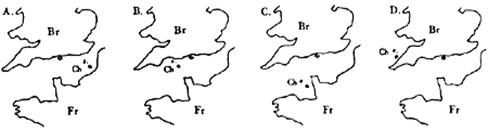
2.Jersey, Guernsey, and Alderney breeds of cattle are __________.
A. considered best in England
B. named after their birthplaces
C. brought to the islands by the Germans
D. raised on well-known farms by the French
3. The Channel Islands have been continuously under British rule since__________.
A. earliest known history B. 1066
C. 1930s D. the end of World War II
4.Why do people on the Channel Islands follow French way of living?
A. Their islands used to be part of France.
B. Their islands are often visited by the French.
C. They came from France.
D. They speak French.
| |||||||||||||||||||||||||||||||||||||||||||||||||||||||||||||||||||||||||||||||||||||||||||||||||||||||||||||||||||||||||||||||||||||||||||||||||||||||||||||||||||||||||||||||||||||||||||||||||||||||||||||||||||||||||||||||||||||||||||||||||||||||||||||||||||||||||||||||||||||||||||
It's a small gas station that has snacks, drinks, cigarettes, and candies. The young man behind the counter knows his __36__ by name and what they normally want to buy. He treats children and adults with equal __37__. He reads science fiction behind the counter when business is __38__.
One day, three people rushed in and grabbed(抓住) food off the shelves as fast as they could, __39__ not intending to pay for it. He hit the “panic button” , then went over the counter(柜台) and __40__ the front door. It was obvious that they were homeless, and equally obvious that they weren't going __41__ with their illgotten(非法获得的) gains. They __42__ the food and simply crowded together in panic(惊慌地)—knowing the police were __43__ the way.
Imagine what they must have felt like when they were told they didn't have to steal if they were that __44__. “We have food in the back, expired (到期)but still __45__ to eat. If you need food, you __46__ have some.”
They were told to __47__ what they had dropped and put it back, and then asked to straighten out(清理) the mess. They were doing just that __48__ the police arrived. The officers were told the situation was under control and the police were no longer __49__.
This wasn't what they had __50__. They were being treated as human beings who could right the wrong they'd done. Shocked, they quickly followed orders to take turns and use the restroom to clean up.
Soon three __51__ people walked out with all the __52__ their arms could hold. They were __53__ that,if they needed to come back again, they were to ask and not just grab.
And then the young man went back to read until the next customer came in. He would be the __54__ person in the world to claim he was a hero. But he gave three people something they were in desperate need of—a __55__amount of selfrespect and a little bit of hope.
| 【小题1】 |
|
| 【小题2】 |
|
| 【小题3】 |
|
| 【小题4】 |
|
| 【小题5】 |
|
| 【小题6】 |
|
| 【小题7】 |
|
| 【小题9】 |
|
| 【小题10】 |
|
| 【小题11】 |
|
| 【小题12】 |
|
| 【小题13】 |
|
| 【小题14】 |
|
| 【小题15】 |
|
| 【小题16】 |
|
| 【小题18】 |
|
| 【小题19】 |
|
| 【小题20】 |
|
湖北省互联网违法和不良信息举报平台 | 网上有害信息举报专区 | 电信诈骗举报专区 | 涉历史虚无主义有害信息举报专区 | 涉企侵权举报专区
违法和不良信息举报电话:027-86699610 举报邮箱:58377363@163.com