
题目列表(包括答案和解析)
“The more time you spend on study the better you learn.” Is that true ? Below is a graph showing the amount a person learns against the number of hours he works in a day.
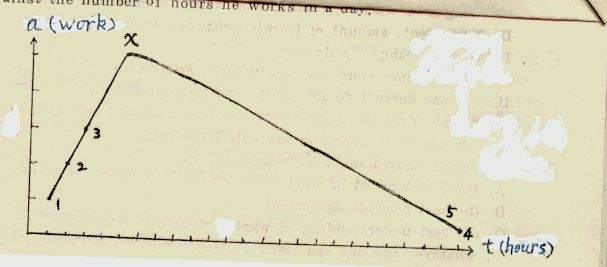
If one doesn’t do any work, one learns nothing. If one does an hour’s work, one learns a certain amount (point 1). If one does two hours’ work, one learns about twice as much. If one does more work , he’ll learn still more . Now if one tried to do 23 hours’ work in 24, one will be so tired that one will hardly remember anything;what one learns will be little (point 4). If one did less work, one would learn more . Point X is the very maximum anyone can learn in a day. It is the optimum. It is the best amount of work to do. It is the best possible agreement between the time spent and the overtiredness as a result.
Overtiredness is a 100% real thing, which no one can escape or try to pay no attention to or try not to see. If one does, if one forces oneself to work past the optimum (and any fool can keep his eyes open 14 hours a day without any sleep), one can only get on this downward slope in this graph and achieve less than the best and then get overtired and lose one’s power to fix any attention on anything one studies.
It is hard to say what the optimum is. When one reaches one’s optimum depends on many things such as one’s health and the kind of work one does. But when you find yourself repeatedly reading over the same paragraph and not taking it in, that shows you have reached the optimum. Most ordinary students find their optimum at about five hours a day.
1. Line A, Line T and the up-and-down slope stand for _____.
A. amount of learning, time spent, changes of working result
B. time spent, change of working result, amount of learning
C. changes of working result, time spent, amount of learning
D. time spent, amount of learning, changes of working result
2. Point 2 probably stands for _________ .
A. “ If one does more work he’ll learn still more.”
B. “ If one doesn’t do any work, one learns nothing.”
C. “ If one does two hours’ work, one learns about twice as much.”
D. “ If one works overtime one will learn less..”
3. The word “maximum” here means _____ .
A. the best amount of work
B. the best possible agreement
C. the best understanding of what one learns
D. whatever anyone can learn
4. Point 5 shows the result of ____ .
A. doing less work after getting past the optimum
B. doing 23 hours’ work in 24
C. forcing oneself to work past the optimum
D. not doing any work at all
5. After reaching one’s optimum, one will have to _____.
A. force one’s eyes open to work overtime
B. lose one’s power to fix one’s attention
C. repeat what one is reading
D. take a rest and do less work.
湖北省互联网违法和不良信息举报平台 | 网上有害信息举报专区 | 电信诈骗举报专区 | 涉历史虚无主义有害信息举报专区 | 涉企侵权举报专区
违法和不良信息举报电话:027-86699610 举报邮箱:58377363@163.com