
How we enjoyed the beautiful views from the top ! 查看更多


题目列表(包括答案和解析)

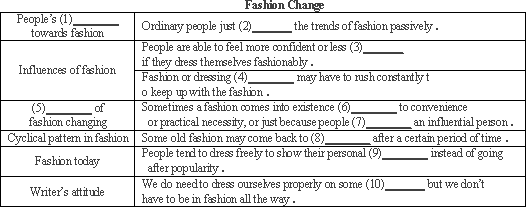
请认真阅读下列短文,并根据所读内容在文章后表格中的空格里填入1个最恰当的单词。

注意:每个空格只填1个单词。

  How we look and how we appear to others probably worries us more when we are in our teens or early twenties than at any other time in our life.Few of us are content to accept ourselves as we are, and few are brave enough to ignore the trends of fashion.

  Most fashion magazines or TV advertisements try to persuade us that we should dress in a certain way or behave in a certain manner.If we do, they tell us, we will be able to meet new people with confidence and deal with every situation confidently and without embarrassment.Changing fashion, of course, does not apply just to dress.A barber today does not cut a boy's hair in the same way as he used to, and girls do not make up in the same way as their mothers and grandmothers did.The advertisers show us the latest fashionable styles and we are constantly under pressure to follow the fashion in case our friends think we are odd or dull.

  What causes fashions to change? Sometimes convenience or practical necessity or just the fancy of an influential person can establish a fashion.Take hats for example.In cold climates, early buildings were cold inside, so people wore hats indoors as well as outside.In recent times, the late President Kennedy caused a depression in the American hat industry by not wearing hats, and more American men followed his example.

  There is also a cyclical(周期性的)pattern in fashion.In the 1920s in Europe and America, short skirts became fashionable.After World War II, they dropped to ankle length.Then they got shorter and shorter until the miniskirt was in fashion.After a few more years, skirts became longer again.

  Today, society is much freer and easier than it used to be.It is no longer necessary to dress like everyone else.Within reason, you can dress as you like or do your hair the way you like instead of the way you should because it is the fashion.The popularity of jeans and the “untidy” look seems to be a reaction against the increasingly expensive fashion of the top fashion houses.

  At the same time, appearance is still important in certain circumstances and then we must choose our clothes carefully.It would be foolish to go to an interview for a job in a law firm wearing jeans and a sweater, and it would be discourteous(失礼的)to visit some distinguished scholar looking as if we were going to the beach or a night club.However, you need never feel depressed if you don't look like the latest fashion photo.Look around you and you'll see that no one else does either!

查看答案和解析>>

完形填空

  Before discussing different kinds of emotions ,let us briefly talk about how researchers   1   bodily processes ,actions and behavior, and how this relates to what we do in our daily lives when we observe emotions in   2  

  Bodily processes can be directly measured by   3   of a polygraph ,When a polygraph is skillfully used to   4   how we react bodily with what we are   5   ,it is called a “lie detector”.Bodily processes can also be measured   6  .This is what we do when we observe someone blushing(脸红).However ,we are not always   7   of what bodily processes respond to.

  Measuring action   8   behavior is the other way researchers assess the emotions.  9   ,one measure of fear of snakes is how   10   a person will go to the snake.Another procedure is to have a person   11   how afraid he is ,or how he feels ,in this way ,researchers have   12   the so-called “fear thermometer”(温度计)to assess person's fear.  13   our everyday living ,we do very much the same thing.Only not too   14  .We react to what a person does ,what he says,   15   he says it ,and how he looks ,Is he smiling ?Is his voice trembling ?We put all this   16   together to infer what a person is feeling.

    17   ,we do not always act as we feel.Sometimes we do things that we don't feel like doing.  18   we say we feel one way and then we act another ,Actors ,for example ,successfully learn to “make believe” emotions ,or learn to   19   them.Thus we   20   always tell what a person is feeling by what he says or by what he does.

(1)

[  ]

A.

measure

B.

describe

C.

make

D.

use

(2)

[  ]

A.

other

B.

others

C.

another

D.

the others

(3)

[  ]

A.

ways

B.

methods

C.

means

D.

tools

(4)

[  ]

A.

combine

B.

treat

C.

examine

D.

compare

(5)

[  ]

A.

doing

B.

saying

C.

observing

D.

carrying

(6)

[  ]

A.

directly

B.

indirectly

C.

easily

D.

difficultly

(7)

[  ]

A.

afraid

B.

fond

C.

aware

D.

accused

(8)

[  ]

A.

but

B.

so

C.

and

D.

or

(9)

[  ]

A.

For example

B.

On one hand

C.

As well as

D.

At times

(10)

[  ]

A.

slow

B.

fast

C.

far

D.

close

(11)

[  ]

A.

tell

B.

say

C.

talk

D.

speak

(12)

[  ]

A.

approved

B.

discovered

C.

developed

D.

informed

(13)

[  ]

A.

During

B.

With

C.

On

D.

In

(14)

[  ]

A.

skillfully

B.

systematically

C.

naturally

D.

eventually

(15)

[  ]

A.

why

B.

where

C.

how

D.

whether

(16)

[  ]

A.

imaginations

B.

observations

C.

impressions

D.

awareness

(17)

[  ]

A.

Therefore

B.

Otherwise

C.

However

D.

Anyway

(18)

[  ]

A.

Sometime

B.

Someway

C.

Sometimes

D.

Anytime

(19)

[  ]

A.

express

B.

hide

C.

act

D.

say

(20)

[  ]

A.

needn't

B.

shan't

C.

won't

D.

cannot

查看答案和解析>>

完形填空

  World Environment Day was established by the United Nations General Assembly in 1972 to mark the opening of the Stockholm Conference on the Human Environment.Another decision, made by the General Assembly the same day,   1   the creation of UNEP(联合国环境规划署United Nations Environment Programme).

  World Environment Day can be celebrated in many   2  ,   3   street rallies, bicycles parades, green concerts, essay and poster competitions in schools, tree planting, recycling efforts, clean-up campaigns   4   much more.

  Heads of State, Prime Ministers and Ministers of Environment make statements and entrust themselves to   5   the Earth.More serious promises are made   6   lead to the establishment of permanent(常设的)governmental structures   7   environmental management and economic planning.This ceremony also   8   an opportunity to sign   9   ratify(批准)international environmental conventions(公约).

  World Environment Day, celebrated each year on June 5 is one of the main mediums   10   which the United Nations arouses(唤醒)worldwide awareness(觉醒)of the environment and   11   political attention and action.

  The World Environment Day theme selected for 2004 is wanted! Seas and Oceans-Dead or   12  ? The theme asks that we make a choice   13   how we want to   14   the Earth’s seas and oceans.It also   15   each and every one of us to act.Do we want to keep seas and oceans   16   and alive or   17   and dead?

  The main international   18   of the World Environment Day 2004 will be   19   in Barcelona, Spain in close collaboration(合作)with the Universal Forum of Cultures.UNEP is   20   that the City of Barcelona, the Catalan Regional Government and the Government of Spain will be hosting this important United Nations day.

(1)

[  ]

A.

led to

B.

lead to

C.

leads to

D.

leading to

(2)

[  ]

A.

places

B.

countries

C.

ways

D.

days

(3)

[  ]

A.

include

B.

includes

C.

including

D.

included

(4)

[  ]

A.

to

B.

and

C.

or

D.

for

(5)

[  ]

A.

care for

B.

care

C.

take care

D.

take care for

(6)

[  ]

A.

which

B.

how

C.

what

D.

of which

(7)

[  ]

A.

dealing with

B.

deal with

C.

dealt with

D.

dealing

(8)

[  ]

A.

provides

B.

refers

C.

made

D.

provides with

(9)

[  ]

A.

but

B.

through

C.

or

D.

for

(10)

[  ]

A.

through

B.

at

C.

in

D.

about

(11)

[  ]

A.

pays

B.

progresses

C.

increasing

D.

increases

(12)

[  ]

A.

living

B.

alive

C.

live

D.

lively

(13)

[  ]

A.

as to

B.

as well

C.

as long as

D.

as well as

(14)

[  ]

A.

treat

B.

treating

C.

considering

D.

destroy

(15)

[  ]

A.

calls for

B.

calls at

C.

calls on

D.

calls in

(16)

[  ]

A.

healthy

B.

health

C.

unhealthy

D.

physical

(17)

[  ]

A.

polluting

B.

polluted

C.

pollution

D.

pollute

(18)

[  ]

A.

celebrating

B.

celebrations

C.

congratulations

D.

congratulating

(19)

[  ]

A.

held

B.

taken place

C.

happened

D.

take place

(20)

[  ]

A.

honored

B.

honor

C.

to honor

D.

honoring

查看答案和解析>>

请认真阅读下列短文,并根据所读内容在文章后表格中的空格里填入1个最恰当的单词。注意:每个空格只填1个单词。

  How we look and how we appear to others probably worries us more when we are in our teens or early twenties than at any other time in our life.Few of us are content to accept ourselves as we are, and few are brave enough to ignore the trends of fashion.

  Most fashion magazines or TV advertisements try to persuade us that we should dress in a certain way or behave in a certain manner.If we do, they tell us, we will be able to meet new people with confidence and deal with every situation confidently and without embarrassment.Changing fashion, of course, does not apply just to dress.A barber today does not cut a boy’s hair in the same way as he used to, and girls do not make up in the same way as their mothers and grandmothers did.The advertisers show us the latest fashionable styles and we are constantly under pressure to follow the fashion in case our friends think we are odd or dull.

  What causes fashions to change? Sometimes convenience or practical necessity or just the fancy of an influential person can establish a fashion.Take hats for example.In cold climates, early buildings were cold inside, so people wore hats indoors as well as outside.In recent times, the late President Kennedy caused a depression in the American hat industry by not wearing hats, and more American men followed his example.

  There is also a cyclical(周期性的) pattern in fashion.In the 1920s in Europe and America, short skirts became fashionable.After World War II, they dropped to ankle length.Then they got shorter and shorter until the miniskirt was in fashion.After a few more years, skirts became longer again.

  Today, society is much freer and easier than it used to be.It is no longer necessary to dress like everyone else.Within reason, you can dress as you like or do your hair the way you like instead of the way you should because it is the fashion.The popularity of jeans and the “untidy” look seems to be a reaction against the increasingly expensive fashion of the top fashion houses.

  At the same time, appearance is still important in certain circumstances and then we must choose our clothes carefully.It would be foolish to go to an interview for a job in a law firm wearing jeans and a sweater, and it would be discourteous(失礼的) to visit some distinguished scholar looking as if we were going to the beach or a night club.However, you need never feel depressed if you don’t look like the latest fashion photo.Look around you and you’ll see that no one else does either!
查看答案和解析>>

完型填空

  Before discussing different kinds of emotions, let us briefly talk about how researchers   1   bodily processes, actions and behavior, and how this relates to what we do in our daily lives when we observe emotions in   2  .

  Bodily processes can be directly measured by   3   of a polygraph(测谎仪).When a polygraph is skillfully used to   4   how we react bodily with what we are   5  , it is called a "lie detector".Bodily processes can also be measured   6  .This is what we do when we observe someone blushing(脸红).However, we are not always   7   of what bodily processes respond to.

  Measuring action or behavior is the other way researchers assess the   8  .  9  , one measure of fear of snakes is how   10   a person will go to the snake.Another procedure is to have a person   11   how afraid he is, or how he feels, in this way, researchers have   12   the so-called "fear thermometer" to assess a person's fear.  13   our everyday living, we do very much the same thing.Only not too   14  .We react to what a person does, what he says,   15   he says it, and how he looks.Is he smiling? Is his voice trembling? We put all this   16   together to infer what a person is feeling.

    17  , we do not always act as we feel.Sometimes we do things that we don't feel like doing.  18   we say we feel one way and then we act another.Actors, for example, successfully learn to "make believe" emotions, or learn to   19   them.Thus we   20   always tell what a person is feeling by what he says or by what he does.

(1)

[  ]

A.

measure

B.

describe

C.

make

D.

use

(2)

[  ]

A.

other

B.

others

C.

another

D.

the others

(3)

[  ]

A.

ways

B.

methods

C.

means

D.

tools

(4)

[  ]

A.

combine

B.

treat

C.

examine

D.

compare

(5)

[  ]

A.

doing

B.

saying

C.

observing

D.

carrying

(6)

[  ]

A.

directly

B.

indirectly

C.

easily

D.

difficultly

(7)

[  ]

A.

afraid

B.

fond

C.

aware

D.

accused

(8)

[  ]

A.

expressions

B.

reactions

C.

conclusions

D.

emotions

(9)

[  ]

A.

For example

B.

On one hand

C.

As well as

D.

At times

(10)

[  ]

A.

slow

B.

fast

C.

far

D.

close

(11)

[  ]

A.

tell

B.

say

C.

talk

D.

speak

(12)

[  ]

A.

approved

B.

discovered

C.

developed

D.

informed

(13)

[  ]

A.

During

B.

With

C.

On

D.

In

(14)

[  ]

A.

really

B.

systematically

C.

naturally

D.

eventually

(15)

[  ]

A.

why

B.

where

C.

how

D.

whether

(16)

[  ]

A.

imaginations

B.

observations

C.

impressions

D.

awareness

(17)

[  ]

A.

Therefore

B.

Otherwise

C.

However

D.

Anyway

(18)

[  ]

A.

Sometime

B.

Someway

C.

Sometimes

D.

Anytime

(19)

[  ]

A.

express

B.

hide

C.

act

D.

say

(20)

[  ]

A.

needn’t

B.

shan’t

C.

won’t

D.

cannot

查看答案和解析>>


同步练习册答案