
题目列表(包括答案和解析)
| |||||||||||||||||||||||||||||||||||||||||||||||||||||||||||||||||||||||||
Read the following passage.Answer the questions according to the information given in the passage.
Noah Webster published his first dictionary of the English language in 1806, and in 1828 published the first edition of his An American Dictionary of the English Language.The work came out in 1828 in two volumes.It contained 12,000 words from 30,000 to 40,000 definitions(定义)that had not appeared in any earlier dictionary.In 1840 the second edition, corrected and enlarged, came out, in two volumes.He completed the revision(修订)of an appendix(附录)a few days before his death, which occurred in New Haven on the 28th of May 1843.
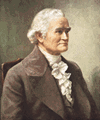
Webster changed the spelling of many words in his dictionaries in an attempt to make them more phonetic(音形一致).Many of the differences between American English and other English variants(变体)evident today originated this way.The modern convention of having only one acceptable and correct spelling for a word is due mostly to the efforts of Webster, in standardizing spelling.Previous to this, the popular viewpoint on spelling might have best been summed up by Benjamin Franklin who said that he “had no use for a man with but one spelling for a word.”
Webster’s dictionary was so popular that “Webster’s” became synonymous(同义的)with dictionary to many Americans.As a result, the Webster’s name lost trademark protection and is now used by many publishers in the titles of their dictionaries.Among these, the Merriam-Webster’s dictionary is considered to be the most direct example of Noah Webster’s lexicographical(词典编纂的)tradition, the Merriam brothers having purchased the rights to revise the dictionary from Webster’s heirs(继承人)upon his death.
1.What was published by Noah Webster in 1828?(No more than 4 words)
___________________(2 marks)
2.When did Noah Webster die?(No more than 8 words)
____________________(2 marks)
3.Why did Webster change the spelling of many words in his dictionaries?(No more than 7 words)
____________________(3 marks)
4.What does the last paragraph mainly talk about?(No more than 5 words)
_____________________(3 marks)
阅读下面短文,简要回答问题。
Recently, in the hope of earning both money and social experience, I became a door-to-door salesman.I once read a saying:“If somebody wants something of yours, you will be treated as warmly as spring, but if they don’t you may be treated as coldly as winter.”You may consider his an exaggeration, but if you are a salesman, it is clearly correct.You would never have found it to be so true if you hadn’t been a salesman.You needn’t stand doubtful looks and unfriendly comments; you needn’t listen to something completely wrong and nod to say that it was quite right; you needn’t always keep patience and a smile; you needn’t repeat the same sentences over again; you needn’t bear talking to somebody you disike…I did this work for a month; then I decided to give it up.Apart from the above reasons, I found I was paying too much attention to the job and thus lessening my study time.The latest test result proved that my grades were getting lower.Even worse, I had been sacrificing much time to join my classmates in college activities.Sometimes I felt lonely and unhappy because of both my study and my part-time job.Now I don’t think it is worth doing such a thing even though I was earning money at great cost.
Newspapers and magazines often publish stories about good students who do part-time work and keep high scores in class.But according to my experience, part-time work can have some strong bad effects on study.Most students don’t see the relationship between study and work in a correct way.In my opinion, if it isn’t must for financial reasons, students should be cautious about taking up a part-time job.In western countries even the children of very rich families take part in hard jobs during the summer vacation.
1.Find in the passage a word closest in meaning to the underlined word“sacrificing”.
2.What’s the author’s opinion on work while studying?(回答词数不超过8个)
3.Who should take part-time jobs according to the text above?(回答词数不超过7个)
Daniel Defoe (about 1660~1731) was an important novelist in the English literature(文学). When he was young, he served as a soldier and had been to Spain, Italy, France and Germany. At the same time, he went in for politics. He cared much about the development of capitalism(资本主义). He had written a lot of articles against it and he was put into prison twice for that. It was not until he was nearly sixty that he began to write the famous novel Robinson Crusoe, which was published in May, 1709. It spread so rapidly that the story was known to every household very soon.
Robinson Crusoe can be divided into three parts. The first part is about Crusoe’s three voyages, the second part about his hunting, hiding in caves farming and his hard struggles against nature on a small island, the third part about the things which happened after his return from the island. The second part is the body of the novel, in which Robinson’s characters are clearly shown.
Defoe wrote his novel in a simple style and his language is easy to understand. His novel-writing set a milestone of the modern English novel. In his later part of life, he was in poor health and lived very poorly. He died on April 24th, 1731.
1..Daniel Defoe was ______ and the writer of ______.
A. an Englishman, “A Tale of Two Cities” B. an American, “A Million Pound Note”
C. a Frenchman, “The Lost Necklace” D. an Englishman, “Robinson Crusoe”
2.. How old was he when he began to write his famous novel “Robinson Crusoe”?
A. He was in his sixties. B. He was in his fifties.
C. He was over 60. D. He was sixty.
3.. Robinson Crusoe can be divided into ______ parts and the first is about _______.
A. two, his lonely life B. three, his characters
C. three, his journeys by sea D. four, his fame
4.. “Every household” in this passage means ______.
A. all members of a family B. all people
C. every building D. persons living in the same house
5..What was Defoe’s contribution(贡献) to the English literature?
A. He wrote a very interesting story.
B. He made people happy while reading his story.
C. He set a milestone of the modern English novel.
D. He was active in politics and was against capitalism.
Daniel Defoe (about 1660~1731) was an important novelist in the English literature(文学). When he was young, he served as a soldier and had been to Spain, Italy, France and Germany. At the same time, he went in for politics. He cared much about the development of capitalism(资本主义). He had written a lot of articles against it and he was put into prison twice for that. It was not until that he was nearly sixty that he began to write the famous novel “Robinson Crusoe”, which was published in May, 1709. It spread so rapidly that the story was known to every household very soon.
“Robinson Crusoe” can be divided into three parts. The first part is about Crusoe’s three voyages, the second part about his hunting, hiding in caves farming and his hard struggles against nature on a small island, the third about the things which happened after his return from the island. The second part is the body of the novel, in which Robinson’s characters are clearly shown.
Defoe wrote his novel in a simple style and his language is easy to understand. His novel writing set a milestone of the modern English novel. In his later part of life, He was in poor health and lived very poorly. He died on April 24, 1731.
Deniel Defoe was ______ and the writer of ______.
A. an Englishman, “A Tale of Two Cities”
B. an American, “A Million Pound Note”
C. a French, “The Lost Necklace”
D. an English, “Robinson Crusoe”
How old was he when he began to write his famous novel Robinson Crusoe?
A. He was in his sixties. B. He was in his fifties.
C. He was over 60. D. He was sixty.
Robinson Crusoe can be divided into ______ parts and the first is about _______.
A. two, his lonely life B. three, his characters
C. three, his journeys by sea D. four, his fame
“Every household” in this passage means ______.
A. all members of a family
B. all people
C. every building
D. persons living in the same house
What was Defoe’s contribution(贡献) to the English literature?
A. He wrote a very interesting story.
B. He made people happy while reading his story.
C. He set a milestone of the modern English novel.
D. He was active in politics and was against capitalism.
湖北省互联网违法和不良信息举报平台 | 网上有害信息举报专区 | 电信诈骗举报专区 | 涉历史虚无主义有害信息举报专区 | 涉企侵权举报专区
违法和不良信息举报电话:027-86699610 举报邮箱:58377363@163.com