26 90 15 30 75 23 19 18 31 25 56 199 查看更多


题目列表(包括答案和解析)

书面表达

读下面关于亚历山大、波波夫的信息(附图),写一篇关于他的文章,不少于60字。

  Name: Alexander Popor

  Place of birth: Sverdlovsk, Russia

  Weight: 90 kg

  Height: 2.00 m

  More information:

  He is a great swimmer.

  He started swimming at age of eight.

  He has been at the top for a long time.

_____________________________________________________________________

查看答案和解析>>

阅读下面短文,从每题所给的A、B、C、D四个选项中,选出最佳选项。

  YOU may feel curious about students in other countries:Do they also have so much homework? What do they do in their spare time?

  On April 8, a report came out on the lives of high school students in China, Japan, South Korea and the US.It surveyed around 6, 200 students from the four countries last year.You will find the answers to many of your questions in this report.

  Who studies hardest?

  Chinese students spend the most time studying.Nearly half of Chinese students spend more than two hours on their homework every day.That's much more than students of the US(26.4%), Japan(8.2%)and South Korea(5.2%).

  Who sleeps most often in class?

  Japanese students fall asleep in class most often.About 45% of them said they sometimes doze off in class.In South Korea, it's 32%; in the US, 21%; and 5% in China.

  South Korean students don't like taking notes.About 70% said they write down what the teacher says in class, many fewer than in Japan(93%), China(90%)and the US(89%).

  Who is the most distracted(分心的)?

  American students are the most active in class, but also the most distracted:64.2% said they chat with friends in class; 46.9% said they eat snacks in class; and 38.9% said they send e-mails or read unrelated(无关的)books in class.

  What do they do after school?

  In their spare time, most Chinese students study or surf the Internet.Most American students hang out with their friends.Most Japanese students do physical exercises.Most Korean students watch TV.

(1)

The report is about ________.

[  ]

A.

the countries

B.

the subjects

C.

the students’ lives

D.

the high schools

(2)

What country isn't mentioned in the report?

[  ]

A.

The US

B.

South Korea

C.

Japan

D.

India

(3)

________ of the Chinese students spend more than two hours on their homework.

[  ]

A.

26.4%

B.

8.2%

C.

5.2%

D.

48.6%

(4)

The phrase doze off means ________.

[  ]

A.

be half asleep

B.

get up

C.

eat snacks

D.

send emails

(5)

What of the following sentences is Not true?

[  ]

A.

The survey from the four countries was made last year.

B.

Most Japanese students do physical exercises after school.

C.

About half of the American students chat with freinds in class

D.

The students in South Korean don't like taking notes in class.

查看答案和解析>>

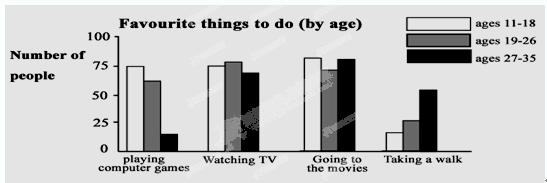
We surveyed 300 young people on what they like to do at weekends. One hundred people are from the ages of 11-18, one hundred 19-26 and one hundred 27-35. The following shows their answers:

(  )41.How many people enjoy playing computer games in the 11-18 group?

      A. 20.        B. 50.        C. 60.             D. 75.

(  )42.The people of 19-26 enjoy ______ most.

     A. watching TV B. going to the movies

C. playing computer games    D. taking a walk

(  )43.According to the survey, which two activities do most people enjoy doing?

A. Playing computer games and watching TV.

B. Playing computer games and taking a walk.

C. Watching TV and going to the movies.

D. Going to the movies and taking a walk.

(  )44.From the chart above, we can see the older people are, the more they like ______.

     A. watching TV B. taking a walk

C. going to the movies      D. playing computer games

(  )45. Which of the following is TRUE according to the chart?

     A. Fewest people like taking a walk. 

B. The people of 11-18 like taking a walk most.

     C. 90 people like going to the movies in the 19-26 group.

D. The people of 27-35 like playing computer games most.

查看答案和解析>>

完形填空。

  You may feel curious(好奇的)about students in other countries:Do they also have   1   homework?What do they do in their spare time?

  On April 8, a report came out on the lives of high school students in China, Japan, South Korea and the US.It surveyed around 6,200 students from the   2   countries last year.You will find the   3   to many of your questions in this report.

  Who studies hardest?

  Chinese students spend the most time   4  .Nearly half of Chinese students spend more than two hours on their homework every day.That's   5   more than students of the US(26.4%), Japan(8.2%)and South Korea(5.2%).

  Who sleeps   6   in class?

  Japanese students fall asleep in class most often.About 45% of them said they sometimes doze off(打瞌睡)in class.In South Korea, it's 32%; in the US, 21%; and 5% in   7  

  South Korean students don't like   8   notes.About 70% said they write down what the teacher says in class, many fewer than in Japan(93%), China(90%)and the US(89%).

  Who is the most distracted(分心的)?

  American students are the most active in class,   9   also the most distracted:64.2% said they chat with friends in class; 46.9% said they eat snacks in class; and 38.9% said they send e-mails or read unrelated(无关的)books in class.

  What do they do   10  ?

  In their spare time, most Chinese students study or surf the Internet.Most American students hang out with their friends.Most Japanese students do exercise.Most Korean students watch TV.

(1)

[  ]

A.

so many

B.

so much

C.

such many

D.

so little

(2)

[  ]

A.

two

B.

three

C.

four

D.

five

(3)

[  ]

A.

answers

B.

solutions

C.

problems

D.

replies

(4)

[  ]

A.

study

B.

studying

C.

studies

D.

studied

(5)

[  ]

A.

quite

B.

a little

C.

much

D.

no

(6)

[  ]

A.

oftener

B.

often

C.

more often

D.

most often

(7)

[  ]

A.

Japan

B.

China

C.

America

D.

South Korea

(8)

[  ]

A.

taking

B.

to take

C.

make

D.

made

(9)

[  ]

A.

so

B.

and

C.

but

D.

for

(10)

[  ]

A.

at school

B.

after school

C.

at home

D.

in class

查看答案和解析>>

Do you plan to go to Hong Kong Disneyland with your family this summer? If your dad smokes, you may have to ask him to be careful. From January 1st, Hong Kong banned(禁止)smoking in most public places.  
These places include restaurants, workplaces, schools and so on. Even smoking in some outdoor places is not allowed, for example, beaches, sports ground, museums and most areas of public parks.  
 Hong Kong  hopes the ban can stop passive smoking. What is passive smoking? When people smoke in a restaurant or on a bus, others have to smoke too. They don’t want to smoke but they have no choice. This is passive smoking. It is bad for people’s health.  
And it’ll be better if more people in  Hong Kong  give up smoking because of the ban. Jack Lee, a 26-year-old student says, “The ban is really good. I don’t like people smoking next to me. It’s so smoky and smelly.”  
If someone breaks the ban, he will be fined HK$5,000.  
 Hong Kong  is not the first Asian city to have a smoking ban. On January 1, 2006,   Singapore   banned smoking in most public places.  
【小题1】Smoking is not allowed             in  Hong Kong .  
A. in indoor places     B. in most public places       C. at home   
【小题2】Which outdoor place is not mentioned in the passage?  
A. The park        B. The beach             C. The airport  
【小题3】 What’s the purpose of the smoking ban in  Hong Kong ?  
A. To stop passive smoking.  
B. To stop the sale of cigarettes.  
C. To stop people from smoking.  
【小题4】The example in Paragraph 4 shows (证明)that           .  
A. Jack Lee likes smoking very much    B. people in  Hong Kong  support the ban  
C. Jack Lee is used to smoking   
【小题5】What’s the Chinese meaning of the underlined word “fined”?  
A. 罚款  B. 给予 C. 奖励 

查看答案和解析>>


同步练习册答案