
题目列表(包括答案和解析)

听力部分(每小题1分,共30分)
A.单句理解:听句子,从所给六幅图中选出与所听到的句子情景相同(相近)的图画(句子读两遍,每小题1分,满分5分)
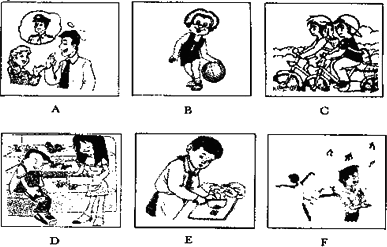
B.听对话根据所听到的内容,选择正确的答案(对话读两遍,每小题1分,满分15分)
第一节:听下面5段对话,每段对话后有一个小题,从题中所给的A、B、C三个选项中选出最佳答案。
6.What's the time now?
A.3∶30.
B.4∶30.
C.5∶30.
7.Whom does the woman want to speak to?
A.Mr.Johnson.
B.Mr.Smith.
C.Mr.Brown.
8.Why can't the man go to the birthday party?
A.Because he is iii.
B.Because he is busy.
C.Because he will go to Shanghai.
9.How will the weather be tomorrow?
A.Rainy.
B.Sunny.
C.Cloudy.
10.What do we know about the new teacher?
A.He often keeps silent.
B.He talks too much.
C.He has no chance to speak.
第二节:听下面4段对话,每段对话后有二或三个小题,从题中所给的A、B、C三个选项中,选出最佳答案。
听第一段对话,回答11、12题。
11.When does the conversation take place?
A.At breakfast time.
B.At lunch time.
C.At supper time.
12.What are they going to do?
A.To drink a cup of milk.
B.To cook at home.
C.To have a meal at a restaurant.
听第二段对话,回答13、14题。
13.What's wrong with the woman?
A.She has a stomachache.
B.She has a toothache.
C.She has a cough.
14.Where are the two speakers?
A.In a chemistry shop.
B.At home.
C.At a bus stop.
听第三段对话,回答15、16、17题。
15.What does the man do?
A.He is a teacher.
B.He is a singer.
C.He is a doctor.
16.Who wants to see the man?
A.The headteacher.
B.The teachers.
C.The students.
17.Why is the man worried about going back to that school?
A.Because he is not popular.
B.Because he made a lot of trouble there when he was young.
听第四段对话,回答18、19、20题
18.Where is the girl from?
A.America.
B.Australia.
C.England.
19.Why does the girl come to China?
A.To see her parents.
B.To go travelling.
C.To find a job.
20.What will the girl do next year?
A.She will work in China.
B.She will work in Japan.
C.She will stay in her own country.
C.听短文,根据所听到的内容,选择正确的答案(敌方读三遍,每小题分,满分5)听第五对话,回答21、22、23、24、25
21.How long did Mr.Black work in a restaurant?
A.For ten years.
B.For ten months.
C.For ten days.
22.Once Mr.Black had to see a doctor because something was wrong with his ________
A.cars
B.eyes
C.nose
23.What did Mr.Black decide to do?
A.To open a hotel.
B.To open a shop.
C.To open a hospital.
24.Who came to knock at his door one evening?
A.A stranger.
B.A woman.
C.A doctor.
25.What happened to the man after he took Mr.Black's medicine?
A.He got better.
B.He got well.
C.He became worse.
D.听一段材料,根据所听到的内容,完成26-30题(材料读三遍,每小题1分,满分5分)
Name:Diana
Age: 26
Hair: 27
Tel: 28
Job:an 29 in Micro Works
Likes:going out, 30 , music and watching TV
One summer evening as I was cooking dinner, there was a knock at the door. I opened it and saw an old man. But his voice was pleasant as he said, “Good evening. I come to see if you have a room for just one night. I live far away from here, and there's no bus till next morning. ”
I told him we would find him a bed, but it was not comfortable. I went inside and cooked dinner. When we were ready, I asked him if he would like to join us. “No, thank you. I have plenty.” When I had finished the dinner, I went out to talk with him. He told me he fished for a living to help his daughter, her five children, and her husband, who was ill and too weak to do anything.
At bedtime, we put a bed in the children's room for him. On his next trip, as a gift, he brought a big fish and some fresh vegetables. In the years he came to stay overnight with us, and there was never a time he did not bring us some fish or vegetables from his garden.
I know it was thankful for our family to know him, from whom we learn what was to accept the bad without a complaint(抱怨) and the good with thanks.
1Why did the old man go to the writer's house?
A. To give a fish to the writer. B. To stay for the night.
C. To sell some fish. D. To ask for some money.
2 How many people were there in the old man's daughter's family?
A. Two. B. Four. C. Six. D. Seven.
3 Which of the following is true?
A. The old man stayed for the night with the writer only once.
B. The old man came to the writer's house to ask for some food.
C. The old man came to stay with the writer for the night many times.
D. The old man felt lonely because he had no son or daughter.
British people are famous for drinking tea. But brother and sister, Sarah and Bobby Green, became young millionaires(百万富翁) when they opened a chain of American-style coffee shops in the UK.
Having the idea: It started when Sarah took a weekend trip to New York to visit her brother Bobby. One evening, in a Thai restaurant, Sarah told Bobby how much she wished she could buy American-style coffee in London. Bobby suggested they started their own coffee shop. Sarah fell in love with the idea.
Doing the research: Back in London, she spent a whole day on the London subway, getting off the train at different stations to taste the coffee. “It was terrible, and I knew there was a gap (空缺) in the market.” In 1995, they opened their first Coffee Republic shop in the center of London.
Making it work: The first year was very difficult. British people were not used to the names of American coffees, like latte and macchiato. But being successful was their dream and they were not going to give up. Today, there are over 100 Coffee Republic shops all over the country and the company has £30 million a year.
Advice for others: Sarah has now written a best-selling book about their experience, called Anyone Can Do It! She hopes it will help other young people to start their own businesses. She says, “If you think you have the energy, then get out and follow your dream.”
4What kind of company do they run?
A. A fast-food restaurant. B. A tea shop.
C. A coffee shop. D. A big hotel.
5 Where are their Coffee Republic shops?
A. All over the UK. B. All over the US.
C. In the center of London. D. In New York.
6Which information is mentioned in the passage?
A. Sarah was not interested in Bobby’s idea.
B. British people never drank coffee before 1995.
C. Sarah’s best-selling book is about how to make coffee.
D. Sarah found a business chance while doing the research.
 Most people around the world are right-handed. This also seems to be true in history. In 1799, scientists studied works of art made at different times from 1,500 B. C. to the 1950s. Most of the people shown in these works are right-handed, so the scientists guessed that right-handedness has always been common through history. Today, only about 10% to 15% of the world's population is left-handed.
Why are there more right-handed people than left-handed ones? Scientists now know that a person's two hands each have their own jobs. For most people, the hand is used to find things or hold things. The right hand is used to work with things. This is because of the different work of the two sides of the brain(脑). The right side of the brain, which makes a person's hands and eyes work together, controls(控制) the left hand. The left-side of the brain, which controls the right hand, is the centre for thinking and doing problems. These findings show that more artists should be left-handed, and studies have found that left-handedness is twice as common among artists as among people in other jobs.
No one really knows what makes a person become right-handed instead of left-handed. Scientists have found that almost 40% of the people become left-handed because their main brain is damaged(伤害) when they are born. However, this doesn't happen to everyone, so scientists guess there must be another reason why people become left-handed. One idea is that people usually get right-handed from their parents. If a person does not receive the gene(基因)for right-handedness, he/she may become either right-handed or left-handed according (根据)to the chance and the people they work or live with.
Though right-handedness is more common than left-handedness, people no longer think left-handed people are strange or unusual. A long time ago, left-handed children were made to use their right hands like other children, but today they don't have to.
7 After studying works of art made at different times in history, the scientists
found ____________.
A. the art began from 1,500 B. C.
B. the works of art ended in the 1950s
C. most people shown in the works of art are right-handed
D. most people shown in the works of art are left-handed
8 How many people in the world are left-handed now?
A. Less than one sixth. B. More than a half.
C. About 40%. D. The passage doesn't tell us.
9 According to the passage, which of the following is NOT true?
A. No one really knows what makes a person become right-handed.
B. Scientists think there must be some reason why people become left-handed.
C. Today children are not made to use their right hands only.
D. Left-handedness is cleverer than right-handedness.
10 What is the best title for this passage?
A. Left-handed People B. Scientists' New Inventions
C. Which Hand D. Different Brains, Different Hands
湖北省互联网违法和不良信息举报平台 | 网上有害信息举报专区 | 电信诈骗举报专区 | 涉历史虚无主义有害信息举报专区 | 涉企侵权举报专区
违法和不良信息举报电话:027-86699610 举报邮箱:58377363@163.com