
题目列表(包括答案和解析)
听力
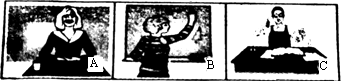
Ⅰ、听句子,根据所提问题选出符合题意的图片。(每小题1分,共5分)
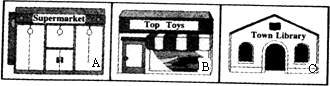
( )1.Where was Peter when the UFO arrived?
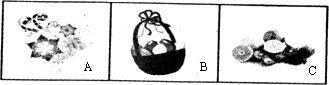
( )2.What should Linda take?
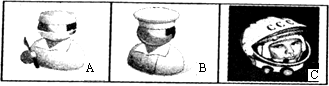
( )3.What does he do?
( )4.What will Jim do this evening?
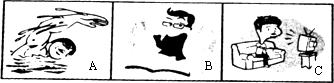
( )5.Who said Rita was lazy?
Ⅱ、听对话,选择正确答案。(每小题1分,共5分)
( )6.What does the girl want to do?
A.She wants to stay with her friends.
B.She wants to join the basketball club.
C.She wants to join the baseball club.
( )7.What do Mary's parents want her to do after she finishes high school?
A.They want her to find a job.
B.They want her to travel around the world.
C.They want her to go to college.
( )8.Why won't Bob wear the jeans today?
A.Because he has to wash them first.
B.Because he doesn't like them.
C.Because they are out of style.
( )9.Who is cutting Linda's father's hair?
A.Mr Black.
B.Linda's mother.
C.Mrs Black.
( )10.Where does Lucy work?
A.In a post office.
B.At a TV station.
C.In a school.
Ⅲ、听长对话,选择正确答案。(每小题1分,共5分)
( )11.Who went to the school party yesterday?
A.The girl.
B.The boy.
C.The girl's cousin.
( )12.Who cooks breakfast in Ann's family every day?
A.Ann.
B.Ann's father.
C.Ann's mother.
( )13.How did they go to the hospital?
A.By car.
B.By bus.
C.By bike.
( )14.What subject did Bill do badly in?
A.Science.
B.History.
C.Math.
( )15.What time did Ann go to bed yesterday evening?
A.At about 10∶30.
B.At about 11∶00.
C.At about 11∶30.
Ⅳ、听长对话,写出所缺部分,每空词数不限。(每小题1分,共5分)
W:Hello.Brian.What's the matter?
M:I had a fight with my best friend last week.I'm very(16)________ now.
W:How did it start?
M:My best friend is very good at math.We had a math test last(17)________.I wanted to copy his answer to a problem.But he said“No”.
W:What happened next?
M:I asked(18)________, he couldn't help me after the test.He said that was not good for me.I was very(19)________ at him.I said I didn't want to be his friend anymore.So we didn't talk to each other.
W:I think he was right.Brian.You should(20)________ sorry to him.
M:I agree with you.But that's not easy.
阅读下面短文,然后根据短文内容回答问题。
Children start out as natural scientists, eager to look into the world around them.Helping them enjoy science can be easy; there's no need for a lot of scientific terms or expensive lab equipment.You only have to share your children's curiosity(好奇).Finally, listen to their questions.I once visited a classroom of seven-year-olds to talk about science as a job.The children asked me“textbook questions”about schooling, salary(薪水)and whether I liked my job.When I finished answering, we sat facing one another in silence.Finally I said,“Now that we've finished your lists, do you have questions of your own about science?”
After a long pause, a boy raised his hand,“Have you ever seen a grasshopper(蚱蜢)eat? When I try eating leaves like that.I get a stomachache.Why?”
This began a set of questions that lasted nearly two hours.
Secondly, give them time to think.Studies over the past 30 years have shown that, after asking a question, adults typically wait only one second or less for an answer, no time for a child to think.When adults increase their“wait time”to three seconds or more, children give more logical(符合逻辑的), complete and creative answers.
Thirdly, watch your language.Once you have a child involved in a science discussion, don't jump in with“That's right”or“Very good”.These words work well when it comes to encouraging good behavior(行为).But in talking about science, quick praise can signal that discussion is over.Instead, keep things going by saying,“That's interesting”or“I'd never thought of it that way before”, or coming up with more questions or ideas.
Never push a child to“Think”.It doesn't make sense, children are always thinking, without your telling them to.What's more, this can turn a conversation into a performance.The child will try to find the answer you want, in as few words as possible, so that he will be a smaller target for your disagreement.
Lastly, show; don't tell.Real-life impressions of nature are far more impressive than any lesson children can learn from a book or a television program.Let children look at their fingertips through a magnifying glass(放大镜), and they'll understand why you want them to wash before dinner.Rather than saying that water evaporates(蒸发), set a pot of water to boil and let them watch the water level drop.
1.What's the most important thing for adults to do when children are natural scientists, and to raise their interest?
________________________________
2.What can replace the word“list”in the last sentence of the first paragraph?
________________________________
3.How long should adults wait so that children can answer questions in a more logical, complete and creative way?
________________________________
4.What can we say to encourage children in a science discussion?
________________________________
5.Which is a better way for adults, tell their children or encourage their children to ask questions of their own?
________________________________
湖北省互联网违法和不良信息举报平台 | 网上有害信息举报专区 | 电信诈骗举报专区 | 涉历史虚无主义有害信息举报专区 | 涉企侵权举报专区
违法和不良信息举报电话:027-86699610 举报邮箱:58377363@163.com