
题目列表(包括答案和解析)
|
A. How do you like your computer? B. What do you usually use your computer for? C. Because it is fast and easy. D. Do you have a computer at home? E. How often do you use your computer? |
A: _______(61)
B: Yes, I have one. It’s a birthday from my uncle.
A: ________(62
B: I usually use it to search the Internet.
A: Why?
B: _________(63)
A: _________(64)
B: Every day.
A: _________(65)
B: I like it very much. It’s very useful
根据下面的对话情景,在每个空白处填上一个适当的句子,使对话的意义连贯、完整。
A : (61)________________________?
B: I’m going to Tom’s party.
A: Great ! I’ll go to the party, too. We can go together.
B: Well, I’m a little nervous. (62)__________________.
A: What about your white skirt? You look beautiful in it.
B: Really? OK, I’ll wear my white skirt. (63)_______________.
A: I bought him a shirt. Perhaps you can buy him a tie. What do you think of it?
B: (64)_______________.A: So how about a watch?
B: (65)_______________.Thank you very much.
A: You are welcome.
阅读下面短文,然后根据要求完成短文后面的题目。(5分)
Wang Fengqin, a 61-year-old woman in Beijing, volunteers to sort(分类) rubbish in her living area in Beijing's Chaoyang District.
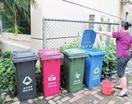 At 6:30 every morning, while half of Beijing is still in sleeping dreams in bed or enjoying a delicious breakfast, Wang rushes through her busiest hours in the day. She gets up, gives her face a quick wash, takes a simple breakfast ,and rushes to the four rubbish dustbins beside the gate of her living area.There she checks the waste left by her neighbors to make sure it is sorted correctly.
“Sorting rubbish will improve the environment for all of us and it only takes a minute," Wang said."I want to help my neighbors ….”
As Wang spoke, an old man came by and threw a plastic bag full of rubbish into the dustbin marked "recyclable ".
"Hey, please, there are some orange peels and fish bones in your bag, so they are supposed to be put into the dustbin marked 'kitchen waste' ," Wang told him.
Learning the old man was in a hurry, Wang let him go, opened the bag herself, picked out the kitchen waste and threw it in the right dustbin.
Wang has been doing this every day from 7 a.m. to 9 a.m.and from 6 p.m.to 8 p.m.since March 10. She says people usually go downstairs and throw out rubbish at this time.
Most people had no idea about sorting rubbish at first, but now 90% can put rubbish in the correct dustbin, Wang says.However, she plans to keep doing this job after all her neighbors sort correctly.
105. 根据短文内容完成句子(每空限填一个单词)
The first and the second paragraphs tell us Wang Fengqin do and
she spends her morning.
106. 根据短文内容完成句子(每空限填一个单词)
Because the old man had no to sort the rubbish, Wang did it .
107. 根据短文内容完成句子(每空限填一个单词)
According to the passage we know that it takes Wang to sort rubbish every day.
108. 把短文中画底线的句子译成汉语。
__________________________________________________________________________
109. 根据短文内容用一个完整的英文句子(限15个词以内)回答问题。
Sorting rubbish will improve our environment. What’s another reason that Wang Fengqin sorts rubbish?
词语填空(共10小题,计l0分)

It was a 61 Saturday afternoon in Oklahoma City. My friend ,a proud father Bobby Lewis was taking his two little boys to a park. He walked 62 to the assistant at the ticket counter and said, "How much is it to get in?"
The young man replied, "$3.00 for you and $3.00 for 63 kid who is 64 than six. We let them 65 free if they are six or younger. How old are they?"
Bobby replied, "Joe's three and David’s seven, so I guess I owe you $6.00."
The man at the ticket counter said, "Hey, Mister, did you just win the lottery or something? You could 66 yourself three dollars. You could 67 told me that the older one was six; I wouldn't know the difference." Bobby replied, "Yes, that may be 68 , but the kids would know the difference."
In challenging times when ethics (道德规范)are more important than 69 before, make sure you set a good 70 for everyone you work and live with.
Wood-block printing was invented sometime between the 4th and the 7th c 56 in Chi?na. The earliest book that we have was p 57 in 868 and was found in a Dunhuang cave. Wood-block printing took a long time because a new block was needed for every p 58 in z book. By the 1 Ith century printed books could be f 59 all over China. They included books of Confucius' thoughts, dictionaries, and books on maths. In 1340, books could be printed u-sing two c 60 , black and red.
A 61 the Chinese learnt about printing so early, printing was not introduced in other parts of the world for hundreds of years. It is thought that when the great Italian traveler Marco Polo visited China in the 13th century, he s 62 printed books. It is possible that Marco Po?lo brought that k 63 to Europe. But printed books did not come to Europe u 64 1450 when a German called Johann Gutenberg i 65 a printing machine. Twenty-four years later, in 1474, an Englishman called William Caxton printed the first printed book in English. His second book was about the game of chess. Caxton printed about a hundred books, and some can still be found today in museums.
56. c_____57. p_____ 58. p_____59. f_____ 60. c_____
61. A_____ 62. s_____ 63. k_____ 64. u_____ 65. i_____
湖北省互联网违法和不良信息举报平台 | 网上有害信息举报专区 | 电信诈骗举报专区 | 涉历史虚无主义有害信息举报专区 | 涉企侵权举报专区
违法和不良信息举报电话:027-86699610 举报邮箱:58377363@163.com