
题目列表(包括答案和解析)
用所给词和短语的适当形式填空
Tom and Fred are 1 the year 2015. “What will the world 2 in the year 2015?” asks Tom. “I don’t know.” Says Fred. “What do you think?” “Well, no one knows, but it is 3 to guess,” “ In the year 2015 4 will carry a pocket computer .The computer will give people the answers to all the questions. We shall all have telephones in our pocket, too, and we’ll be able to talk to our friends 5 . Perhaps we’ll be able to see them at the same time.”
“A lot of people will live and work under the sea. Perhaps there’ll be big towns, factories, and farms 6 , too.” “
“Machines will do most of the 7 , so people will have more holidays . Perhaps they’ll work 8 two or three days a week. They will be able to fly to the moon by spaceship and spend their holidays there.
“I am 9 the year 2015. I hope to fly to the moon.” Says Tom. “And I hope I’ll be able to live under the sea,” says Fred. “Won’t it be interesting? Just 10 a fish.”
— Excuse me, could you tell me ________ to fly to Guilin?
— About two hours.
|
A.how soon does it take |
B.how long it takes |
|
C.how long did it take |
D.how soon it took |
Nigel is our new next-door neighbour. He’s a pilot(飞行员). He was in the R.F.A. He will fly to New York next month. The month after next he’ll fly to Tokyo. At the moment, he’s in Madrid. He flew to Spain a week ago. He’ll return to London the week after next . He’s only forty-one years old, and he has already been to nearly every country in the world. Nigel is a very lucky (幸运的)man. But his wife isn’t very lucky. She usually stays at home!
1. Nigel’s job is a ________.
A.teacher B.doctor C.actor D.pilot
2. ____ Nigel will fly to Tokyo.
A.Next month
B.The month after next
C.A week before
D.We don’t know in the text.
3.What does Nigel’s wife usually do?
A.Goes to every country in the world with Nigel.
B.Goes to work
C.Flies to New York and London.
D.Stays at home.
4. Is Nigel’s wife lucky?
A.Yes, she is. B.No, she isn’t.
C.She is lucky. D.No, she is.
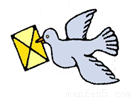
People have used pigeons to carry messages to one another for hundreds of years. In the 12th century, the royal palaces of Iraq and Syria included pigeon houses so the kings could be kept informed of their generals’ victories and defeats on the battlefield. In fact, pigeons were a common way to send messages right up through World War II.
Many countries, such as the United States, England, France, Germany, and Italy, in both World War I and World War II, used carrier pigeons. Not only were the birds often the fastest, most reliable way to send messages, they could also be used to reach soldiers far behind enemy lines, where radios and field telephone lines were useless. Since they could easily be released (释放) from airplanes or ships, every branch of the armed services used the birds. In World War II, more than 3,000 soldiers and 150 officers were needed to care for and train the tens of thousands of birds in the U.S. Pigeon Service.
Carrying messages could be a dangerous job. Some pigeons performed with such bravery that they became famous and were even awarded medals, such as England’s Dicken Medal of Gallantry. In a few cases, pigeons even became prisoners of war. In 1918 American forces captured a pigeon named Kaiser, which had been trained to fly special missions for Germany during battle. He was taken to America, where he lived to the age of 32. The most famous pigeon of all may have been Cher Ami. Stationed in France during World War I, he carried twelve important messages for American forces. On his last mission, though wounded, he carried a message that saved the lives of 194 American soldiers. For his extraordinary service, he was awarded the French “Croix de Guerre.”
Carrier pigeons are a slightly different breed (品种) from the kind of pigeons you see on city streets. They are much thinner and taller, with longer legs. Many people find carrier pigeons ugly because of their big wattle, a bent buildup of skin on the beak(鸟嘴); however, people who raise pigeons often enjoy this strange appearance and consider carriers the best of their breed.
Today, modern communication methods can carry information from one place to another hundreds of times faster than a pigeon could do. However, few people would argue with the fact that carrier pigeons—especially those that served in the military—have earned their place in history. Stories about brave pigeons such as Cher Ami, President Wilson, and Colonel’s Lady have the power to inspire us as no fax machine or high-speed Internet connection could ever do.
1.Many countries used carrier pigeons in the war because_______.
A.they could be believed in
B.they were easily raised
C.they could reach the enemy lines
D.they could hardly be found by airplanes
2.Which is the best example to show the bravery of carrier pigeons?
A.Carrier pigeons could fly to places where radios and telephone lines were useless.
B.For his extraordinary service, Cher Ami was awarded the French “Croix de Guerre”.
C.In World War II, more than 3,000 soldiers were needed to care for and train the pigeons.
D.In the 12th century, kings in Iraq were kept informed of the victories and defeats by pigeons.
3.From the passage, we can learn _________.
A.how carrier pigeons developed in history
B.how to train carrier pigeons to get victory
C.carrier pigeons played an important role in the wars in the old days
D.pigeons inspired soldiers to fight before high-speed Internet invented
湖北省互联网违法和不良信息举报平台 | 网上有害信息举报专区 | 电信诈骗举报专区 | 涉历史虚无主义有害信息举报专区 | 涉企侵权举报专区
违法和不良信息举报电话:027-86699610 举报邮箱:58377363@163.com