题目列表(包括答案和解析)
听力(20分)
A)从A、B、C三幅图中找出与你所听内容相符的选项。听两遍。
1.What's the weather like in Jiangyan today?

2.How does David usually go to school?

3.What will Tony give his father?

4.Where is the boy's soccer?

5.Which sign is mentioned in the conversation?

B)听对话,根据所听对话及问题选择正确答案。听两遍。
6.Who wanted to borrow the dictionary?
A.Daniel.
B.Kitty.
C.Millie.
7.What are the boys doing?
A.They're having a meeting.
B.They're playing a game.
C.They're making too much noise.
8.What did the girls do last Sunday?
A.They visited a museum.
B.They saw an interesting film.
C.They visited a large factory.
9.What time do you think they got to the supermarket?
A.9∶00
B.11∶00
C.17∶15
10.Where did the dialogue take place?
A.In a bookshop
B.In a library.
C.In a classroom.
C)听下面两段对话,每段对话后有几个小题,从题中所给的A、B、C三个选项中选出最佳选项。每段对话读两遍。
听第1段对话,回答第11-12题。
11.Where does this dialogue happen?
A.At home.
B.At school.
C.In the open air.
12.What does Jack like to eat?
A.A chicken sandwich.
B.A tomato sandwich.
C.A potato sandwich
听第2段对话,回答第13至15题。
13.Where does the man want to go?
A.The post office.
B.The railway station.
C.The Olympic Village.
14.Is it far from here?
A.Yes, it is.
B.No, it isn't
C.I don't know.
15.How is he going there?
A.On foot.
B.By bus.
C.By train.
D)听短文 根据所听到的短文,选择最佳答案(听两遍)。
16.Who sent George to work when he was 8 years old?
A.His uncle.
B.His father.
C.His teacher.
17.When did George learn to read?
A.In 1992.
B.In 1994.
C.In 1996.
18.Where were the adult classes?
A.Near his home.
B.Far from his home.
C.In another city.
19.What is George's book about?
A.Poor children in different counties.
B.How to read fast.
C.Stories from his life.
20.What is the main idea of this story?
A.Life is so good.
B.Reading is important.
C.Never too late to learn.
听力理解:(本大题分为A、B、C、D四部分,共25小题,30分)
听句子(本题共5小题,每小题1分,共5分)
A.根据所听句子的内容和所提的问题,选择符合题意的图画回答问题。每小题听一遍。
1.What does the woman do every day?
A.
B.
C.
2.What does the speaker prefer?
A.
B.
C.
3.What happened to Tom?
A.
B.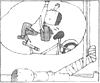
C.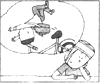
4.What will the weather be like tomorrow?
A.
B.
C.
5.What festival do they plan to celebrate?
A.
B.
C.
B.听对话(本题共10小题,每小题1分,共10分)
根据所听对话内容回答每段对话后面的问题,在所给的三个选项中选出一个最佳答案。每段对话听两遍。
听第一段对话,回答第6题。
6.What did Amy use to be like?
A.Shy.
B.Outgoing.
C.Easy-going.
听第二段对话,回答第7题。
7.Where are they?
A.At the airport.
B.At the railway station.
C.At the cinema.
听第三段对话,回答第8题。
8.Why hasn’t the boy been to a concert?
A.Because his mother didn’t allow him to go there.
B.Because he missed it.
C.Because the ticket is too expensive.
听第四段对话,回答第9题。
9.Who should wash the dishes?
A.Jack.
B.Lily.
C.Mum.
听第五段对话,回答第10题。
10.What’s the house made of?
A.Metal.
B.Wood.
C.Rubbish.
听第六段对话,回答第11-12题。
11.How long has Celia been in the United States?
A.For about three weeks.
B.For about thirteen days.
C.For about half a month.
12.What was the weather like in Chicago?
A.It was windy.
B.It rained a lot.
C.It was snowy.
听第七段对话,回答13-15题。
13.Where was Sam born?
A.In the USA.
B.In Australia.
C.In China.
14.What does Sam do?
A.A painter.
B.A doctor.
C.A photographer.
15.When did Sam get his camera?
A.After taking photos of Mt.Qomolangma.
B.After he won the first prize.
C.When he was ten.
C.听短文(本题共5小题,每小题1分,共5分)
根据所听短文的内容,在每小题给出的三个选项中,选出一个能完成句子的最佳选项。本题听两遍。
16.________ are good seasons for outdoor activities.
A.Autumn and winter
B.Summer and autumn
C.Spring and autumn
17.It is important that you should take ________ in order to get simple medical treatment.
A.a tent and sleeping bags
B.a first-aid box(急救箱)
C.food and drinks
18.When hiking in a group, young people have a good chance to ________.
A.enjoy the beautiful view
B.learn team spirit
C.know how to deal with a snake
19.If you see a snake nearby during the hiking, you should ________.
A.run away as fast as possible
B.fight with it
C.wait quietly for it to go away
20.You should ________ to stop the poison(毒物)from spreading to other parts of the
body if you are bitten(咬)by a snake.
A.send for help
B.wash the wounded part
C.tie something round the bite
D.听填信息(本题共5小题,每小题2分,共10分)
你将听到的是一篇关于礼仪习俗的短文,请根据所听内容填写正确的信息完成表格。本题听两遍。

| |||||||||||||||||||||||||||||||||||||||||||||||||||||||||||||||||||||||||
| |||||||||||||||||||||||||||||||||||||||||||||||||||||||||||||||||||||||||||||||||||||||
根据短文内容,从各题的四个选项中选择一个最佳答案。
Some people believe that dreams can tell them what will happen in the future. 1 knows why this is so, but there are many stories about people who had dreams that__2__. One of these people was a man ___3_ John Chapman, who lived in Swaffham in England many years ago.
John Chapman dreamt that he _4___ on London Bridge and a man told him how to become rich. John Chapman was a poor man and he needed __5__, so the next day he decided to left for London. ___6__ was 100 miles from Swaffham to London. He walked for few days and at last he __7__ London Bridge. There were many people on the bridge, but they weren’t ___8_ in John Chapman. No one __9___ him. After three days, John Chapman decided to go home, __10__ before he could do this, a shopkeeper came up to him.
“I’ve been watching you,” he said. “Are you __11__ someone?”
“Yes,” said John. “I had a dream about a man here. He would help me to get much money.”
“Oh,” said the shopkeeper. “You shouldn’t believe in dreams. __12_ I believe in dreams, I’d be in Swaffham right now. I had a dream a few days ago about a man called John Chapman from Swaffham. He had __13__ in his garden, near an old apple tree.”
John Chapman was __14__ by what the shopkeeper said. At once he went home and dug near an old apple tree. He soon found many pieces of gold. He was so happy __15__ he gave some of the gold to his church. For the rest of his life, he was a rich man.
1. A. Nobody B. Anybody C. Somebody D. Everybody
2. A. came out B. came up C. came true D. came to
3. A. call B. to call C. calling D. called
4. A. is standing B. was standing C. will stand D. stands
5. A. dream B. future C. money D. apple
6. A. This B.It C. That D. Its
7. A. reached B. arrived C. got D. went
8. A. interest B. interests C. interesting D. interested
9. A. listened to B. talked to C. said to D. needed to
10. A. as B. and C. but D. or
11. A. waiting for B. asking for C. caring for D. looking for
12. A. When B. Where C. If D. How
13. A. money B. apple C. tree D. gold
14. A. angry B. surprised C. happy D. amazed
15. A. which B. that C. until D. unless
湖北省互联网违法和不良信息举报平台 | 网上有害信息举报专区 | 电信诈骗举报专区 | 涉历史虚无主义有害信息举报专区 | 涉企侵权举报专区
违法和不良信息举报电话:027-86699610 举报邮箱:58377363@163.com