
题目列表(包括答案和解析)
单词拼写
We should try our best to p________ wild animals like the giant pandas.
填词。
【小题1】I can work out(算出)the math p_________.
【小题2】We are students.We have a lot of h________ to do every day.
【小题3】He is a cook.He works in a r__________.
【小题4】Tom and I are in the same class.We are c___________.
【小题5】The dress has four c__________.They are black,red,white and green.
【小题6】Han Mei often ________ me ________(帮助)my English.
【小题7】_________ __________ (两百)students are in this school.
【小题8】The dress is too expensive(昂贵的),and I’ll _______ ________(考虑)it.
【小题9】We are good friends.We often help ________ ________(互相).
【小题10】She _______ _______(住在)America now.
【小题11】Help ________(you),kids!
【小题12】She is glad _________ (help)you.
【小题13】Mr. Brown is a good teacher.We like________(he) very much.
【小题14】We ar from China.We are____________(China).
【小题15】How about _________(fly) kites with me?
先通读下面的短文,然后根据短文内容和所给首字母,在空格内填入一个适当的单词。使短文完整。所填单词必须在答题卡标有题号的横线上完整写出。(本大题共10空,每空0.5分,共5分)
Do you like listening to radio? For some people, listening to radio programs has become a part of their d__1.lives. How did this start?
Radio began as ship-to-ship and ship-to-land c__2.. In the early 1900s, several people showed that radio could do more than that. Dr. Lee De Forest, is w____3. known as the father of radio. He made the first p___4. radio broadcast. As a fan of opera, De Forest wanted to s__5. the musical entertainment into homes. His first try was on January 13,1910, from the Metropolitan Opera House (大都会歌剧院) in New York City. However, the signal was not good enough. Only a few listening stations and a___6.in the harbor (港湾) area were able to hear this broadcast. Although there was a lot to do to improve, it s__7.what radio could do.
Look at the world around us. Radio broadcasts are e___8.. Information now travels at the speed of l____9.. Music, news, traffic reports and speeches from world leaders are all on the radio. Can you imagine a world w___10.radio?
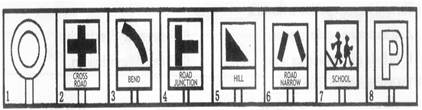
A sign is another kind of language. Here are some of them that you see on the roads.
Number One is a sign with the number thirty on it. When drivers see this sign, they must not go at more than thirty kilometers an hour. We see this sign when we are getting near a town. Number Two is a sign that we’re near a crossing. We must drive carefully. Number Three is a sign that there is a bend (拐弯) in the road. Again, we must drive slowly and carefully. It is not safe to go around a bend very fast. Number Four is a sign that there is another road coming in from the right. There is a junction (交叉) at this place. Number Five is a sign that there is a hill and Number Six is a sign that the road gets narrow. Drivers must go slowly and carefully. Number Seven has the word “SCHOOL” on it. This is a sign that there is a school at the side of the street or the road. Perhaps there are children going to or leaving school. So drivers must look carefully and go slowly. Number Eight is a sign with the letter “P” on it. The letter “P” means “Parking”. At some places, there are the signs “No parking” or “No waiting”. If a driver leaves his car near one of these signs, a policeman may come and write down the number of his car.
1.At the places where you see Sign 1, ____________. .
A.you are already out of a town
B.you still have thirty kilometers to go
C.there must be many houses and building not far away
D.there must be a town thirty kilometers away
2.A driver can leave his car ___________.
A.near a sign with “P” on it in the daytime
B.near a sign with “No parking” on it
C.near a sign with “No waiting” if there’re no policemen there
D.near Sign 8 at any time
3.People put these signs on the roads to ____________.
A.make driving even safer B.show drivers the way
C.stop cars going too fast D.learn another kind of language
A sign is another kind of language. Here are some of them that you can see on the roads.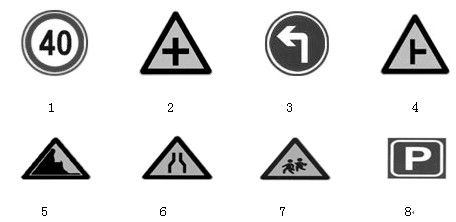
Number One is a sign with the number forty on it. When driver see this sign, they must not go at more than forty kilometers one hour. We see this sign when we are getting near a town. Number Two is a sign that we’re near a crossing. We must drive carefully. Number Three is a sign that there is a bend (弯道) on the road. Again, we must drive slowly and carefully. It is not safe to go round a bend very fast. Number Four is a sign that there is another road coming in from the right. There is a junction(交叉点) at this place.
Number Five is a sign that there is a dangerous mountain road and Number Six is a sign that the road gets narrow. Drivers must go slowly and carefully when they see these signs. Number Seven is a sign that there is a school at the side of the street or the road. Perhaps there are children going to or leaving school. So drivers must look carefully and go slowly. Number Eight is a sign with a letter “P” on it. The letter “P” means “Parking”. At some places, there are signs “NO PARKING” or “NO WAITING”. If a driver leaves his car near one of these signs, a policeman may come and write down the number of his car.
【小题1】. At the place where you see Sign 1, ________.
| A.you are already out of the town |
| B.you still have forty kilometers to go |
| C.there must be a town forty kilometers away |
| D.there must be many houses and buildings not far away |
| A.two roads cross | B.the road gets narrow |
| C.there are no traffic lights | D.people can cross the road |
| A.either of signs 2 and 3 | B.all of signs 3, 5, 6 and 7 |
| C.each of the eight signs | D.any of signs 3, 6, 7 and 8 |
| A.near Sign 8 at any time |
| B.near a sign with “NO PARKING” on it |
| C.near Sign 3 in the daytime |
| D.near a sign with “NO WAITING” if there’re no police there |
| A.show drivers the way | B.stop cars going too fast |
| C.make driving even safer | D.learn another kind of language |
湖北省互联网违法和不良信息举报平台 | 网上有害信息举报专区 | 电信诈骗举报专区 | 涉历史虚无主义有害信息举报专区 | 涉企侵权举报专区
违法和不良信息举报电话:027-86699610 举报邮箱:58377363@163.com