
25.Can we sit ▲ the table ▲ the window? A.on, near B.at, by C.on, by D.at, on 查看更多


题目列表(包括答案和解析)

How can we ________ there?

[  ]

A.

get

B.

arrive in

C.

get to

D.

arrive at

查看答案和解析>>

—Mum, can we go to the art museum tomorrow?

—Sure. But first we should find out ________.

A. what can we do          B. where we can go

C. how can we go there        D. if it will be open

查看答案和解析>>

阅读理解

阅读下列短文,从每小题所给的A、B、C、D四个选项中选出一个能回答所提问题或完成所给句子的最佳选项。

  When you finish high school or university, is learning done? The answer is “no”.In many countries, people continue learning all their lives.Why is lifelong learning important? How can it help you? Let's look at one example of lifelong learning in Japan.

  Why is lifelong learning important?

  You go to school and learn.You take tests.But learning doesn't only happen in school.And learning doesn't stop when you graduate from high school or college.You are learning all the time.For example, learning can happen when you go to a museum.It can also happen when you get a job.You learn when you play a sport or when you take a trip.Learning is life! We never stop learning.Every day, you can improve yourself by learning something new.

  Lifelong learning in Japan

  In Japan, life learning is very important.People in Japan like to try new learning activities.Music calligraphy, flower arranging, and foreign languages are some of their favorite classes.The Japanese take classes to improve their skills and learn new things.

  Conclusion

  When we graduate from school, we can continue to learn.Make lifelong learning one of your goals!

(1)

Why is lifelong learning important?

[  ]

A.

It helps you improve yourself.

B.

It's the best way to learn.

C.

It's fun and easy.

D.

It's an important goal.

(2)

Some people in Japan take foreign language classes to ________

[  ]

A.

get a job

B.

learn new things

C.

get good grades

D.

finish college

(3)

Which of the following is TRUE according to the passage?

[  ]

A.

Learning only happens in school.

B.

When we graduate from school, learning is done.

C.

You can't learn anything when you play a sport.

D.

Music, calligraphy, flower arranging and foreign languages are popular classes in Japan.

(4)

When can we learn?

[  ]

A.

in the high school

B.

in the college

C.

when you get a job..

D.

A, B and C

(5)

What is the main idea of the reading?

[  ]

A.

Learning can be fun.

B.

We are always learning in school.

C.

Finishing high school is important.

D.

People can learn all their lives.

查看答案和解析>>

根据短文内容回答问题。(Answer the questions according to the passage.)

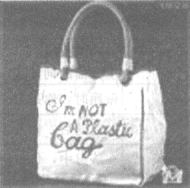
Say“No”to plastic bags

  In order to stop plastic pollution, China put a ban(禁令)on thin plastic bags(plastic bags thinner than 0.025 mm).From June 1, 2008, China stopped the production, sale and use of these plastic bags.It stopped shops from giving out free plastic bags to the public and call on the consumers to adopt healthy shopping habits to protect our environment.
Why are plastic bags so bad?

  China's plastic bag consumption(消费量)has rocketed to near three billion bags per day-that's about 2 for every man, woman and child-causing many tons of plastic to go to landfill sites.

  The bags can take between 400 and 1, 000 years to break down, and like all forms of plastic they do not biodegrade.They clog(阻碍)waterways and spoil the landscape.They also pollute the soil and water.

  Plastic bags also present a serious danger to animals.They often mistake them for food.Thousands of them die each year after swallowing or choking with discarded(丢弃的)plastic bags.

  Finally, producing plastic bags requires millions of gallons of petroleum(石油)that could be used for transportation or heating.

What can we do?

  Refuse plastic bags in shops, and try to recycle or reuse the ones you do have.Buy a cloth bag/basket and keep it with you when you need to go to the shops.

1.When did China put a ban on thin plastic bags?

________________________________

2.What is this passage about?

________________________________

3.What is another saying of“plastic bag consumption”?

________________________________

4.What can you do if you go shopping with your mother in the supermarket?

________________________________

5.Why does the writer think plastic bags are bad for the animals?

________________________________

查看答案和解析>>

完形填空

  A:Tomorrow is   1  .We don’t have to go to school and let’s have a picnic.

  B:  2  !  3   can we go?

  A:To the   4  

  B:  5  , there are too many people at the beach.Let’s go to the park.

  A:How do we   6   there?

  B:By bus.  7   is one at nine O’clock.

  A:  8   do we meet?

  B:Eight thirty at the bus stop.And I want to bring some   9  

  A:Then let   10   bring something to drink.

(1)

[  ]

A.

Monday

B.

Saturday

C.

Wednesday

D.

Thursday

(2)

[  ]

A.

Great

B.

Oh dear

C.

Well

D.

Thank goodness

(3)

[  ]

A.

How

B.

When

C.

Why

D.

Where

(4)

[  ]

A.

park

B.

zoo

C.

shop

D.

beach

(5)

[  ]

A.

No

B.

Ok

C.

That’s right

D.

Yes

(6)

[  ]

A.

walk

B.

get

C.

come

D.

run

(7)

[  ]

A.

The bus

B.

He

C.

It

D.

There

(8)

[  ]

A.

How

B.

When

C.

Where

D.

When and where

(9)

[  ]

A.

chicken and dumplings

B.

desks and chairs

C.

books and pens

D.

water and porridge

(10)

[  ]

A.

you

B.

him

C.

me

D.

her

查看答案和解析>>


同步练习册答案