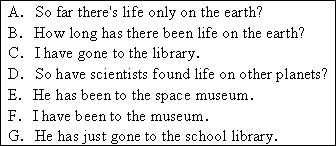
题目列表(包括答案和解析)
Ann comes from England. She’s English. She speaks English. She can also speak a little Chinese. She’s in Shanghai now. She’s studying(学习) in a middle school of Shanghai. She has classes on weekdays. On Sundays she often plays games with her Chinese friends. Her father is working in a factory near her school. He helps the Chinese workers to make nice watches. Ann and her father like Chinese food. And they like China and the Chinese people very much.
1.Which is right(正确的)?
A. Ann speaks little Chinese. B. Ann is good at Chinese.
C. Ann can speak some Chinese.
2. Can Ann’s father speak Chinese?
A. We don’t know. B. Yes. C. No.
3. Ann has _______ classes on Sundays.
A.some B.no C.many
4. Ann’s father works in a _______ factory.
A.bike B.watch C.food
5. Does Ann’s father like China?
A. We don’t know. B. Yes. C. No.
What do people do with their old, out-of-date but still useful computers? Most people don’t know what to do with them. Many old computers are put away in homes. Many more are simply thrown out with the rubbish.
Some companies are thinking of ways to bring down the number of old computers. Sony has agreed to help recycle old Sony products. Dell, Hewlett-Packard and other companies now also take back some old computers.
In some countries, laws are being passed, too. Computer companies will have to collect and recycle their used products. And 70% of computer waste must be recycled. The idea behind the laws is that computer companies themselves should pay the cost. That will encourage them to make computers that are easier and cheaper to repair and upgrade(升级).
Yet while many people are throwing away good computers, others cannot afford them at all. Hundreds of organizations are working to solve this problem. They collect and repair old computers. Some also teach others how to repair computers.
The computers then go to schools, charities and people who need them. Giving a used computer to one of these organizations can turn one person’s rubbish into someone else’s useful things—and cut down on waste, too.
1. How do people usually deal with their old computers?
A. They stop using them. B. They give them to others. C. They fix them up.
2. What do some computer companies do to bring down the number of old computers?
A. They don’t do anything about them.
B. They take back some old ones.
C. They donate them to some charities.
3.According to some countries’ laws, what must computer companies do?
A. Collect and recycle most of computer waste.
B. Repair and upgrade old computers.
C. Make much cheaper computers.
4. What may people who can’t afford computers think of the used computers?
A. Expensive. B. Useful. C. Out-of -date.
5. What is the passage about?
A. Repairing old computers.
B. Selling old computers.
C. Recycling old computers.
The word“day” has two meanings. When we talk about the number of days in a year, we are using “day” to mean 24 hours. But when we talk about day and night, we are using“day” to mean the time between sunrise and sunset. Since the earth looks like a ball, the sun can shine on only half of it at a time. Always one half of the earth is having day and the other half night. A place is moved from day into night and from night into day over and over by the spinning(旋转)of the earth. At the equator(赤道)day and night are sometimes the same length(长度). They are each twelve hours long. The sun rises at 6 o’clock in the morning and sets at 6 o’clock in the evening. For six months the North Pole is tilted(倾斜)toward the sun. In those months the Northern Hemisphere(半球)gets more hours of sunlight than the Southern Hemisphere. Days are longer than nights. South of the equator nights are longer than days. For the other six months the North Pole is tilted away from the sun. Then the Southern Hemisphere gets more sunlight. Days are longer than nights. North of the equator nights are longer than days. Winter is the season of long nights. Summer is the season of long days.
1.When the Western Hemisphere is having day, the Eastern Hemisphere is having ________.
A. both day and night B. day
C. neither day nor night D. night
2.A place is moved from day into night and from night into day over and over by ________ of the earth.
A. the pushing B. the pulling C. the spinning D. the passing
3..At the equator day is as long as night ________.
A. sometimes B. never C. usually D. always
4.When the North Pole is tilted toward the sun, the Northern Hemisphere gets ________ sunlight.
A. less B. more C. all D. no
5..When it is winter in China, ________.
A. the USA is tilted toward the sun
B. the South Pole is tilted away from the sun
C. the North Pole is tilted toward the sun
D. the North Pole is tilted away from the sun
| |||||||||||||||||||||||||||||||||||||||||||||||||||||||||||||||||||||||||||||||||||||||||||||||||||||||||||||||||||||||||||
| |||||
湖北省互联网违法和不良信息举报平台 | 网上有害信息举报专区 | 电信诈骗举报专区 | 涉历史虚无主义有害信息举报专区 | 涉企侵权举报专区
违法和不良信息举报电话:027-86699610 举报邮箱:58377363@163.com