later in the day 接近于late in the afternoon , in the late afternoon . 白天的较晚时间 查看更多


题目列表(包括答案和解析)

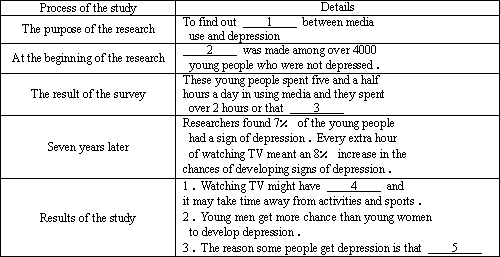
阅读短文,捕捉信息,根据短文内容完成表格。

  A new study suggests that the more teenagers watch television, the more likely they are to develop depression(抑郁症)as young adults.

  The researchers used a national long-term survey of healthy young teenagers of about 13-16 to find out the relationship between media(媒体)use and depression.They based their findings on more than 4000 young teenagers who were not depressed when the survey began in 1995.

  As part of the survey, the young people were asked how many hours of television or videos they watched daily.They were also asked how often they played computer games and listened to the radio.Here was the result.The young people spent five and a half hours a day using media and more than 2 hours of that was spent watching TV.

  Seven years later, in 2001, more than 7% of the young people had signs of depression.The average age at that time was 21.Brian Primack at the University of Pittsburgh medical school was the lead author of the new study.He says every extra hour of television meant an 8% increase in the chances of developing signs of depression.

  The researchers say they did not find any such relationship with the use of other media such as movies, video games or radio.But the study did find that young men were more likely than young women to develop depression given the same amount of media use.

  Doctor Primack says the study did not find out if watching TV causes depression directly.But one possibility, he says, is that it may take time away from activities that could help prevent depression, like sports and social activities.It might also prevent a person from sleeping well, he says, and that could have an influence.

  The study was just published in the Archives of General Psychiatry.

  In December, the journal Social Indicators Research published a study of activities that help lead to happy lives.Researchers from the University of Maryland found that people who describe themselves as happy spend less time watching television than unhappy people.The study found that happy people are more likely to be socially active, to read, attend social services and to vote.

查看答案和解析>>

完形填空

  Last year twenty-two Chinese boys went to a small village in Brazil.They were not there for a   1  .They were trained(训练)to   2   China’s football stars.

  These boys were China’s top teenage football players.They went to Brazil for a(n)  3   of training with a Brazilian football coach(教练).“The training was very   4  .”said Wei Ming, the team head.“Every morning we started at six o’clock because it was too   5   to play later in the day.We had to play,   6   and study football for eight hours a day, six days a week.”

  In their   7   time, the boys watched Chinese videotapes.Wei Ming said, “Life was sometimes very   8  there.I missed my family very much.But we all wanted to be successful(成功的).”

  Why did these boys go to train in Brazil? The   9   is clear.Brazil is a strong football country.The Chinese government hopes that Brazil can help China to   10   a successful football team.

(1)

[  ]

A.

job

B.

study

C.

game

D.

holiday

(2)

[  ]

A.

help

B.

look for

C.

become

D.

bring up

(3)

[  ]

A.

program

B.

lesson

C.

understanding

D.

exam

(4)

[  ]

A.

interesting

B.

useful

C.

difficult

D.

easy

(5)

[  ]

A.

hot

B.

cold

C.

easy

D.

dirty

(6)

[  ]

A.

watch

B.

listen to

C.

practise

D.

think about

(7)

[  ]

A.

free

B.

busy

C.

training

D.

sleeping

(8)

[  ]

A.

unhappy

B.

strange

C.

hard

D.

untrue

(9)

[  ]

A.

answer

B.

truth

C.

word

D.

subject

(10)

[  ]

A.

boat

B.

catch up with

C.

copy

D.

produce

查看答案和解析>>

根据对话内容,选用方框中适当的句子补全对话。
A. Which bus goes to the hospital?
B. This little girl brought me here.
C. You can take a bus.
D. The No. 3 bus will take you there.
E. Let's ask this policeman.
F. It'll take you about half an hour.
G. We'd better take a bus.

A: How can I get there? I don't know the way.   
B: 1.            He may know. Excuse me! Which is the way to the North Hospital?   
C: Go down this street until you reach the second traffic lights. Turn right. At he end of the road you'll see
    the hospital. 2.               
B: Half an hour? That's too long! Is there a bus?   
C: Yes. 3.               
B: Thanks a lot. Granny, the hospital is not very near. 4.            I'll go with you.   
A: How kind! Thank you.   
(Twenty minutes later. In the hospital the woman finds her husband.)  
D: But how did you get here?   
A: By bus. 5.              
D: Which girl? I must thank her!

查看答案和解析>>

I didn’t cry when I learned I was the parent of a disabled child. I just sat still and didn’t say anything.
When Jenny was old enough, I sent her to a kindergarten(幼儿园). On the first morning, Jenny spent hours playing by herself. It seemed that she felt very(41).
However, to my joy, Jenny’s classmates always (42) her, “You got al your speling words right today!”In fact, her speling list was the (43). Later, she faced a very painful (44) —— at the end of the term, there was a game which had (45) to do with physical education. But Jenny was (46) in it.
My husband and I were anxious about the day. I wanted to let my child stay home! But my heart wouldn’t let me off that easily. So I (47) a pale, unwiling Jenny onto the school bus.
At the kindergarten, I was quite worried because of her (48) action, Jenny would probably hold up her team. The game went wel until it was time for the sack(麻袋)race. Surely Jenny would find it (49). Now each child had to climb into a sack, jump to the finishing line, return and climb out of the sack. I noticed Jenny standing near the end of her line of players.
But as it was her turn to join, a change took place in her (50). The talest boy behind Jenny placed his hands on her waist(腰). Two other boys (51) in front of her. The moment the player before Jenny stepped out from the sack, the two boys (52) the sack suddenly and kept it open while the tal boy lifted Jenny and (53) her into it. A girl nearby took her hand and supported her (54) Jenny got her balance. Then she jumped forward, smiling and proud. In the cheers of the teachers, schoolmates and parents, I silently  thanked  the  warm, understanding people in life who made it  (55) for my disabled daughter to be like her felow human beings. Then  I finaly cried.
【小题1】
A.excitedB.lonelyC.happyD.weak
【小题2】
A.greetedB.expectedC.encouragedD.folowed
【小题3】
A.easiestB.longestC.smalestD.tidiest
【小题4】
A.choiceB.problemC.resultD.exam
【小题5】
A.nothingB.anythingC.everythingD.something
【小题6】
A.forwardB.fastC.behindD.up
【小题7】
A.threwB.pushedC.knockedD.fixed
【小题8】
A.slowB.quietC.quickD.secret
【小题9】 A. stupid    B. simple relaxing    D. difficult
【小题10】
A.schoolB.familyC.teamD.heart
【小题11】
A.ranB.layC.walkedD.stood
【小题12】
A.picked upB.gave upC.cut up   D.made up
【小题13】
A.droveB.hidC.putD.hit
【小题14】
A.whenB.untilC.afterD.unless
【小题15】
A.popularB.specialC.necessaryD.possible

查看答案和解析>>

阅读短文,判断句子的正误,正确的写T,错误的写F。

  In England people don't usually talk very much.You can go on a bus or in a train, and everyone sits, looking out of the window.

  Often they read.They read books and papers.But they don't talk much.

  When you meet English people, they often talk about one thing-the weather.So when you meet someone in England, you can say,“Nice weather for the time of year!”

  “But it was a little cold yesterday,”someone may answer.

  “But it was a little warmer later!”you can say.

  Talk like this, and the English will think,“How friendly you are!”

(1)

In England, people don't like talking.

(  )

(2)

English people in a train usually look out of the window.

(  )

(3)

English people like reading books and papers.

(  )

(4)

English people like talking about the weather because it is always fine.

(  )

(5)

English people will think you are friendly to them if you talk about the weather with them.

(  )

查看答案和解析>>


同步练习册答案