
题目列表(包括答案和解析)
In Chicago, a computerized system has been developed that controls(管理)traffic on the city’s 235 miles of seven expressways. Now one—a controller—can follow the movement of Chicago’s traffic by looking at a set of lights. The system uses electric sensors(感应器) that are built into each expressway, every half a mile. Several times a second, the computer receives information from each sensor and translates it into green, yellow or red lights on a map in the control room. A green light means traffic is moving forty-five miles an hour, yellow means thirty to forty-five miles an hour, and red means heavy traffic—cars standing still or moving less than thirty miles an hour.
“See that red light near Austin Avenue?”the controller asked a visitor.“That’s a repair truck fixing the road, and the traffic has to go around it.”At the Roosevelt Road entrance to the expressway, the light kept changing from green to red and back to green again.“A lot of trucks get on the expressway there,”the controller explained.“They can’t speed up as fast as cars.”The sensors show immediately where an accident or a stopped car is blocking the traffic, and a truck is sent by radio to clear the road. The system has lowered the number of accidents by 18 percent. There are now 1.4 deaths on Chicago’s expressway for each one hundred million miles traveled, while in other parts of the county there are 2.6.
Traffic experts say that the Chicago system is the “coming thing”.Systems like Chicago’s are already in use on some expressways in Los Angeles and Houston.“Chicago has taken the lead,”said New York City’s traffic director and he added,“Chicago’s a good example.”
根据短文内容,选择最佳答案,并在答题卡上按要求作答。
1.The passage is mainly about ________ on expressways in Chicago.
A. the traffic control system B. the movement of the traffic
C. the electric sensors D. the traffic lights
2.When the cars move under 30 miles an hour, ________ on the map in the control room.
A. the red light appears B. the red light turns yellow
C. the yellow light appears D. the green light turns red
3. According to the passage, we may learn __________.
A. some visitors are traveling on the expressway
B. there is no heavy traffic on Chicago’s expressways
C. the traffic on Chicago’s expressways is well managed
D. the number of accidents in the US has dropped by 18%
4.In Paragraph 2 the underlined word “it” refers to ___________.
A. the red light B. the truck that needs repairing
C. the traffic D. the truck that is fixing the road
5.The writer writes the article mainly by _________.
A. giving reasons and results B. giving examples and explaining them
C. describing what he thinks D. asking and answering questions
Large population has caused many problems. For example, the traffic is very heavy in some big cities.
During the last ten years, big cities like Beijing and Harbin were full of cars and buses. Now the streets are completely crowded and it’s very difficult to drive a car along them. Drivers must stop at hundreds of traffic lights. What are our cities going to be like in the future? How can we solve the problem?
There are some good ideas to reduce the use of private(私人的) cars. In 1971, the officer in Rome began an interesting experiment: Passengers on the city buses didn’t pay for their tickets.
In Stockholm there was another experiment: People paid very little for a season ticket to travel on any bus, trolley bus(电车) and train all over the city.
In many cities now some streets are closed to vehicles(机动车) and pedestrians are safe there.
In London there is another experiment: Part of the streets is for buses only. So the buses can travel fast. There are no cars or taxis in front of them.
根据短文内容, 选择最佳答案。
1.The passage is about .
A.big cities B.streets C.cars D.traffic
2.The city of once experimented on a completely free bus service.
A.London B.Paris C.Rome D.Stockholm
3.The city of experimented on a very cheap bus service.
A.Paris B.Stockholm C.London D.None of the above
4.The underlined word “pedestrians” means_________ in Chinese.
A.行人 B.司机 C.旅客 D.向导
5.In many cities, pedestrians are much safer because .
A.no traffic is allowed in some streets B.traffic is computer-controlled
C.cars move very slowly D.only one-way streets are open to traffic
Fengcheng River is a 6650-meter-long moat(护城河)that protected Taizhou from enemy. Currently, the Fengcheng River Scenic Area has become a natural area of the modern city.
The four cultural treasures of Taizhou——history, local opera, customs and business—— can all be seen along the river. Taizhou Old Street lies on the east of the Fengcheng River Scenic Area, offering choices of restaurants and local specialties(特产). The Peach Garden is also along the river, with blooming peach trees. The Sea-watching scenic area is also on the river front, among many other attractions. To have a holistic view, you may be interested in taking a night boat around the ancient moat and the ride shows Taizhou’s culture.
Fengcheng River Night Cruise(巡游)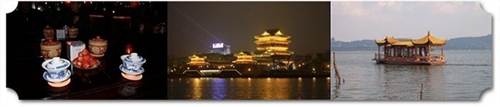
This night cruise takes you an hour long ride on the city moat. The boats are classic ones that seem to be floating houses. While on the boat you'll be able to enjoy local snacks like sesame seed biscuits and tea. Along the river side, local dance and song groups perform, creating the perfect mood for the boat ride. Also, the scenery formed is wonderful. The Sea-Watching Pavilion with shining lights is beautiful in the evening.
【小题1】At first, Fengcheng River was built to ________.
| A.carry things by boat |
| B.make the city beautiful |
| C.make the city safer in the war |
| D.feed fish |
| A.dragon boat race |
| B.some cultural treasures |
| C.Taishan Park |
| D.Lizhong Water Forest |
| A.The Peach Garden |
| B.Taizhou Old Street |
| C.The Sea-Watching Pavilion |
| D.Meilangfang Park |
| A.have a holistic view |
| B.enjoy local snacks |
| C.enjoy local dance and song groups perform |
| D.see blooming peach trees |
| A.half an hour | B.sixty minutes | C.two hours | D.the whole night |
| A.the traffic control system | B.the movement of the traffic |
| C.the electric sensors | D.the traffic lights |
| A.the red light appears | B.the red light turns yellow |
| C.the yellow light appears | D.the green light turns red |
| A.some visitors are traveling on the expressway |
| B.there is no heavy traffic on Chicago’s expressways |
| C.the traffic on Chicago’s expressways is well managed |
| D.the number of accidents in the US has dropped by 18% |
| A.the red light | B.the truck that needs repairing |
| C.the traffic | D.the truck that is fixing the road |
| A.giving reasons and results | B.giving examples and explaining them |
| C.describing what he thinks | D.asking and answering questions |
The happy Prince was blind﹙瞎﹚。The swallow﹙燕子﹚sat on his shoulder and told him many __.
He told him about so many amazing places __ __ Nile River﹙尼罗河﹚,the desert in Africa and so on. The Happy Prince greatly enjoyed his stories. He wanted to know __ was happening in the city, so he asked the swallow to fly over the city to have a look. The Swallow did as the Prince asked. He _ ___ through the sky. Below him, he saw rich people living __ __ in their homes. He saw poor people were in cold and hunger.__ __ one bridge, two boys shook their bodies t stay warm. The Swallow told the Prince everything. The Happy Prince became even __ _ and told the Swallow to take his gold to the cold and hungry people. Heavy snow fell off the sky on the city. Life for the swallow was becoming more difficult._ __ he still didn’t leave the Prince, he flew to the Prince’s shoulder fell dead at his feet. At the same time, there was a loud“Crack”and the Prince _ _ two halves, he might be very sad.The next morning, people in the city found them_ _ and took them out of the square. The angel found them and made them live forever in the city of gold.
1.A.magazines B.stories C.novels D.words
2.A.such as B.at least C.so far D.because of
3.A.how B.what C.why D.when
4.A.walked B.ran C.flew D.rode
5.A.normally B.surprisingly C. comfortably D.personally
6.A.From B.In C.Under D.With
7.A.sadder B.happier C.sad D.happy
8.A.And B.But C.So D.Because
9.A.brought out B.fell down C.made up D.broke into
10.A.both B.all C.each D.none
湖北省互联网违法和不良信息举报平台 | 网上有害信息举报专区 | 电信诈骗举报专区 | 涉历史虚无主义有害信息举报专区 | 涉企侵权举报专区
违法和不良信息举报电话:027-86699610 举报邮箱:58377363@163.com