
题目列表(包括答案和解析)
听力。
A.看图听对话,选出与所听对话内容相匹配的图画。(听一遍)(5分)
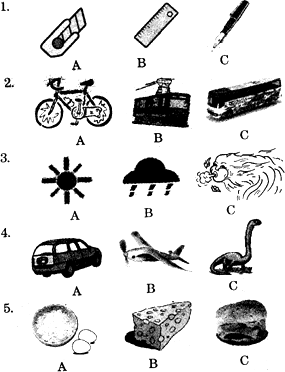
1.________ 2.________ 3.________ 4.________ 5.________
B.听对话,根据对话内容和问题,选择最佳答案。(听两遍)(5分)
( )6.At what time does the post office open?
A.7∶45.
B.8∶00.
C.8∶15.
( )7.What are the two speakers talking about?
A.A fine boat.
B.Their friend Tom.
C.The weather.
( )8.What is the relationship between the two speakers?
A.They are friends.
B.They are strangers.
C.They are brother and sister.
( )9.What will the woman do this evening?
A.Meet her Mum at the station.
B.Say good-bye to her Mum at the airport.
C.Fly to another city together with her Mum.
( )10.What did the man do last Saturday?
A.He acted in a play.
B.He went to the tea house.
C.He saw a play.
C.根据所听短文内容,选择正确答案。(听两遍)(10分)
( )11.What did the passengers think of the conductor at first?
A.They thought him as one of the best conductors.
B.They felt he was better than before.
C.They thought he was just the same as he used to be.
( )12.What did the passengers know about the conductor’s past?
A.He wasn’t liked by people on the bus before.
B.He always treated the passengers politely.
C.He often helped the passengers in trouble.
( )13.Why did a man like a teacher ask the conductor’s name?
A.Because he wanted to make friends with him.
B.Because he wanted to learn from him.
C.Because he wanted to write something about him.
( )14.What did the child’s words show?
A.He mistook the conductor for his father.
B.The conductor, the woman and the child were really from the same family.
C.The conductor often played jokes on others.
( )15.How did the passengers feel after they heard the child’s words?
A.Disappointed.(失望的)
B.Funny.
C.Surprised.
I’m seventeen. I worked as a box boy at a supermarket in Los Angeles. People came to the counter (柜台) and I put things in their bags for them and carried things to their cars. It was hard work.
While working, I wore a plate with my name on it. I once met someone I knew years ago. I remembered his name and said, “Mr. Castle, how are you?” We talked about this and that. As he left, he said, “It was nice talking to you, Brett.” I felt great, he remembered me. Then I looked down at my name plate. Oh, no. He didn’t remember me at all, he just read the name plate. I wish I had put “Irving” down on my name plate. If he’d have said, “Oh yes, Irving, how could I forget you?” I’d have been ready for him. There’s nothing personal here.
The manager and everyone else who were a step above the box boys often shouted orders. One of these was: you couldn’t accept tips(小费). Okay, I’m outside and I put the bags in the car. For a lot of people, the natural reaction(反应)is to take a quarter and give it to me. I’d say, “I’m sorry, I can’t.” They’d get angry. When you give someone a tip, you’re sort of being polite. You take a quarter and you put it in their hand and you expect them to say, “Oh, thanks a lot.” When you say, “I’m sorry, I can’t.” they feel a little put down. They say, “No one will know.” And they put it in your pocket. You say, “I really can’t.” It gets to a point where you almost have to hurt a person physically to prevent him from tipping you. It was not in agreement with the store’s belief in being friendly. Accepting tips was a friendly thing and made the customer feel good. I just couldn’t understand the strangeness of some people’s ideas. One lady actually put a tip in my pocket, got in the car, and drove away. I was puzzled and didn’t know what to do. Should I d have had to throw the quarter at her or eaten it or something?
I decided that one year had been enough. Some people needed the job to stay alive and fed. I guess I had the means and could afford to hate it and give it up.
【小题1】. From the second paragraph, we can infer (推断) that ________.
| A.the writer didn’t like the impersonal part of his job |
| B.people can easily start talking with a name plate |
| C.Mr. Castle mistook Irving for Brett |
| D.Irving was the writer’s real name |
| A.customers only gave small tips to |
| B.some customers had strange ideas about tipping |
| C.he didn’t want to fight with the customers |
| D.the store didn’t allow the box boys to take tips |
| A.relaxed | B.upset |
| C.bored | D.surprised |
| A.How I Could Find a Job |
| B.How I Got along with Customers |
| C.Why I Gave up My Job |
| D.Why I couldn’t Take Tips |
When M r.
Jones went to a restaurant one day, he left his coat near the door. There was
nothing in the pockets of the coat when he left it, so he was very surprised
when he took his coat after his meal and found the pockets full of jewelry(珠宝).There was a waiter near the door, so Mr. Jones said
to him, “Somebody has made a mistake. He has put some jewelry in my coat. Take
it, and when he comes back, give it to him.” The waiter took it and went away.
Suddenly another man came in with a coat just like Mr. Jones’s. “I’m sorry
”,said this man. “but I made a mistake. I mistook your coat and you have got
mine. Please give me my coat and jewelry .”Mr. Jones answered, “I gave the
jewelry to the waiter. He will give it to you.” Mr. Jones called the manager of
the restaurant at once, but the manager said, “We
have no waiter here. We only have waitresses.” “You gave the jewelry to a thief !” Shouted the other man. “I
shall call the police!” Mr. Jones was frightened and paid the man
a lot of money for the jewelry.
r.
Jones went to a restaurant one day, he left his coat near the door. There was
nothing in the pockets of the coat when he left it, so he was very surprised
when he took his coat after his meal and found the pockets full of jewelry(珠宝).There was a waiter near the door, so Mr. Jones said
to him, “Somebody has made a mistake. He has put some jewelry in my coat. Take
it, and when he comes back, give it to him.” The waiter took it and went away.
Suddenly another man came in with a coat just like Mr. Jones’s. “I’m sorry
”,said this man. “but I made a mistake. I mistook your coat and you have got
mine. Please give me my coat and jewelry .”Mr. Jones answered, “I gave the
jewelry to the waiter. He will give it to you.” Mr. Jones called the manager of
the restaurant at once, but the manager said, “We
have no waiter here. We only have waitresses.” “You gave the jewelry to a thief !” Shouted the other man. “I
shall call the police!” Mr. Jones was frightened and paid the man
a lot of money for the jewelry.
1.Who took the jewelry?
A. The waiter. B. Mr. Jones. C. The manager. D. The thief.
2.Which of the following is the best title for the passage?
A. We have no waiters here. B. Mr. Jones.
C. Jewelry in Mr. Jones’ coat. D. A clever waiter.
3.Which of the following statements is right?
A. Mr. Jones had put some jewelry in his pocket.
B. Mr. Jones was an honest man.
C. The man who came later was the thief.
D. Mr. Jones was punished by the police.
4.Why was Mr. Jones frightened?
A. The man wanted to beat him. B. He was afraid of the police.
C. He had no money to pay. D.
He was afra id
of the manager.
id
of the manager.
湖北省互联网违法和不良信息举报平台 | 网上有害信息举报专区 | 电信诈骗举报专区 | 涉历史虚无主义有害信息举报专区 | 涉企侵权举报专区
违法和不良信息举报电话:027-86699610 举报邮箱:58377363@163.com