
题目列表(包括答案和解析)
London used to be “foggy” for the same reason that cities like Beijing or Chongqing are “foggy” today. The “fog” was in fact smog, a mixture of smoke and fog. In other words, it was made by air pollution. In London, some of this pollution came from factories, but much of it came from the coal(煤)that people burnt in their houses to keep warm during the winter. By the 1950s, London’s smog problem had become so bad that the government decided to do something to clean the air. A new law was made and nobody could burn coal in any British city. Within a few years, the air became much cleaner. There were no more “pea-soupers”.
Many Chinese cities now face the same sort of problem with air pollution that London faced 40 or 50 years ago. However, this problem is more difficult for Chinese cities to solve. One reason is that more of the pollution comes from the factories, rather than from coal burnt in people’s houses. If these factories were closed, this would harm the economy and lots of people would lose their jobs. Another reason is that changing from coal to cleaner fuel(燃料), like gas, is quite expensive.
However, the air in many Chinese cities is becoming cleaner and cleaner, as the government and people pay more and more attention to cutting down pollution. As a result, there are fewer “pea-soupers” in Beijing than there used to be.
根据短文内容,选择最佳答案,并在答题卡上按要求作答。
【小题1】What was the main reason for air pollution in London?
| A.There was too much smoke in the sky. |
| B.There were too many factories in the city. |
| C.People burnt too much coal in the houses. |
| D.The city was too big for the cleaners to clean. |
| A.There was not so much fog in the winter later. |
| B.A law was made to keep people from burning coal in their houses. |
| C.Many factories in the city were closed. |
| D.People paid more attention to cleaning their city. |
| A.Smog | B.Smoke | C.Gas | D.Coal |
| A.one | B.two | C.three | D.four |
| A.The government will ask people to burn coal. |
| B.The government will ask people always use gas instead of coal. |
| C.The government will close all the factories in China. |
| D.The government will pay more and more attention to cutting down pollution. |
It is true that people with better education are usually able to get better paying jobs. In other words, they have more chances to choose a good job while people with little or no education don’t. It seems that the purpose of education is to make people get jobs. But this isn’t accepted* by all people.
Some people may think that a person should spend the best years of his life to get education only for a way of living. This was probably one of the earliest reasons of education. In fact, if education is just a way of making a living, people don’t need to spend so much time in school. People can get education for a living in a short time. Subjects like history and geography need not be taught to everyone. Even language and math need not be taught in details*, either. Here it is clear that education is much more than teaching a man to get a way of living.
Education is well-rounded and it is mainly for improving a man. It is not only to teach him to speak, read and write, but also to develop his creative thinking and other abilities*. After that, it is to make him a wise man and thankfully enjoy the achievements* of human. Education is to make a man have a better life. Educated people are expected *to be able to listen to good music, read good books, watch plays and most of all take an interest in the world.
I would agree that making a good living is an important reason for education, but certainly not the most important or the main reason.
1.People with little education usually ?????? .
A. spend a long time in school????????????? ????????????? ?????????????
B. have a good chance to get a job
C. spend the best years to choose jobs????????????? ??
D. have fewer chances to get a good job
2.The underlined word “well-rounded” in the passage means “?????? ” in Chinese.
A. 圆满的????????????? ????????????? ????????????? B.崭新的????????????? ????????????? ?? C.公平的????????????? ????????????? ?? ????????????? D.全面的
3.It is expected that educated people will be able to ?????? .
A. accept education as a way of living?????????????
B. take an interest in the whole world
C. develop their abilities to make plays?
D. learn subjects like language and math
4.The passage mainly tells us that ?????? .
A. education should make a man improve?????????????
B. people can get education in a short time
C. people should be able to get better paying jobs
D. all subjects are so important for a way of living
Johnny lived with his mother and father in a small town in the mountains
One day there was an earthquake near the town. Many houses were damaged(被损坏的). Everyone thought that there would soon be another earthquake.
They were worried that the second earthquake would be worse than the first.
“We must send Johnny to a safe place,” Johnny’s mother said to her husband. “Many of our friends are sending their children to relatives(亲戚) in other towns,’
“We’ll send him to my brother, Peter,” Johnny’s father said. “He lives a long way away. Johnny will be safe with him.’
He telephoned Johnny’s Uncle Peter and asked him if he would let Johnny live with him.
“He’s a good boy,” he said. “He won’t give you any trouble.’
“All right,’ Johnny’s Uncle Peter said, “but I’m not used to children. I live a very quiet and peaceful life.”
“You won’t know Johnny’s in the house,” his father told him.
So Johnny, who was five, went to live with his uncle.
Two days later, his mother and father received a telegram(电报)from Peter.
It said: “I am returning the child. Please send an earthquake.”
1.Where did Johnny and his parents live?
A.in a big town B.near the sea C.in the mountains D.with his Uncle Peter
2.Why did Johnny‘s parents send him away?
A.He was a naughty (顽皮的) boy. B.Their house was damaged.
C.They did not want him to get hurt. D.His uncle wanted to see him.
3.Why was Uncle Peter worried about Jonny coming to live with him?
A.He was not used to children.
B.He was an old man.
C.He lived a long way from the mountains.
D.He had never met Jonny before.
4.Why did Uncle Peter send Johnny back home?
A.There was an earthquake in his town.
B.The boy was more trouble than an earthquake.
C.Johnny was not happy with him.
D.His parents wanted him back.
阅读理解
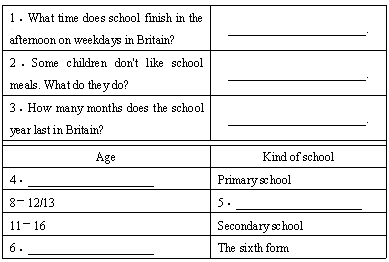
Maybe there are many differences between going to school in Britain and going to school in your country. In Britain school starts between 8:30 and 9:00 and finishes at about 4 o'clock in the afternoon. It is a long day but there are no lessons on Saturdays. Children usually have lunch at school. School meals are not very expensive and are quite good. But some children don't like them and bring sandwiches or go home.
In Britain school holidays are different from those in other countries. They are shorter at Christmas and Easter but much longer in the summer. The school year starts in the first week in September and ends in the third or fourth week of July.
Children start primary school when they are five years old; they stay there until they are eleven. Then they usually go to a secondary school. Children cannot leave. school before they are sixteen. At this age most students take public exams. Students who continue their studies go into the sixth form. If their school doesn't have a sixth form, they change schools or go to a college. Students need two years in the sixth form, and they take more public exams. In some parts of Britain, students go to middle school at the age of eight and then go to secondary schools when they are twelve or thirteen.
湖北省互联网违法和不良信息举报平台 | 网上有害信息举报专区 | 电信诈骗举报专区 | 涉历史虚无主义有害信息举报专区 | 涉企侵权举报专区
违法和不良信息举报电话:027-86699610 举报邮箱:58377363@163.com