
题目列表(包括答案和解析)
Many years ago,there lived a rich man who wanted to help the people of his town.But first he wanted to find out whether they deserved(应得到)his help.So he placed a very large stone in the center of the road.Then he hid behind a tree and wailed.
Soon an old man came."Who put this stone here?" asked the old man, but he didn't try to move away the stone.Instead, he passed around the stone and kept on walking.Another man came and did the same thing.Then another appeared, and another, Later, a young man came.He saw the stone and said, "The night will be very dark.Some people will come and fall because of the stone." Then he moved the stone to one side of the street with great difficulty.To his surprise, under the stone he found a bag of money and this message; "This money is for the kind person who removes this stone from the road.That person deserves my help."
1.We can learn from the passage that _________.
A.the stone itself fell from the mountain to the road
B.an old man hid behind a tree to see what would happen later
C.a young man forced the people of his town to work for him
D.a rich man wanted to help the people by leaving a large stone in the road
2.When he came to the center of the road, the old man _________
A.passed around the stone and walked away
B.didn't see the stone
C.moved the stone away
D.waited for help
3.How many people are mentioned(提到) according to tile story?
A.Less than four. B.Four.
C.Six. D.More than eight.
4.What does the underlined word “removes” mean in this passage?
A.消除 B.移开 C.拆迁 D.摘下
Thirty years ago, Lake Ponkapog was full of life. Many birds and animals lived beside the water, which was full of fish. Now there are few birds, animals and fish. The lake water is polluted. It is filled with strange plants.
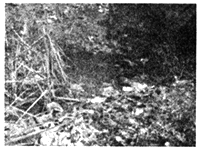
How did this happen? First, we must think about how water gets into Lake Ponkapog. When it rains, water comes into the lake from all around. In the past, there were forests all round Lake Ponkapog, so the rainwater was clean. Now there are many homes around the lake. People often use chemicals in their gardens. They use other chemicals inside their houses for cleaning or killing insects. There are also many businesses. Businesses use chemicals in their machines or shops. When it rains, the rainwater picks up all the chemicals from homes and businesses and then carries them into the lake. They pollute the water and kill the animals.
Boats on the lake are also a problem. Lake Ponkapog is a popular place for motorboats. But oil and gas
(汽油)from boats often get into the lake. So more bad chemicals go into the water this way.People around the lake love their lake and want to save it. Will it be possible? A clean lake must have clean rainwater going into it. Clean rainwater is possible only if people are careful about chemicals at home and at work. They must also be more careful about gas and oil and other chemicals on the ground. And they mustn't use motorboats any more on the lake. All these may change people's lives. Only then can Lake Ponkapog be a beautiful clean lake again.
(1)In the past the water in Lake Ponkapog was made clean by ___________.
[ ]
|
A .fish |
B .rain |
|
C .birds |
D .forests |
(2)The third paragraph mainly tells us ____________.
[ ]
A
.people like to go boating on the lakeB
.some bad chemicalsC
.chemicals from motorboats also make the lake water dirtyD
.how oil gets into the lake water(3)To save the lake, people need to ___________.
[ ]
A
.be less careful about chemicalsB
.use less waterC
.grow fewer plants in the gardensD
.change their daily lives(4)
“Chemicals”in the story means“__________”.[ ]
|
A .化学家 |
B .污染品 |
|
C .药品 |
D .化学制品 |
(5)What makes the lake water dirty?
[ ]
|
A .Chemicals. |
B .Strange plants. |
|
C .Rainwater. |
D .Both A and B. |
读下面短文,回答问题
Many years ago, Mr Johnson was living in a hotel in Germany. He usually had lunch in a little restaurant. Every time he came to the table, a German who was sitting there stood up and said, “Mahlzeit”. The Englishman answered, “Johnson.”
One day, Mr Johnson was talking to an English friend.“The German have some strange traditions,” he said. “Every time I came to the restaurant for lunch, a German stands up and tells me his name.”
“That seems strange to me, too,” the friend said. “What does the man say?”
“He tells me his name, Mahlzeit.” Mr Johnson answered.
His friend laughed. “Mahlzeit isn't his name. It is a German word for good appetite(胃口好). He wants you to have a good appetite for your lunch.” he explained(解释).
The next day, when Mr Johnson came into the restaurant, he smiled to the German and said, “Mahlzeit.” The German stood up and answered, “Johnson!”
1.Where did the story happen?
2.Why did the man in the little restaurant say “Mahlizeit” to Mr Johnson?
3.What strange traditions did Mr Johnson think in Germany?
4.Did the German in the little restaurant know the meaning of the word “Johnson”?
听力部分
一、根据你所听到的对话内容,选出正确答案:
1.What will David buy for Lisa's birthday?
A.
B.
C.
D.
2.In which country did Emma enjoy her holiday?
A.
B.
C.
D.
3.How much is the blue T-shirt?
A.
B.
C.
D.
4.How does the man go to work every day?
A.
B.
C.
D.
5.What is John's telephone number?
A.5067789.
B.5066789.
C.5066798.
6.When is the woman's birthday?
A.On December 24.
B.On December 25.
C.On December 26.
7.Where were the woman and her father four years ago?
A.In China.
B.In England.
C.In America.
8.Where are the two speakers?
A.In the bus.
B.At the bus stop.
C.In the Children's House.
9.Who runs the fastest?
A.Lucy.
B.Lily.
C.Kate.
10.When did the early bus leave?
A.At 6∶25.
B.At 6∶30.
C.At 6∶35.
二、听对话和短文,回答问题。
听第一段对话,回答第11-12小题。
11.When will the match start on Sunday?
A.At 1∶30
B.At 1∶45
C.At 2∶00
12.Who are they going to play with?
A.A team of soldiers
B.Their friends
C.Their classmates
听第二段对话,回答第13-15小题
13.How is the man going to the zoo tomorrow?
A.By bus.
B.By car.
C.On foot.
14.When are they going to meet?
A.At 9 a.m.
B.At 8 a.m.
C.At 10 a.m.
15.Where are they going to have lunch?
A.In the zoo.
B.At Mr.Wu's home.
C.At school.
听一篇短文,回答第16-20小题。
16.When did this story happen?
A.One evening.
B.One night.
C.One morning
17.How many persons were there in the room when someone was knocking at the door?
A.One person.B.Two persons.C.Three persons.
18.What did the young man wear?
A.White shirt.
B.Long trousers.
C.A pair of glasses.
19.Who was the young man?
A.He was a friend of the writer's.
B.He was the friend of the writer's brother's.
C.He was a stranger(陌生人 )to them.
20.What was mostly the end of the story?
A.The young man was taken away by the police.
B.The young man became their friends.
C.The young man ran away.
湖北省互联网违法和不良信息举报平台 | 网上有害信息举报专区 | 电信诈骗举报专区 | 涉历史虚无主义有害信息举报专区 | 涉企侵权举报专区
违法和不良信息举报电话:027-86699610 举报邮箱:58377363@163.com