
We’d better him now. a. not to tell b. not tell c. not telling d. not say 查看更多


题目列表(包括答案和解析)

I had been a high school teacher for six years and had watched a lot of TV shows about solving cases (破案). I was about to begin my dream    35   , something I had wanted for a long, long time.
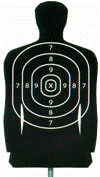
target

 
On the first Monday of the Firearm Officer Safety Training we were given guns and by Wednesday we were given our first test. We would score one mark for a hit to the    36    on the target, and half a mark for anywhere else on the body. When it was my turn, I entered the house    37   . It was dark and I could hardly see a single thing. Suddenly, one of the targets jumped out at me. I    38    my gun out quickly and fired two shots (射击). He fell to the ground. Another target appeared from behind and I    39    to get a successful shot. Just at the moment, I noticed something in the corner. I fired four shots and then the test ended. I came out of the house, feeling    40    that I was finally going to pass the test.

When one of the officers followed me out, I couldn’t wait to ask, “Did I pass, sir?” “No,” he said angrily. “What? Why?” I wondered. He then    41    at his shirt and shouted, “See this?   42    shots! Luckily they were paintballs. I didn’t wear any protective gear (装备) because I was just in the corner to    43    you.”

I said sorry to the officer and told him that I was not terrible at other police trainings and I always scored a high mark when we    44    telling someone that their family member had died. “That’s good,” he said. “Because when you accidentally    45    someone with the way you did, you will be able to tell the family very nicely how they died.” In the end, after nine months of what is usually a six-month course, I realized that people around me would be a lot better off if I    46    to teaching.

I am now the Head of Department for English at a high school. The words of the Rolling Stones spring to mind: You can’t always get what you want, but if you try sometimes, you just might find you get what you need.

35. A. test                     B. job                    C. action                   D. chance

36. A. legs                   B. arms                C. head                     D. chest

37. A. nervously            B. happily           C. carefully                   D. quietly      

38. A. pulled              B. picked            C. held                      D. found

39. A. tried                   B. started            C. decided                    D. managed

40. A. proud              B. confident           C. pleased               D. surprised

41. A. looked             B. knocked            C. pointed                     D. laughed

42. A. Two                   B. Three                C. Four                        D. Five

43. A. score                  B. help                  C. watch                      D. protect

44. A. finished            B. practiced           C. kept                         D. enjoyed

45. A. hurt                    B. hit                     C. kill                           D. wound

46. A. took                B. changed            C. got                          D. returned

查看答案和解析>>

阅读下面短文,掌握其大意,然后从各个小题后所给的A、B、C、D四个选项中,选出可以填入空白处的最佳选项。

I got out of the train station with my father. A woman came to him and said that her  31  had been stolen. She asked if he could  32  her some money to go back home. My father gave her what she asked for and told her not to  33  paying it back. I was shocked. How could my father be so  34 ? It was clear that she was telling a lie, staying at the station all day long  35  money.

“She was lying!” I shouted.“ 36  did you give her anything? ”

My father looked at me. He was a bit  37  . “And what would you like me to do?” he said. “Should I tell  38  that I am a college professor and I can see through her scam(诡计)?” I did not understand him at all, and then he told me something that I have  39  forgotten. “First, she would not do this  40  she did not need the money. Second, I made her day, because now she thinks that she is  41  than me. It is more important to her than the money, but I do not  42  this.”

A week later, we were at the same  43  , and the same woman came to my father with the same story. “Not this time,” my father told her. “In your business, you  44  learn to recognize people. Try another story  45  me next week.”

31. A. money                B. bicycle                     C. phone               D. child

32. A. borrow               B. keep                         C. lend                  D. pay

33. A. give up         B. worry about             C. hurry up       D. turn off

34. A. clever          B. friendly                    C. strict          D. silly

35. A. asking for       B. dealing with             C. fighting for        D. picking out

36. A. What                  B. When             C. Why                 D. How

37. A. angry                  B. happy                       C. sad                   D. shy

38. A. them                   B. her                           C. you                   D. me

39. A. seldom                B. often                        C. never                D. usually

40. A. unless                 B. until                         C. while                D. if

41. A. smarter               B. younger           C. taller                 D. better

42. A. close                  B. mind                        C. enter                 D. hear

43. A. stop                    B. hospital                    C. station               D. school

44. A. should                B. can               C. may                  D. would 

45. A. of                       B. in                C. on                     D. at

查看答案和解析>>

完形填空

  I got out of the train station with my father.A woman came to him and said that her   1   had been stolen.She asked if he could   2   her some money to go back home.My father gave her what she asked for and told her not to   3   paying it back.I was shocked.How could my father be so   4  ? It was clear that she was telling a lie, staying at the station all day long   5   money.

  “She was lying!” I shouted.“  6   did you give her anything? ”

  My father looked at me.He was a bit   7  .“And what would you like me to do?” he said.“Should I tell   8   that I am a college professor and I can see through her scam(诡计)?” I did not understand him at all, and then he told me something that I have   9   forgotten.“First, she would not do this   10   she did not need the money.Second, I made her day, because now she thinks that she is   11   than me.It is more important to her than the money, but I do not   12   this.”

  A week later, we were at the same   13   , and the same woman came to my father with the same story.“Not this time,” my father told her.“In your business, you   14   learn to recognize people.Try another story   15   me next week.”

(1)

[  ]

A.

money

B.

bicycle

C.

phone

D.

child

(2)

[  ]

A.

borrow

B.

keep

C.

lend

D.

pay

(3)

[  ]

A.

give up

B.

worry about

C.

hurry up

D.

turn off

(4)

[  ]

A.

clever

B.

friendly

C.

strict

D.

silly

(5)

[  ]

A.

asking for

B.

dealing with

C.

fighting for

D.

picking out

(6)

[  ]

A.

What

B.

When

C.

Why

D.

How

(7)

[  ]

A.

angry

B.

happy

C.

sad

D.

shy

(8)

[  ]

A.

them

B.

her

C.

you

D.

me

(9)

[  ]

A.

seldom

B.

often

C.

never

D.

usually

(10)

[  ]

A.

unless

B.

until

C.

while

D.

if

(11)

[  ]

A.

smarter

B.

younger

C.

taller

D.

better

(12)

[  ]

A.

close

B.

mind

C.

enter

D.

hear

(13)

[  ]

A.

stop

B.

hospital

C.

station

D.

school

(14)

[  ]

A.

should

B.

can

C.

may

D.

would

(15)

[  ]

A.

of

B.

in

C.

on

D.

at

查看答案和解析>>

Some students, parents and teachers in Shanghai were surveyed last month. According to the result of the survey, the generation gap (代沟) between students and parents as well as teachers is becoming wider. Here is what they said.
Voice of the students:
  “Our parents hold too high expectations(期望)which put us under lots of pressure. They care too much about our lives and studies,” one student said.
“It’s impolite that some students’ parents read their children’s diaries without permission!” one student said angrily.
“Some of our teachers are so serious that we can’t make friends with them at all,” another student said sadly.
Voice of the parents:
One mother said, “After school, my daughter usually locks herself into her room and spends lots of time talking with others on the phone. And I can’t stand(忍受) her clothes and hairstyle!”
“I thought my son was doing very well in his studies. I didn’t realize I was being cheated by him until I got a call from his teacher,” said a father.
Voice of the teachers:
An English teacher said, “Today, the role of the teacher is to put knowledge into students’ brain. The power (权力) teachers have kept students away from them.”
“Some parents pay too much attention to their children’s grades instead of creating a lively and colorful environment at home,” another teacher said.
“In the past, teachers and students often played games together or talked with each other. Today, only studies and grades are talked about,” said a teacher. “A school should be a place where students can learn not only knowledge, but also how to face failure and frustration(挫折) bravely enough.”

  1. 1.

    What does the first paragraph mainly tell us?

    1. A.
      Students like telling how they feel to their classmates
    2. B.
      More and more students don’t like to be surveyed
    3. C.
      Some parents don’t like their children’s clothes and hairstyle
    4. D.
      There has been a great distance between students and parents as well as teachers
  2. 2.

    The underlined word “cheated” in the passage means ___________

    1. A.
      欺骗
    2. B.
      批评
    3. C.
      表扬
    4. D.
      揭露
  3. 3.

    What can we infer (推断) from the teachers who were surveyed?

    1. A.
      Teachers feel what they are doing for students is good
    2. B.
      Parents, teachers and educational rules all influence students greatly
    3. C.
      Teachers should care more about excellent students
    4. D.
      Now teachers and students communicate better than before
  4. 4.

    Which of the following could be the best title for the passage?

    1. A.
      Unhappy Teenagers
    2. B.
      Educational Rules
    3. C.
      The Generation Gap
    4. D.
      Serious Parents

查看答案和解析>>

Some students, parents and teachers in Shanghai were surveyed last month. According to the result of the survey, the generation gap (代沟) between students and parents as well as teachers is becoming wider. Here is what they said.
Voice of the students:
  “Our parents hold too high expectations(期望)which put us under lots of pressure. They care too much about our lives and studies,” one student said.
“It’s impolite that some students’ parents read their children’s diaries without permission!” one student said angrily.
“Some of our teachers are so serious that we can’t make friends with them at all,” another student said sadly.
Voice of the parents:
One mother said, “After school, my daughter usually locks herself into her room and spends lots of time talking with others on the phone. And I can’t stand(忍受) her clothes and hairstyle!”
“I thought my son was doing very well in his studies. I didn’t realize I was being cheated by him until I got a call from his teacher,” said a father.
Voice of the teachers:
An English teacher said, “Today, the role of the teacher is to put knowledge into students’ brain. The power (权力) teachers have kept students away from them.”
“Some parents pay too much attention to their children’s grades instead of creating a lively and colorful environment at home,” another teacher said.
“In the past, teachers and students often played games together or talked with each other. Today, only studies and grades are talked about,” said a teacher. “A school should be a place where students can learn not only knowledge, but also how to face failure and frustration(挫折) bravely enough.” 
小题1: What does the first paragraph mainly tell us?
A.Students like telling how they feel to their classmates.
B.More and more students don’t like to be surveyed.
C.Some parents don’t like their children’s clothes and hairstyle.
D.There has been a great distance between students and parents as well as teachers.
小题2:The underlined word “cheated” in the passage means ___________.
A.欺骗B.批评C.表扬D.揭露
小题3: What can we infer (推断) from the teachers who were surveyed?
A.Teachers feel what they are doing for students is good.
B.Parents, teachers and educational rules all influence students greatly.
C.Teachers should care more about excellent students.
D.Now teachers and students communicate better than before.
小题4:Which of the following could be the best title for the passage?
A.Unhappy TeenagersB.Educational Rules
C.The Generation GapD.Serious Parents

查看答案和解析>>


同步练习册答案