6.She’s sitting on a chair in a corner. 查看更多


题目列表(包括答案和解析)

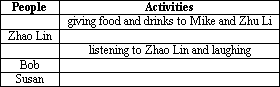
Read the passage, and then fill in the chart.

It's New Year's Eve.Bob and his classmates are having a party in their classroom.Peter is giving food and drinks to Mike and Zhu Li.Zhao Lin is telling a funny story.Some of the boys are listening to him and they are laughing.Bob is singing an English song.Susan is sitting on a chair in a corner.She's watching and smiling.They are all enjoying themselves very much at the party.

查看答案和解析>>

阅读理解。
    Studies have shown it takes a doctor about 18 seconds to stop a patient after he begins talking. 
    It was Sunday. I had one last patient to see. I came close to her room in a hurry and stood at the doorway.
She was an older woman, sitting at the edge of the bed, trying to put socks on her swollen(肿大的) feet. I
spoke quickly to the nurse, saw her chart saying she was in stable(稳定的) condition. I was almost in the
clear. 
   She asked if I could help put on her socks. Instead, I began a long speech that went something like this:
" How are you feeling? Your blood sugar and blood pressure (血压)were high but they're better today. The
nurse said you can't wait to see your son who's visiting you today. It's nice to have a family visit from far
away. I'm sure you really look forward to seeing him. "
    She stopped me with a serious voice. " Sit down, doctor. This is my story, not your story. "
    I was surprised and ashamed. I sat down. I helped her with the socks. She began to tell me that her only
son lived around the corner from her, but she had not seen him in five years. She believed that the pressure of
this caused greatly to her health problems. After hearing her story and putting on her socks, I asked if there
was anything else I could do for her. She shook her head and smiled. All she wanted me to do was to listen.
     Listening to someone's story costs less than expensive diagnostic(诊断的) testing but is key to healing
(痊愈).
     I often thought of what that woman taught me the importance of stopping, sitting down and truly listening.
And, not long after, unexpectedly, I became the patient, with a diagnosis of sclerosis(硬化症) at age 31. Now,
 20 years later, I sit all the time in a wheelchair.
     For as long as I could, I continued to see patients from my chair, but I had to give up my job when my
hands were influenced. I still teach medical students and other health care professionals, but now from the view
of doctor and patient.
    I tell them I believe in the power( 力量) of listening. I tell them I know firsthand that huge healing takes place within me when someone stops, sits down and listens to my story.  
1. What does"I was almost in the clear" mean?
A. I thought everything was clear.
B. I was about to finish my work.
C. I almost made myself understood.
D. I was very quickly out of her sight.
2. From the 4th paragraph, we can infer the woman ___from the way she said.
A. showed her anger and impatience
B. refused to listen to the doctor
C. liked giving orders to people
D. could not wait to break in
3. What is the best title of the passage?
A. Listening-a Powerful Medicine
B. An Unforgettable Experience
C. A Lesson Given by a Patient
D. Care—a Key to Treatment .

查看答案和解析>>

  People often say that an Englishman’s home is his castle(城堡).They mean that the home is very important and personal.Most people in Britain live in houses rather than in flats(公寓),and own their homes.They can paint and change them in any way they like.In a crowded city everyone knows that he or she has private space which is only for himself or herself and for invited friends.

  People usually like to mark(做标记)their space.Are you sitting on a beach or a train or in a library?If you are on the beach you may have spread(撒)your sands around you; on the train you may have put your coat or small bag on the seat beside you, in a library you may have one corner or chair which is your own.

  Once I was traveling on a train to London.I was in a section(区域)for four people and there was a table between us.The man opposite me had his bag on the table.There was no space on my side of the table at all.I was made rather angry.Maybe he thought that he owned the whole table!I took some newspapers out of my bag and put them on his.When I did this he sat up straight at once, opening his eyes wide.I had invaded(侵占)his space!A few minutes later I took my newspapers off his bag in order to read them.He at once moved his bag to his side of the table.

(1)

The English call their homes“castles”because ________.

[  ]

A.

they don’t make friends with others

B.

homes provide them their own space

C.

they don’t want to stay with others

D.

they are very important persons

(2)

The word“private”in the first paragraph means“________”in Chinese.

[  ]

A.

私人的

B.

公共的

C.

相邻的

D.

隐蔽的

(3)

According to the passage, if an Englishman is on the beach, he will probably ________ to show his own space to others.

[  ]

A.

sit in another person’s chair

B.

talk loudly with his friends

C.

cover himself with sands

D.

spread sands around him

(4)

Why did the writer get angry?

[  ]

A.

Because the man’s bag fell on the writer’s foot.

B.

Because the man’s bag was on the writer’s seat.

C.

Because the man didn’t leave space for the writer on the table.

D.

Because the man’s bag prevented the writer looking out of the window.

(5)

The writer put his newspapers on the man’s bag in order to ________.

[  ]

A.

invade the man’s space

B.

let the man read the newspapers

C.

take the man’s seat

D.

let the man move his bag to his side

查看答案和解析>>

仔细阅读下列短文, 根据题目, 选出最佳选项. People often say that an Englishman's home is his castle(城堡). They mean that the home is very important and personal. Most people in Britain live in houses rather than in flats(公寓), and own their homes. They can paint and change them in any way they like. In a crowded city everyone knows that he or she has private space which is only for himself or herself and for inviting friends. People usually like to mark(做标记) their space. Are you sitting on a beach or a train or in a library If you are on the beach you may have spread(撒) your sands around you; on the train you may have put your coat or small bag on the seat beside you; in a library you may have one corner or chair which is your own. Once I was traveling on a train to London. I was in a section(区域) for four people and there was a table between us. The man opposite me had his bag on the table. There was no space on my side of the table at all. I was made rather angry. Maybe he thought that he owned the whole table! I took some newspapers out of my bag and put them on his. When I did this he sat up straight at once, opening his eyes wide. I had invaded(侵占) his space! A few minutes later I took my newspapers off his bag in order to read them. He at once moved his bag to his side of the table.

(1)

The English call their homes "castles" because ________.

A. they don't make friends with others

B. homes provide them their own space

C. they don't want to stay with others

D. they are very important persons

[  ]

(2)

The word "private" in the first paragraph means "_______" in Chinese.

A. 私人的

B. 公共的

C. 相邻的

D. 隐蔽的

[  ]

(3)

According to the passage, if an Englishman is on the beach, he will probably ________ to show his own space to others.

A. sit in another person's chair

B. talk loudly wit his friends

C. cover himself with sands

D. spread sands around him

[  ]

(4)

Why did the writer get angry

A. Because the man's bag fell on the writer's foot.

B. Because the man's bag was on the writer's seat.

C. Because the man didn't leave space for the writer on the table.

D. Because the man's bag prevented the writer looking out of the window.

[  ]

(5)

The writer put his newspapers on the man's bag in order to ________.

A. invade the man's space

B. let the man read the newspapers

C. take the man's seat

D. let the man move his bag to his side

[  ]

查看答案和解析>>

One day, I went to see my last patient(病人), an old woman. In the doorway, I saw she was struggling (挣扎) to put socks on her swollen (浮肿)feet in the bed. I stepped in, spoke quickly to the nurse, read her chart noting. I was almost in the clear that she was not in serious condition.
I asked, “Could I help put on your socks? How are you feeling? Your sugars and blood pressure were high but they’re better today. The nurse mentioned you’re anxious to see your son. He’s visiting you today. It’s nice to have a family visit. I think you really look forward to seeing him."
"Sit down, doctor. This is my story, not yours." She said with a serious voice.
I was surprised as I helped her with the socks. She told me that her only son lived around the corner from her, but she had not seen him in five years. She believed that was the main cause of her health problems. After hearing her story and putting on her socks, I asked if there was anything else I could do for her. She shook her head no and smiled. All she wanted me to do was to listen.
Each story is different. Some are detailed; others are simple. Some have a beginning, middle and end; others don’t have clear ends. Some are true; others not. Yet all those things do not really matter. What matters to the storyteller is that the story is heard — without interruption(打断) or judgment(评价).
It was that woman who taught me the importance of stopping, sitting down and truly listening. And, not long after, in an unexpected accident, I became a patient. 20 years later, I sit all the time — in a wheelchair.
For as long as I could, I continued to see patients from my chair. I believe in the power of listening

  1. 1.

    How was the old woman?

    1. A.
      Her feet were swollen
    2. B.
      Her sugars were high
    3. C.
      She was not badly ill
    4. D.
      Her blood pressure was better
  2. 2.

    How did the doctor know that the old woman’s son was visiting her?

    1. A.
      The nurse told him
    2. B.
      The old woman told him
    3. C.
      The woman’s son told him
    4. D.
      The doctor got it from her chart noting
  3. 3.

    What did the old woman think caused her health problems?

    1. A.
      Her son’s not seeing her
    2. B.
      No one listening to her story
    3. C.
      The medical care of the hospital
    4. D.
      The distance between her and her son
  4. 4.

    When the patient told the doctor her stories, what she needed might be ______

    1. A.
      keeping smiling
    2. B.
      interruption or judgment
    3. C.
      listening without interruption
    4. D.
      communicating with each other
  5. 5.

    Which statement is NOT right according to the passage?

    1. A.
      Her son lived close to her house
    2. B.
      The old woman didn’t need the doctor’s treatments
    3. C.
      Listening is powerful medicine
    4. D.
      The doctor has to “walk” with the help of a wheel chair

查看答案和解析>>


同步练习册答案