less 2. anything 3. health 4. without 5. good 6. babies' 7. will come 8. some 9. ninth 10. carefully 11. fatter 12. eating 13. five 14. the thinnest 15. asleep 16. women doctors 17. is singing 18. Canadians 19. well 20. meaning 21. slowly 22. himself 23. dangerous 24. could 25. worried 26. yourselves 27. found 28. to eat 29. is 30. take 31. took 32. asleep ; woke 33. interesting ; interested 34. Picking 35. dressed 36. reading 37. drawing 38. better; better 39. stop ; crying 40. am ; will go 41. myself 42. himself 43. could ; was 44. tried ; didn't find 45. fell ; didn't hurt 46. will come ; have 47. didn't play ; did 48. Have 49. to leave 50. his 查看更多


题目列表(包括答案和解析)

  阅读理解

    Can you make a telephone call? Of course you can make it in Chinese. But the call in English is quite different from the one in   Chinese. If(如果) you want to ask somebody to answer the telephone, you cannot say, "Please ask Mr...to answer the telephone." Instead(相反), you must say, "May I speak to Mr...?" If you want to ask who   is answering the telephone, you should say, "Who is that?" or "Is that   Mr...(speaking)?" instead of (不能说) "Who are you " If you want   to tell the other who you are, you should say, "This is...(speaking)"instead of "I'm..."

  判断下列句子是否符合短文内容,符合的用“T”表示,不符合的用“F”表示。

  1. You are able to make a telephone call in Chinese.

  [  ]

2. An English telephone call is the same as a Chinese one.

                             [  ]

  3. If you want to ask someone to answer the call, you should say,"May I speak to Mr...?" 

             [  ]

  4. If you want to ask who is answering the telephone, you should say, "Who's that?" 

               [  ]

  5. If you want to tell the other who you are on the phone you should say, "I'm...". 

                 [  ]

查看答案和解析>>

仔细阅读下列短文, 根据题目, 选出最佳选项. In Europe many people died during the Second World War. As a result, at the end of the war there were many orphans there. A man called Hermaann Gmeiner wanted to help these children. His idea was simple. He wanted orphans to have a home, and he wanted them to have care and kindness of parents. Gmeiner asked people to give him some money. With this money he built the first SOS Children's Village at Imst, in Australia. It opened in 1949. This is how the SOS Children's Village stared. The letters SOS stand for "Save Our Souls(灵魂)". This means "Please help us!" An SOS Children's Village gives help to orphans. Henmanna Gmeiner's idea for helping orphans soon spread(传播) all over the world. By 1983 there were 170 SOS Children's Villages in the world. People in many countries give money to help the villages. Today the children from the first village have grown up. Now some of them work in other SOS Children's Villages. In SOS Villages orphans live in family groups. There are several houses in each village. The biggest villages have 40 or 50 houses! Between seven and ten children live in a house. A woman lives with each group of children and looks after them. She gives the children a lot of love and kindness. She cooks for them and makes comfortable(舒适) and happy home for them. Of course, the children don't spend all their time in the village. They go to school, go out with their friends and also go into town. But the village gives them a home梥ometimes for the first time in their lives.

(1)

Which of the following came last

A. People gave Gmeiner some money.

B. There were many orphans at the end of the war.

C. Gmeiner built the first SOS Children's Village with the money people gave him.

D. A man called Hermann Gmeiner wanted to help the orphans.

[  ]

(2)

An orphan is a child ________.

A. who has no brother

B. who has no sister

C. who has no parents

D. none of the above

[  ]

(3)

How many houses are there in the biggest SOS Children's Village

A. Seven and ten.

B. Forty or fifty.

C. 170

D. About 30.

[  ]

(4)

We can tell from the article that the money for helping the SOS Villages mainly comes from ________.

A. government(政府)

B. special organizations(组织)

C. The orphans themselves

D. people in general(普通)

[  ]

(5)

What does a woman in an SOS Village do for each group of children

A. She gives the children a lot of love and kindness.

B. She lives with each group of children.

C. She cooks the meals for children.

D. She looks after them.

[  ]

查看答案和解析>>

阅读理解

根据短文内容,判断下列句了正误。正确为“T”,错误为“F”。并在答题卡上把“T”或“F”涂黑。

(1)

An e–reader can keep thousands of e-books.

(  )

(2)

An e–reader can help to make schoolbags lighter than before.

(  )

(3)

In every US school, e–readers are used instead of paper textbooks.

(  )

(4)

The passage mainly introduces the size of an e–reader.

(  )

(5)

A different opinion is against the WI-FI and multimedia of e–readers.

(  )

查看答案和解析>>

完形填空

  Have you ever had problems in your life and don't know how to be happy?If   1  ,you will find Being a Happy Teenager(青少年) written by an Australian writer Andrew Matthews useful.

  In his book,Matthews tells us how to have a happy life and   2   the questions of teenagers.

  There are many subjects,such as parents and friends.And the book says we should stop   3   and forgive(宽恕).The book tells us some useful skills(技能),such as how to put what you have learned into pictures of your mind to   4   your memory better.

  Many teenagers think that happiness comes from a good exam result or praise(赞扬) from other people.But you can   5   be happy when there are no   6  “good”things.

  Success comes from a good attitude(态度).If you   7   problems,you will have success in the future.

  Some school students have problems.such as being too tall or too short.But Matthews tells us that happiness comes from thinking about things   8   a positive(积极的) way.If you are tall,people notice you and you can get a   9   view at the movie;if you are short,your clothes and shoes take less   10   in your bedroom!This is Matthews's most important lesson:you choose to be happy!

(1)

[  ]

A.

so

B.

not

C.

do

(2)

[  ]

A.

answered

B.

answers

C.

answering

(3)

[  ]

A.

to be angry

B.

be angry

C.

being angry

(4)

[  ]

A.

make

B.

let

C.

change

(5)

[  ]

A.

yet

B.

already

C.

still

(6)

[  ]

A.

such

B.

so

C.

such a

(7)

[  ]

A.

hear from

B.

learn from

C.

come from

(8)

[  ]

A.

at

B.

in

C.

on

(9)

[  ]

A.

lower

B.

worse

C.

better

(10)

[  ]

A.

room

B.

rooms

C.

place

查看答案和解析>>

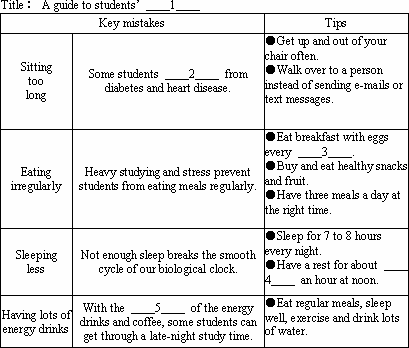
任务型阅读

  The stressful school life and unhealthy lifestyles cause some problems to students.Here are some key mistakes and some tips.

  ■Sitting too long

  So much homework and many computer games make students sit for several hours without standing or walking around.Because of long time sitting,some students have got diabetes (糖尿病) and heart disease(疾病).

  Tips:●Get up and out of your chair for about five minutes every hour.

  ●Walk over to a person instead of sending e-mails or text messages.

  ■Eating irregularly

  Some students develop unhealthy eating habits.Fast food becomes more often.Heavy studying and stress prevent students from eating meals regularly.

  Tips:●Eat breakfast with eggs at the start of every day.

  ●Buy healthy snacks like nuts and fruit,and eat them between meals.

  ●Have three meals a day at the right time.

  ■Sleeping less

  Not enough sleep breaks the smooth cycle of our biological clock(生物钟).It can cause heart disease and high blood pressure(高血压).

  Tips:●Be sure to sleep for seven to eight hours every night.

  ●Have a rest for about 30 minutes at noon.

  ■Having lots of energy drinks

  An energy drink or an extra cup of coffee might seem like the only way to get through a late-night study time.High levels of caffeine(咖啡因) can also cause high blood pressure.

  Tips:●The safest way to get more energy is to eat regular meals,sleep well,exercise and drink lots of water.

阅读以上信息,完成下面表格,每空一词。

1.________

2.________

3.________

4.________

5.________

查看答案和解析>>


同步练习册答案