
Neither John nor Mary to eat hamburgers. A. like B. likes C. is like D. was like 查看更多


题目列表(包括答案和解析)

(完型填空)

Harry Potter returns!

Kids make different (1) for new year. Some hope that the days will pass by (2) . Why? Because they are waiting to (3) a new book, “Harry Potter and the Half?blood Prince (《哈利-波特和半血王子》)”! It is (4) book in the Harry Potter stories. It will be in bookstores in Britain and the US on July 16. Chinese kids will (5) read it three months later. The last one, “Harry Potter and the Order of the Phoenix” came out (6) June 21, 2003.“I only hope you feel it was worth (值得) the wait when you finally read it,” said the writer J. K Rowling, (7) the Internet. Rowling, 39, is going to have her third baby. The (8) book tells of Harry’s sixth year at Hogwarts School of Witchcraft and Wizardry (霍格沃兹巫术和魔法学校). Rowling has been (9) how to start the new book (10) many years. She gave her readers some hints (提示) (11) what the book was about.Rowling(12) said who the Half?Blood Prince is. But she did say it is (13) Harry nor Voldemort. One of her characters (角色) will die in the book. No one (14) who it will be. It’s still a secret. However, fans can be sure Harry is safe for now. Rowling has said this may be the sixth and final book about Harry (15) a young boy. On the Internet, Rowling said the book will probably be shorter than the 870 pages of the last one.

(1)

A. wish    B. wishes    C. hope    D. wishful

[  ]

(2)

A. quick    B. more quick    C. quickly   D. more quickly

[  ]

(3)

A. look at    B. see    C. look    D. read

[  ]

(4)

A. six    B. sixth    C. the six    D. the sixth

[  ]

(5)

A. be to    B. able to    C. be able    D. be able to

[  ]

(6)

A. on    B. in    C. at    D. around

[  ]

(7)

A. from    B. in    C. on    D. at

[  ]

(8)

A. late    B. later    C. latest    D. lately

[  ]

(9)

A. think about     B. thinking about  

C. thought about     D. thinks about

[  ]

(10)

A. for    B. in    C. of    D. by

[  ]

(11)

A. in    B. on    C. at    D. over

[  ]

(12)

A. has    B. have    C. hasn’t    D. haven’t

[  ]

(13)

A. either    B. both    C. also    D. neither

[  ]

(14)

A. know    B. know    C. knows    D. known

[  ]

(15)

A. like    B. be    C. as    D. be like

[  ]

查看答案和解析>>

--Which would you like, tea or milk?

  --_______________is OK. I really don't mind.

  A. Both        B. Neither      C. None     D. Either


查看答案和解析>>

My summer hols wr CWOT. B4, we usd 2 go 2 NY 2C my bro, his CF & thr 3:-@ kids FTF ILNY, its gr8.
  Can you understand this sentence? If you can't, don't feel too bad: neither could the middle school teacher in England who received this as homework. This is Netspeak: the language of computerized communication found on Internet or cellphones. To newcomers, it can look like a completely foreign language. So, what is the "translation" of the sentence above? My summer holidays were a complete waste of time. Before, we used to go to New York to see my brother, his girlfriend, and their three screaming kids face to face. I love New York; it's great.
  Schoolteachers and parents say this new form of writing is harming(破坏)the English language. Increasing spelling and grammatical mistakes cxan be seen in students' writing. They fear the language could become corrupted(面目全非的).
  Everyone should just relax, say linguists(语言学家). They believe Netspeak is in fact more of a good thing. David Crystal, from the University of Wales, argues that Netspeak and Internet create a new language use and the almost lost art of diary writing has been picked up again. Geoffrey Nunberg, from Stanford University, agrees. "People get better at writing by writing," he says, "Kids who are now doing text messaging, e-mail, and instant messages will write at least as well as, and possibly better than, their parents."
  Linguist James Millroy says, for centuries, it is believed without exception that young people are harming the language. And you can bet your bottom dollar that when today's teenagers become tomorrow's parents, they too will think this way. Milroy argues that languages do not and cannot become "corrupted"; they simply change to meet the new needs.
  However, Netspeakers do agree that it is important to teach young people how to speak and write Standard English. Cynthia McVey says, "I can understand Netspeak worries teachers and it's important that they get across to their pupils that text messaging is for fun, but that learning to write proper English is a must for their future."
  Perhaps we should give teenagers a little more trust anyway. Erin, age 12, says, "I wouldn't use text language in my homework. Texting is just for fun"
 【小题1】What is the main purpose of the first paragraph?
A.To give an example of a foreign language.
B.To show an example of creative methods.
C.To express worries about using Netspeak.
D.To lead in the topic of Netspeak.
 【小题2】Which of the following is true according to the passage?
A.Cynthia McVey points out teenagers can deal with Netspeak properly.
B.Geoffrey Nunberg believes Netspeakers can write Standard English.
C.David Crystal thinks Netspeak helps develop the habit of writing.
D.James Milroy says that language is changing and improving.
  【小题3】The expression "bet your bottom dollar" in Paragraph 5 means ______.
A.be fairly sure B.be greatly surprised
C.think it a pity D.find it interesting
  【小题4】 What can be the best title for the passage?
A.Netspeak: A Widely-Used Language on Internet
B.Is Netspeak Harming the English Language?
C.Is Netspeak Helpful in Language Learning?
D.Netspeak: Advantages and Disadvantages

查看答案和解析>>

He is not good ________ remembering phone numbers.Neither am I.

[  ]

A.

in

B.

at

C.

on

查看答案和解析>>

In the summer of 1978 an English man named Steven was driving his tractor through a field of wheat when he discovered something strange. Some of his wheat was lying on the ground. The flattened wheat formed(形成)a circle about six meters across . Around this circle were four smaller circles of flattened wheat.

  Three years later a farmer who lived nearby discovered almost the same circles in one of his fields. These circles were larger—nearly 15 meters across . That same year , another English farmer discovered three circles of flattened wheat on his land—one large circle between two small circles. During the following years, farmers in England found circles in their fields more and more often.

  The circles are called “crop circles” because they usually appear in fields of wheat or corn. The wheat in the circles lies on the ground but is never broken; it keeps on growing, and the farmers can later harvest it. Farmers always discover the crop circles in the morning, so the circles probably form at night. They appear only in the months from May to September. What causes the crop circles?

  At first, people thought that some kids were making them as a joke, or that farmers were making them to attract tourists.(In fact, in 1991, two men said they made the circles themselves, but many scientists don’t believe them.) People tried to copy them: They tried to make circles exactly like the ones the farmers had found. They couldn’t do it. They couldn’t enter a field of wheat without leaving tracks, and they couldn’t flatten the wheat without breaking it.

  Several times people reported seeing stranger objects near the fields where crop circles later appeared. Many people believe that these crop circles are the messages sent by living things from outer space(外层空间)or the marks left by their spaceships.

  Scientists who have studied the crop circles try to find out what causes them. In the summer of 1990 some scientists spent three weeks in the part of England where many circles have appeared. They had all the latest high-tech equipment(最新高科技设备). The equipment—worth 1.8 million dollars—got nothing. But one night, as the scientists were watching a field, crop circles formed in the field behind them, which were quite different from the others. The scientists had neither seen nor heard anything.

  When Steven discovered the crop circles on his land in 1978, he said, “It was just like something that had landed in the field from the air and gone back up again. I don’t know what to make of these things.”

  Crop circles have appeared in England, Japan, the United States and Russia. Experts from all over the world have studied them, and they say what Steven said: They don’t know what to make of these things.

1.Which picture is probably the one formed in the field behind the scientists?
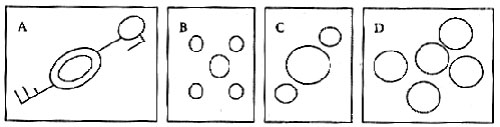
2.“Flattened wheat” means ___________.

     A. broken wheat             B. lying wheat

     C. harvested wheat          D. growing wheat

3.The passage is mainly about something ___________ .

A. that is done by living things from outer space

B. that cannot be solved but found all around the world

C. that cannot be made clear or understood

D. that is discovered and copied by the farmers


查看答案和解析>>


同步练习册答案