
题目列表(包括答案和解析)
| |||||
| |||||||||||||||||||||||||||||||||||||||||||||||||||||||||||||||||||||||||||||||||||||||||||||||||||||||||||||||||||||||||||||||||||||||||||||||
 Do you believe that there might be life on other planets? Would you like to be the first “Earthling” to get in touch with an alien? Well, you can start your search from home. All you need is a computer and the Internet, and you can join the project of the US-based National Aeronautics and Space Administration(NASA).
NASA started the Search for Extra-Terrestrial Intelligence (SETI) project eight years ago. Its goal is to examine the radio signals (信号) from nearby stars. Researchers believe that a large number of stars in the universe could have planets orbiting (circling) around them. And they want to know if these planets have conditions suitable for life forms.
How does the project work? There is a huge radio telescope with a large bowl-shaped dish at Arecibo, Puerto Rico. It catches radio signals which are then fed in to SETI computers. The researchers have to study thousands of radio signals daily. They are looking for signals whose patterns (模式)would show the existence(存在)of hydrogen or water molecules that are necessary for life on Earth. They could be at it for years before showing a single positive result!
Of course, even the researchers know that they cannot do a fast job on their own. So they want as many helpers as possible. Even you ! To join search, just download SETI’s free software (SETI @home). What happens next is fun. While you are away from your computer, the SETI program in your computer downloads the information on radio signals received by the radio telescope. It studies the information and send the result back to the research center.
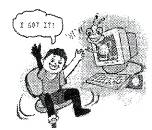 There are other benefits too of having the SETI project software in your computer. When you leave your computer unattended, instead of seeing the usual screen saver, you can feast your eyes on an amazing 3-D chart on the screen. This shows that your computer is busy studying SETI data and searching for signs of alien life!
More than 1824500 people around the world are currently in the program and more are joining in every day. It’s slim chance, but wouldn’t it be fantastic if your computer were to be the first to discover an alien signal!
53. Why do researchers examine the radio signals from nearby stars?
A. They plan to help people who live on the stars.
B. They need to make sure that the stars have planets.
C. They have to keep in touch with the aliens on the stars.
D. They wonder if the stars’ planets are suitable for life forms.
54. What does a helper’s computer do in the research?
A. It finds the radio signals. B. It looks for other planets.
C. It shows a positive result. D. It studies the information.
55. What’s the writer’s purpose in writing the passage?
A. To prove the value of a research. B. To invite people to join a project.
C. To suggest the existence of aliens. D. To advise people to study planets.
E-mail is one of the biggest threats(威胁)to your home computer. By understanding how E-mail works, and by taking some steps in how you deal with reading and writing messages, you can keep this threat out of your computer. When you exchange E-mail with someone else, the messages sent between you and that person pass through several computers before they reach their places. Imagine this conversation as it is taking place in an Internet“room”, a very, very big room. Anyone, or more exactly, any program can probably understand what is being said, because most Internet conversations are not hidden(隐藏)in any way. As a result, others may be listening in, capturing what you send, and using it for their own good.

E-mail-borne viruses(病毒)often arrive in attractive, fantastic appearances, much like the beautiful ads we receive by way of traditional mail that is made to sell us something. By beautiful appearances, an infected(感染)E-mail message seems to be something we want to read from someone we know, not a mean virus ready to destroy or damage our computers.
There are some steps that you can take to help you decide what to do with every E-mail message with an attachment(附件)that you receive. You should only read a message that passes all of these tests:
1)The Know Test: Is the E-mail from someone that you know?
2)The Received Test: Have you received E-mail from this sender before?
3)The Expect Test: Were you waiting for E-mail with an attachment from this sender?
4)The Meaning Test: Do the topic line of the E-mail massage and the name of the attachment both have meanings?
5)The Virus Test: Is the E-mail infected?
1. Which of the following is the main idea of the first paragraph?
A. We should not exchange our E-mail with someone else.
B. It is dangerous to read and write E-mail message sat home.
C. We should learn how E-mail works to take care of our computers.
D. Our chats on computers are usually going on in a big Internet room.
2. What does the underlined word“capturing”probably mean?
A. taking B. hiding C. receiving D. destroying
3. As the Internet is open to anyone, we should ___________.
A. not read and write messages in our home computers
B. not allow nice advertisements to reach our computers
C. stop our conversations while someone is listening in it
D. be careful with the attractive E-mails sent by strangers
4. What is the passage mainly talking about?
A. The threats of E-mail.
B. The safety of home computers.
C. The E-mail-borne viruses.
D. The steps to receive E-mail messages
| |||||||||||||||||||||||||||||||||||||||||||||||||||||||||||
湖北省互联网违法和不良信息举报平台 | 网上有害信息举报专区 | 电信诈骗举报专区 | 涉历史虚无主义有害信息举报专区 | 涉企侵权举报专区
违法和不良信息举报电话:027-86699610 举报邮箱:58377363@163.com