
题目列表(包括答案和解析)
BASEBALL. It’s just a word, but for millions of Americans it brings much more than a word.
Hot dogs. Cold beers. Sunny afternoons. Baseball is the game of fathers and sons. Fathers and sons catch with each other on lawns (草坪) in the US. A father’s favorite team becomes his son’s. Grandfathers talk to their grandsons about games played long ago.
Many American kids collect baseball cards. The cards have pictures of their favorite players on them. In school, friends trade (交换) baseball cards just like they trade their lunches.
Players are known as “the boys of summer” because people often play the sport mostly in warm months. You don’t need to be of a certain size or shape to play baseball. You don’t have to be tall like a basketball player or strong like an American footballer. You just need to want to have fun.
Baseball is not as fast-paced (快节奏的) a game as basketball. But when you go to see a game, there’s time to relax, talk and get to know other people.
Baseball may not be the most popular sport in the US, but it is the most traditional. It’s not just a game any more, but an important part of American culture, like apple pie and grandma’s house.
1.Many American kids like to collect _______________.
A. baseballs B. baseball cards C. lunches D. apple pies
2.People like to play baseball in _____________.
A. wet months B. cool months C. warm months D. cold months
3.Most of the Americans play baseball just want to _______________.
A. enjoy themselves B. make money
C. keep warm D. make friends
4.Which one is WRONG in the article?
A. We can find many children’s favorite baseball players on their cards.
B. If you are not strong enough, you can’t play baseball.
C. When you go to watch a baseball play, you’ll relax and have time to talk to other people.
D. Baseball is the most traditional sport in the US.
1从方框里选择正确的句子补全对话。
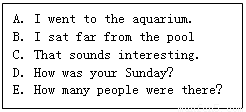
Tina: Hi, Dave. 1.
Dave: Oh, it was awful and boring. I didn't have fun that day.
Tina: What did you do?
Dave: 2.I saw a dolphin show there.
Tina: 3.
Dave: But there were so many people.
Tina: 4.
Dave: About 5,000 people.
Tina: Wow! Too many.
Dave: 5.I couldn't see it clearly.
Tina: Oh, that's too bad.
Every year, we celebrate many special days─Mother’s Day, Father’s Day, and New Year’s Day. In some countries, there is a special day for playing tricks on others. In North America and parts of Europe, this day is known as April Fool’s Day, and is celebrated on April 1.
Many people believe that the French started April Fool’s Day. Centuries ago, New Year’s Day in Europe was April 1. In 1582, the calendar changed and King Charles IX of France moved it to January 1.
Some people did not like this, and chose to keep April 1 as New Year’s Day. Many called these people ‘April fools’ and played jokes and tricks on them. Over time, April 1 became a day to have fun in France. It then spread to England and Scotland, and later, to North America.
On April Fool’s Day, jokes are common. In the United States, for example, a person may move a friend’s clock ahead one hour, or change the sugar and salt. In Scotland, April Fool’s Day lasts for two days. The second day is called ‘Taily Day’─for one’s ‘tail’. On this day, people might secretly put a sign saying ‘kick me’ on a person’s back or behind. Other countries have their own ‘Fool’s Day’. In Spain and Mexico, people play tricks on each other on December 28. In India, it happens on March 31.
In many countries around the world, April 1 is a day of fun. Jokes bring about a lot of laughter, and many shouts of ‘April Fool’!
【小题1】 It is said that people first celebrated ‘Fool’s Day’ in .
| A.the United States | B.France |
| C.Scotland | D.Spain |
| A.April 1 | B.April 2 |
| C.December 28 | D.March 31 |
| A.kick your friends in the behind |
| B.move a friend’s clock ahead one hour |
| C.play jokes and tricks on your friends |
| D.take a holiday from work for two days |
| A.England. | B.India. |
| C.Mexico. | D.Japan. |
| A.盛行 | B.流传 |
| C.接受 | D.发展 |
Ruby, the artist, is an Asian elephant, She is17 years old. She lives in the zoo. Ruby has produced about 100 paintings since last year. She has made more than $ 40,000 for the zoo. Zoo leaders say Ruby first showed the talent (才能) about four years ago. Zoo workers watched her make the marks in the sand with her trunk. She rubbed (擦掉) out the marks, then made the new ones. The zoo worker gave her brushes and paints. Soon Ruby painted pictures.
Newspaper reporters wrote Ruby, then people asked about buying her pictures. And in this way, she made a lot of money for the zoo. This is how Ruby does the paintings. A zoo worker holds different color paints. Ruby touches the colors she wants. Then the worker gives her brushes with the chosen colors in her trunk and Ruby begins painting.
1.We can most probably read this story_______.
A. in a dictionary about read animals
B. in a newspaper
C. in a book on art
D. in history textbooks
2.People asked about buying Ruby's pictures because_______.
A. newspaper reporters bought her picture
B. her pictures were better than those of real artists
C. they just wanted to have fun
D. zoo workers would let them have a free visit to the park
3.Ruby rubbed out the marks she had drawn in order to(为了)_______.
A. make other ones
B. clear her trunk
C. dig a hole in the sand
D. ask for brushes and paints
4.From the story, we can know that_______.
A. Ruby can paint a picture all by herself
B. Ruby can draw better pictures than the other animals in the zoo
C. Ruby has to finish a painting with the help of zoo workers
D. Ruby will ask for money if she finishes a picture
Sitting on a chair all day in school can make anyone want to move around. So, more and more teachers are letting students have a ball. By sitting on exercise balls instead of chairs, teachers find students' posture (姿势) and attention improve.
Dottie Pownall, a fifth-grade teacher in West Virginia, USA, has been using balls as chairs since December 2008. "The students love them", she says. Pownall took a survey of her students. She found that 80% of the students thought sitting on the balls helped them pay more attention to what they were learning.
The teacher, Pisa Witt, felt so strongly about the use of balls as chairs, she started Witt Fitt. This company encourages the use of the balls. And the company educates not only teachers but also students on how to use them. "Our products are used in 24 states, three provinces in Canada, Puerto Rico ('波多黎各) and Japan," says Witt. "Research shows that sitting on the balls makes them sit up straighter. You can slouch (低头垂肩地坐) on a ball," says Witt, "but it feels awful." Because the students are moving, their blood (血液) increases. That carries more oxygen (氧气 to the brain (大脑), so the kids have more energy and can focus longer.
"Furthermore, they're fun." says Pownali.
1. What will happen if a student sits on a chair all day in school? The student will _________.
A. pay more attention to his lessons B. be fun
C. like to move around D. sit up straighter
2. How long has Dottie Pownall used the balls?
A. About three years. B. Only one year.
C. In 2008. D. Since he was a fifth-grade teacher.
3. In how many countries are the balls used as the students' chairs?
A. Four. B. Three. C. Two. D. One.
4.Teachers choose balls instead of chairs because sitting on balls helps the kids___________.
A. improve the students' posture and attention B. slouch on the chairs
C. have fun D. Both A and C are correct answers.
5.Which is better for kids to study in class, sitting on a chair or sitting on a ball?
A. Sitting on a chair. B. Sitting on a ball.
C. They are the same. D. We don't know.
湖北省互联网违法和不良信息举报平台 | 网上有害信息举报专区 | 电信诈骗举报专区 | 涉历史虚无主义有害信息举报专区 | 涉企侵权举报专区
违法和不良信息举报电话:027-86699610 举报邮箱:58377363@163.com