
题目列表(包括答案和解析)
Two weeks ago, Ruichang City in Jiangxi Province was hit by an earthquake measuring 5.7 on the Richter scale(里氏震级). It killed 18 people and left hundreds homeless.
Earthquakes are one of the most deadly natural disasters(灾难) in the world. They happen more often than you would expect.
In the 24 hours after you read this, 400 to 500 earthquakes will shake the earth. You won't notice most of them because you live in a relatively(相对地) safe area or the quake is too far away or because the quake will be too small to notice.
Earthquakes are caused by sudden breaks in rock masses(群) deep in the earth. Rock masses are always under very high pressure. If the pressure in a certain area become too much and the rock masses break, an earthquake happens. But exactly when the rock masses reach the breaking point is a mystery(谜).
China is on the Eurasia(欧亚) plate, where earthquakes happen very often due to the earth's plates knocking against each other. Up to 17,139 earthquakes have taken place in China in the past 44 years, according to scientific research.
1What happened to the City of Ruichang?
A.18 people were killed in an earthquake.
B. Hundreds homeless people left the city.
C. An earthquake ruined thousands of houses there.
D. An earthquake measuring 7.5 on the Richter scale happened.
2How many earthquakes can happen in a day in the world?
A. 24. B. 44. C. 400 to 500. D. 17139.
3Why does the earth quake? Because ______.
A. we live in a relatively safe area
B. the pressure in the earth is too big
C. the rock masses is reaching the breaking point
D. the rock masses break suddenly deep in the earth
C
Once upon a time a woman found she was not easy to wake up in the morning as early as she wished. So she bought a beautiful alarm clock. These clocks are so made as to strike with loud whirring noise at any hour the owner pleases to set them.
The lady placed her clock at the head of the bed, and at the right time she found herself roused by the long, rattling sound.
She got up at once, and felt better all day for her early rising. This lasted for some weeks. The alarm clock faithfully did its duty, and was plainly heard so long as it was obeyed.
But, after a time, the lady grew tired of early rising. When she was waked by the noise, she merely turned over in bed, and slept again.
In a few days, the clock ceased to wake her from her sleep. It spoke just as loudly as ever; but she did not hear it, because she had been in the habit of not obeying it.
Finding that she might as well be without it, she made up her mind that when she heard the sound she would jump up.
Just so it is with conscience(自觉意识,诚意). If we will obey its voice, even in the least important things, we can always hear it, clear and strong.
But if we allow ourselves to do what we have some fears may not be quite right, we shall grow more and more sleepy, until the voice of conscience has no longer power to wake us.
4Why did the clock failed to stop to get the woman up later?
A. Because she was tired of getting up early in the morning.
B. Because she could not hear the clock any more.
C. Because she was too tired to wake up at it.
D. Because the clock stopped to do its duty.
5 Both the underlined words “whirring” and “rattling” are kinds of ______.
A. colours B. sounds C. actions D. feelings
6 The writer mainly wants to tell us that ______.
A. we should always obey our clocks
B. the clock sometimes can’t wake us up as we wish
C. It is conscience that ensures early rising not the clock
D. The voice of conscience has no longer power to wake us.
Amy was a dear little girl, but she was too ready to waste time in getting ready to do her tasks, instead of doing them at once as she ought to.
In the village in which she lived, Mr. Thornton kept a store where he sold fruit of all kinds, including berries in their season. One day he said to Amy, whose parents were quite poor, “Would you like to earn some money?”
“Oh, yes, ” replied she, “for I want some new shoes, and papa has no money to buy them with.”
“Well, Amy,” said Mr. Thornton, “I noticed some fine, ripe blackberries in Mr. Green’s field today, and he said that anybody was welcome to them. I will pay you thirteen cents a quart(度量单位) for all you will pick for me.”
Amy was delighted at the thought of earning some money; so she ran home to get a basket, intending to go immediately to pick the berries.
Then she thought she would like to know how much money she would get if she picked five quarts. With the help of her slate(书写板) and pencil, she found out that she would get sixty-five cents.
“But supposing I should pick a dozen quarts,” thought she, “how much should I earn then?” “Dear me!” she said, after figuring(测算) a while, “I should earn a dollar and fifty-six cents.”
Amy then found out what Mr. Thornton would pay her for fifty, a hundred, and two hundred quarts. It took her some time to do this, and then it was so near dinner time that she had to stay at home until afternoon.
As soon as dinner was over, she took her basket and hurried to the field. Some boys had been there before dinner, and all the ripe berries were picked. She could not find enough to fill a quarter of a quart.
As Amy went home, she thought of what her teacher had often told her---“Do your task at once; then think about it,” for “One doer is worth a hundred dreamers.”
7How many times did Amy figure with her slate?
A. 3. B. 4. C. 5. D. 6.
8The underlined sentence may mean “______”.
A. she got ready to waste some time to do her tasks
B. she thought it was a waste of time to do her tasks
C. she liked to waste time when should do her tasks immediately
D. she was not ready to get her tasks ready, and it’s a waste of time
9What can we infer from the story?
A. Amy’s family was very poor.
B. Amy was good at counting with a slate.
C. Mr. Thornton was the richest person in the village.
D. Amy would learn a better lesson from this affair than from school.
10 The best title of the passage may be “_____”.
A. The Money Amy Did Not Earn
B. The Girl Did Not Like To Waste Time
C. Amy, A Good Student To her Teachers
D. A Poor Girl Wanted To Earn Some Money
| 用所给动词的适当时态填空。 | |
2. We ________ a room next year, shan't we? 3. He became a teacher three years ago, and now he ________ well. 4. You ________ a student two years ago, right? 5. The teacher asked who ________ the book. 6. They ________ a meeting tomorrow, aren't they? 7. He ________ to his parents when I went to see him last night. |
Listening(听力)
Ⅰ.Listen and choose the right picture(根据你听到的内容,选出相应的图片):
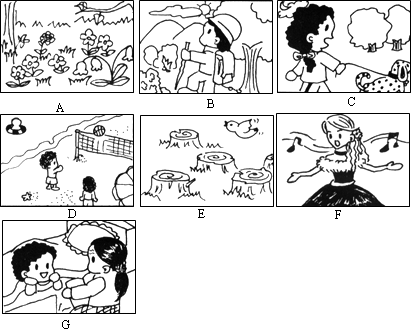
1.________
2.________
3.________
4.________
5.________
6.________
Ⅱ.Listen to the dialogue and choose the best answer to the question you hear(根据你听到的对话和问题,选出最恰当的答案):
7.A.Coffee.
B.Milk.
C.Tea.
D.Water.
8.A.Sue.
B.Lucy.
C.Sue’s cousin.
D.Lucy’s sister.
9.A.A fireman.
B.A driver.
C.A clerk.
D.A pilot.
10.A.Beijing.
B.Xi’an.
C.Guilin.
D.Hainan Island.
11.A.For one day.
B.For two days.
C.For three days.
D.For four days.
12.A.Have a picnic.
B.Cook for his family.
C.Go shopping.
D.Have dinner with the woman.
13.A.In the classroom.
B.In the library.
C.In the language lab.
D.In the computer room.
14.A.He didn’t go to bed.
B.He didn’t sleep well.
C.He has got a stomachache.
D.He has worked too hard.
15.A.In the kitchen.
B.In the bedroom.
C.In the sitting room.
D.In the garden.
16.A.Waitress and customer.
B.Teacher and student.
C.Wife and husband.
D.Boss and clerk.
Ⅲ.Listen to the passage and tell whether the following statements are true or false(判断下列句子是否符合你听到的短文内容,符合的用“T”表示,不符合的用“F”表示):
17.Zhang Ping came to London two years ago.
18.She works in a hotel in London.
19.She thinks London is a very interesting city.
20.She likes the big parks and some of the buildings in London.
21.She is never lonely because she has many friends there.
22.A friend from Canada shares a room with her.
23.She likes London in some ways, but she still wants to work in shanghai.
Ⅳ.Listen to the dialogue and complete the table(听对话,完成下列表格,每空格限填一词):
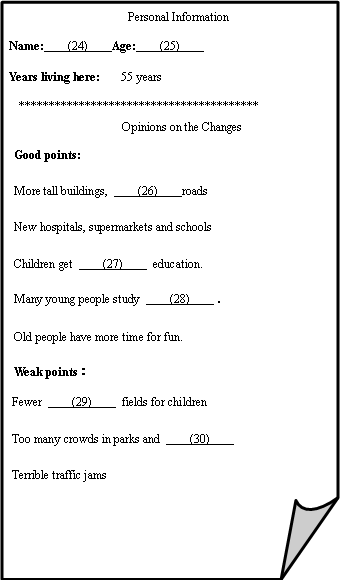
听力测试(共30分)
Ⅰ.听句子,选择正确的画面。每小题读一遍。(每小题1分。共5分)
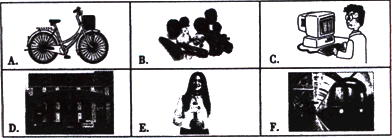
1.________
2.________
3.________
4.________
5.________
Ⅱ.听句子.选择恰当的答语。每小题读一遍。(每小题1分.共5分)
6.
A.Winter.
B.Chinese.
C.Sunday.
7.
A.It's bad.
B.Thank you.
C.You're welcome.
8.
A.It's dry.
B.It's exciting.
C.It's expensive.
9.
A.Go ahead.
B.Sorry, he's not in.
C.This is Jane speaking.
10.
A.You're right.
B.Well done.
C.Good idea.
Ⅲ.听对话.选择正确的答案。每段对话读两遍。(每小题1分.共10分)
听第一段对话,完成第ll小题。
11.Where are the two speakers talking?
A.In a theatre
B.In a restaurant.
C.In a museum.
昕第二段对话,完成第12小题。
12.Who has the girl's bike now?
A.Tom.
B.Sally.
C.Michael.
听第三段对话,完成第13小题。
13.What does John want to be?
A.A singer.
B.A teacher.
C.An engineer.
听第四段对话,完成第14小题。
14.What's the relationship between the two speakers?
A.Doctor and patient.
B.Teacher and student.
C.Boss and clerk.
听第五段对话,完成第15-17小题。
15.Which country did Kate visit last month?
A.America.
B.Australia.
C.Canada.
16.How long did she stay there?
A.Two years.
B.Two months.
C.Two weeks.
17.How was her trip?
A.Very nice.
B.Not good.
C.Just so-so.
听第六段对话,完成第18-20小题。
18.What will the boy give a talk about?
A.Chinese history.
B.Chinese culture.
C.Space science.
19.What kind of books does the boy like?
A.History books.
B.Science books.
C.Sports books.
20.On which day is the library closed?
A.Sunday.
B.Wednesday.
C.Friday.
Ⅳ.听短文.选择最佳答案。短文读两遍。(每小题1分.共5分)
21.What was Li Hong like before?
A.Shy.
B.Serious.
C.Careless.
22.What was she afraid to do in the English classes?
A.Recite texts.
B.Answer questions.
C.Write compositions.
23.When did she begin to show interest in English?
A.Five years ago.
B.At the age of 16.
C.After going to middle school.
24.How did she learn English in her free time?
A.By reading English stories.
B.By listening to English songs.
C.By going to the English comer.
25.What does she hope to do?
A.To teach English.
B.To study abroad.
C.To travel abroad.
Ⅴ.听短文.完成下面表格.每空一词。短文读两遍。(每小题1分。共5分)
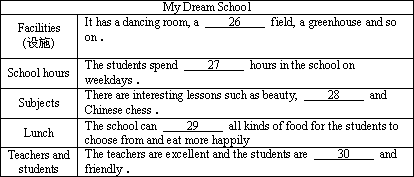
湖北省互联网违法和不良信息举报平台 | 网上有害信息举报专区 | 电信诈骗举报专区 | 涉历史虚无主义有害信息举报专区 | 涉企侵权举报专区
违法和不良信息举报电话:027-86699610 举报邮箱:58377363@163.com